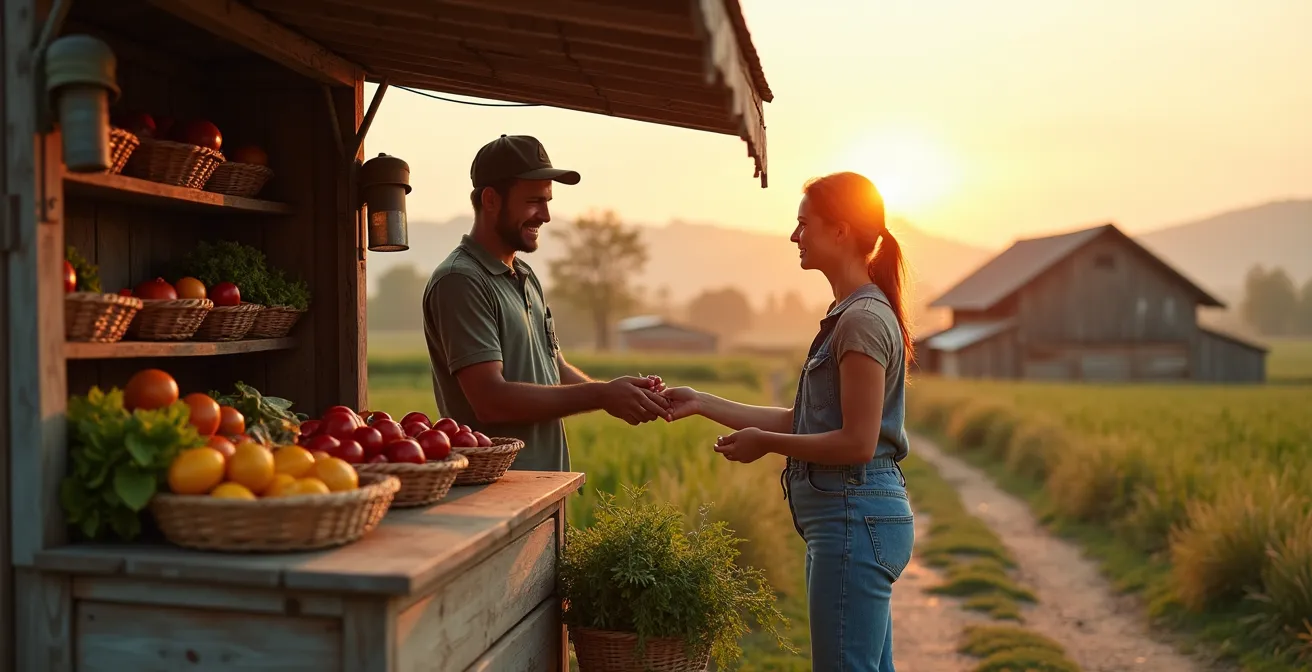
Buying food directly from farms isn’t just a charming experience; it’s a quantifiable strategy that can cut your food’s transport-related emissions by over 90%.
- It dramatically shortens the supply chain, which can be 5 to 17 times more carbon-intensive than local systems.
- It supports traditional, often more sustainable, farming methods protected by designations like AOC.
Recommendation: Use farm-finding apps and look for official network logos to ensure your purchases have a real environmental and economic impact.
For the eco-conscious traveler, minimizing impact is a constant calculation. You bring reusable water bottles, offset flights, and choose eco-lodges. Yet, one of the most significant parts of your travel carbon footprint often goes unexamined: your food. The typical tourist relies on supermarkets, where produce and meat have traveled vast distances, contributing significantly to emissions. The common advice is to visit a local farmers’ market, which is a step in the right direction but often only scratches the surface of what’s possible.
Many believe that “buying local” is a simple, feel-good act. But what if the real key to a meaningful reduction in your food’s carbon footprint wasn’t just proximity, but a strategic understanding of the entire system? The truth is, the impact of your food choices goes far beyond “food miles.” It involves packaging, refrigeration efficiency, farming practices, and the economic resilience of the communities you visit. This guide moves beyond platitudes and provides a data-driven framework for turning your food shopping into a powerful tool for positive change. It’s about transforming a simple purchase into a measurable act of environmental stewardship.
This article will equip you with the analytical tools to do just that. We’ll explore how to identify authentic direct-sale opportunities, decode quality labels that guarantee more than just a product, and ensure your choices are both safe and impactful. We will also delve into how your purchases can support traditional agriculture and even contribute to scientific research, making your holiday a force for good.
Summary: A Strategic Guide to Farm-Direct Shopping for Eco-Tourists
- Signs on the Road: How to Spot “Vente Directe” Boards While Driving?
- What Does the Flower Logo Guarantee for Farm Visitors?
- BBQ Packs: Is It Safe to Buy Meat Directly from a Farm in Summer?
- Language Barrier: How to Buy Cheese from a Farmer Who Speaks No English?
- Milking Time: When Should You Visit to See the Animals Active?
- “Bio” vs “Natural”: Which Sign Actually Means Organic in France?
- Citizen Science: How to Contribute to Wildlife Counting During Your Holiday?
- Why Buying AOC Products Directly Supports Traditional Farming?
Signs on the Road: How to Spot “Vente Directe” Boards While Driving?
The first step in reducing your food’s travel footprint is intercepting it at the source. This means moving beyond the town market and finding the farms themselves. While driving through rural areas, especially in Europe, you’ll see a variety of signs indicating direct sales. However, not all signs are created equal. An analyst’s approach requires knowing what to look for to maximize both efficiency and impact. Keywords like “Fermier” (farm-style), “Artisanal” (artisan-made), and “du Producteur” (from the producer) are strong indicators of authenticity.
The carbon math is crucial here. A long detour for a single jar of jam might negate the environmental benefits. The goal is to plan strategically. Before you even start your engine, using digital tools can create a highly efficient route. This transforms a spontaneous sign-spotting into a calculated plan. A short detour becomes a net positive when you buy supplies for several days, drastically cutting down on the “food miles” that accumulate in a conventional supply chain. This is where the concept of a “data-driven detour” comes into play—a small investment in travel time for a massive return in carbon savings.
- Step 1: Download farm-finding apps like ‘Bienvenue à la Ferme’ or search ‘vente directe’ on Google Maps before your trip.
- Step 2: Look for roadside signs with keywords: ‘Fermier’, ‘Artisanal’, ‘Paysan’, ‘du Producteur’ indicating different production scales.
- Step 3: Follow brown tourist signs with farm symbols often placed 2-3km before the actual farm.
- Step 4: Check Waze community alerts where locals often flag seasonal farm sales.
- Step 5: Calculate your detour efficiency – if under 10km and buying for 2+ days, the carbon savings outweigh the extra fuel.
What Does the Flower Logo Guarantee for Farm Visitors?
Once you start looking, you’ll notice logos and labels on farm signs. In France, one of the most prominent is the “Bienvenue à la Ferme” (Welcome to the Farm) network, identifiable by its cheerful yellow flower logo. From a carbon analyst’s perspective, this logo is a data point. It signifies adherence to a specific set of standards that go far beyond simply selling produce. It guarantees a level of professionalism and transparency, ensuring that your purchase supports a farm committed to certain practices.
The “Bienvenue à la Ferme” network, for instance, requires that at least 50% of products sold are sourced directly from that farm’s own production. This provides a clear metric against resellers who might simply operate a roadside stand with produce from a wholesale market. Furthermore, these networks often have different philosophies, from the professionalized tourism of “Bienvenue à la Ferme” to the activist-minded, immersive stays offered by “Accueil Paysan.” Understanding these distinctions allows you to align your spending with your values, whether you seek a quick, high-quality purchase or a deeper connection with a peasant-farming ethos.
Case Study: Bienvenue à la Ferme Network Quality Standards
The Bienvenue à la Ferme flower logo network guarantees specific quality standards including farm tours, direct farmer interaction, and at least 50% farm-origin products. Farmers in this network commit to transparent practices, environmental stewardship, and standardized hospitality levels that transform simple purchases into memorable travel experiences.
This table breaks down the key differences between the main French farm networks, providing a clear guide for the discerning eco-tourist.
| Network | Philosophy | Visitor Experience | Product Guarantee |
|---|---|---|---|
| Bienvenue à la Ferme | Professionalized farm tourism | Structured tours, educational activities | Min. 50% farm origin |
| Accueil Paysan | Activist-minded peasant farming | Immersive stays, work participation | 100% farm production |
| Marchés de Producteurs | Direct producer markets | Market atmosphere, multiple vendors | Producer-only sales |
BBQ Packs: Is It Safe to Buy Meat Directly from a Farm in Summer?
Buying fresh meat for a campsite barbecue directly from the farmer who raised the animal is the epitome of short-circuit shopping. It closes the loop between pasture and plate in a way a supermarket never can. However, this raises a critical question of food safety, especially during warm summer months. The entire carbon benefit is irrelevant if the food isn’t safe to eat. The key variable is the cold chain: the unbroken series of refrigerated production, storage, and distribution activities.
In a conventional system, food travels immense distances. For instance, American food travels an average of 1,500 to 2,500 miles from farm to table, a journey that introduces multiple points of potential failure in the cold chain. When you buy direct, you shorten this chain to its absolute minimum, but you also take on the final responsibility for maintaining it. This requires vigilance. Look for professional, refrigerated displays at the farm and verify the temperature. The presence of an oval veterinary stamp (“estampille sanitaire” in France) is a non-negotiable sign of regulatory compliance and safety. By managing this last leg of the journey properly, you secure a product that is not only fresher and less carbon-intensive but also perfectly safe.
Action Plan: Cold Chain Safety for Farm-to-Campsite Meat
- Check the farm’s refrigerated display temperature (should be below 4°C/39°F).
- Bring a quality cooler with frozen gel packs or ice covering the bottom and sides.
- Request vacuum-sealed packaging from the farmer for better insulation.
- Transport time should not exceed 2 hours without proper refrigeration.
- Store immediately in the camper’s 12V fridge upon arrival at the campsite.
- Look for the oval veterinary stamp (estampille sanitaire) on all meat packages.
Language Barrier: How to Buy Cheese from a Farmer Who Speaks No English?
The idea of approaching a French farmer to buy artisanal cheese can be intimidating if you don’t speak the language. However, this barrier is often more perceived than real. In the world of direct farm sales, a transactional language of gestures, smiles, and a few key phrases has long been established. The interaction is a core part of the experience, and farmers are accustomed to communicating with visitors from all over the world. The key is to approach the situation with respect and a willingness to engage non-verbally.
Pointing is a universal language, as is using your fingers to indicate quantity. A simple “bonjour” (hello) and “merci, au revoir” (thank you, goodbye) go a long way in showing respect. Arming yourself with a few specific phrases related to the product can unlock a much richer interaction, allowing you to inquire about taste, aging, or the type of milk used. This effort is almost always appreciated and can turn a simple transaction into a moment of genuine human connection. Remember, your goal is to buy excellent cheese, not to pass a linguistics exam.
Case Study: The Power of Non-Verbal Communication
Successful cheese purchases at French farms often rely on universal gestures: pointing to indicate choice, using fingers to show quantity, and a thumbs-up for appreciation. French farmers typically expect customers to wait their turn, observe prices often displayed on small slate boards, and are generally more comfortable with cash transactions. A warm ‘merci, au revoir’ transcends any language barrier and ensures a positive, respectful interaction for both parties.
Here are a few essential phrases to have ready on your phone:
- Puis-je goûter? – May I taste?
- Lequel est le plus doux? – Which is the mildest?
- C’est de quel animal? – From which animal (is the milk)?
- Une tranche comme ça? (with a gesture) – A slice like this?
- Combien ça coûte? – How much does it cost?
Milking Time: When Should You Visit to See the Animals Active?
Part of the appeal of buying direct is witnessing the agricultural process firsthand. Seeing the animals and the environment they live in provides a powerful connection to your food. To maximize this experience, timing your visit is crucial. Animals, like people, have daily routines, and arriving at the right moment can mean the difference between seeing a herd of cows resting in the shade and witnessing the bustling activity of milking time.
As a general rule, the most active periods on a dairy or livestock farm are early in the morning (around 6-8 AM) and again in the late afternoon (around 4-6 PM). These are the typical times for milking and feeding. A mid-morning visit can also be rewarding, as you might see animals being moved to fresh pastures. The midday hours are often the quietest, as animals seek shelter from the sun. Many farms that are part of networks like “Bienvenue à la Ferme” offer scheduled tours or activities, which is the surest way to guarantee you’ll see something interesting. Don’t hesitate to call ahead or check their website. This simple act of planning ensures your visit is not just a shopping trip, but an educational and memorable part of your journey.
- Early morning (6-8 AM): Witness morning milking and feeding routines.
- Mid-morning (9-11 AM): See pasture rotation and animals grazing actively.
- Late afternoon (4-6 PM): Observe the evening milking and, on some farms, the start of the cheese-making process.
- Avoid midday (12-3 PM): This is typically a rest period for the animals.
- Inquire about seasonality: Ask about specific seasonal activities like sheep shearing or honey extraction.
“Bio” vs “Natural”: Which Sign Actually Means Organic in France?
In the quest for sustainable food, the term “organic” is a beacon. However, the language used on farm signs can be confusing. You might see words like “naturel” (natural), “raisonnée” (reasoned), or “bio” (short for biologique). From an analytical standpoint, these terms are not interchangeable. Only one has a legally binding, verifiable meaning that guarantees a specific set of practices beneficial to the environment.
The key term to look for is “Bio”, often accompanied by the green EU organic leaf logo. This certification is legally protected and strictly regulated. It guarantees that no synthetic pesticides or GMOs were used and that strict animal welfare standards were met. An annual audit by a third-party organization is required to maintain this status. In contrast, the term “Naturel” has no legal definition and can mean anything the producer wants it to mean. “Agriculture Raisonnée” is a certified approach that focuses on reducing chemical inputs, but it is not organic. For the eco-tourist aiming for maximum positive impact, prioritizing products with the official “Bio” label is the most data-driven choice.
The table below clarifies the hierarchy of these common French agricultural labels.
| Label | Legal Status | Requirements | Verification |
|---|---|---|---|
| Bio (EU Organic) | Legally binding | No synthetic pesticides, no GMOs, strict animal welfare | Annual third-party audits |
| Nature & Progrès | Private standard | Beyond organic: social ethics, local economies | Peer review system |
| Natural/Naturel | No legal meaning | Varies by producer | No official verification |
| Agriculture Raisonnée | Certified approach | Reduced pesticides, not organic | Regular inspections |
If you’re ever unsure, engaging the farmer with a few direct questions can provide clarity: “Utilisez-vous des traitements chimiques?” (Do you use chemical treatments?) or “Les animaux vont dehors?” (Do the animals go outside?).
Citizen Science: How to Contribute to Wildlife Counting During Your Holiday?
A healthy farm is a bustling ecosystem. The presence of diverse insects, birds, and wildflowers is not just a pleasant sight; it’s a key performance indicator of the farm’s environmental health. Farms practicing agroecology and organic methods often foster a level of biodiversity that is visibly absent from industrial monocultures. As a visitor, you are in a unique position to act as a field analyst, and your observations can contribute valuable data to a growing body of research through citizen science.
This is where your travel becomes an act of contribution. By using specialized mobile apps, you can document the life you see around the farms you visit. This data helps scientists track pollinator populations, bird behaviors, and the spread of native plants, creating a large-scale picture of ecosystem health. Your simple act of photographing a butterfly or logging a bird sighting provides tangible evidence of how certain farming practices support biodiversity. It transforms the consumer into a collaborator, using a holiday to generate data that proves the systemic impact of choosing to support sustainable agriculture.
Biodiversity as an Ecosystem Health Indicator
Small farms practicing agroecology often rebuild crop and insect diversity, use fewer pesticides, enrich the soil with cover crops, and create border areas for wildlife. These practices create a measurable increase in biodiversity that citizen scientists can document, providing tangible evidence of how purchasing choices support healthier ecosystems.
You can become part of this effort with a few simple tools:
- Use the Spipoll app to track pollinating insects on and around farms.
- Document bird species and their behaviors with BirdLab.
- Photograph and identify wildflowers in farm hedges and borders using PlantNet.
- Submit your observations through the INPN Espèces app, which centralizes biodiversity data in France.
Key Takeaways
- Prioritize farms with official logos (“Bienvenue à la Ferme,” EU “Bio”) as they guarantee verifiable standards.
- Always maintain the cold chain for meat and dairy by using a quality cooler and minimizing transport time.
- Use citizen science apps like PlantNet or BirdLab to turn your farm visits into valuable data collection for biodiversity research.
Why Buying AOC Products Directly Supports Traditional Farming?
When you purchase a product with an “Appellation d’Origine Contrôlée” (AOC) label, you are doing more than buying a high-quality food item. You are casting an economic vote for the preservation of traditional farming methods and regional heritage. An AOC is a legal designation that ties a product to a specific geographical area (its terroir) and a set of legally mandated, ancestral production methods. From a systems perspective, this is a powerful tool for ensuring economic resilience for small-scale, traditional producers.

Consider the case of AOC Roquefort cheese. The designation legally requires that the cheese be made from the milk of Lacaune sheep and aged in the natural limestone caves of Roquefort-sur-Soulzon. This protects the 2,100 traditional farmers who follow these costly, time-honored practices from being undercut by industrial competitors who cannot use the prestigious name. By buying AOC Roquefort directly from a producer in this region, you are directly funding the continuation of transhumance grazing and cave-aging traditions. Your purchase becomes a shield against the homogenization of industrial agriculture. The global data supports this; a comprehensive Korean study found that local food consumption yields a massive annual decrease in CO2 emissions, demonstrating the large-scale climatic benefit of supporting these localized food systems.
This principle applies to countless products, from Lentilles du Puy to Piment d’Espelette. Choosing AOC products is a direct investment in cultural and agricultural biodiversity, ensuring these unique traditions and the sustainable practices they embody can thrive for generations to come.
Incorporate these data-backed strategies into your next trip to transform your food choices from a simple necessity into a powerful and measurable tool for environmental and cultural preservation.
Frequently Asked Questions About Buying Food Directly from Farms
How close can I get to the animals during milking?
Stay at least 3 meters away from milking areas unless invited closer by the farmer. The animals need a calm environment during this sensitive time, and sudden movements or noises can cause them stress.
Can I take photos of the farming activities?
Always ask for permission before taking photographs. Most farmers appreciate genuine interest in their work but need to prioritize the safety of visitors and the welfare of their animals first and foremost.
Should I bring my children to watch milking time?
Yes, it can be a wonderful educational experience. However, it’s important to prepare them to be quiet and calm observers. Explain beforehand that loud noises or sudden movements can frighten the animals and affect their well-being.