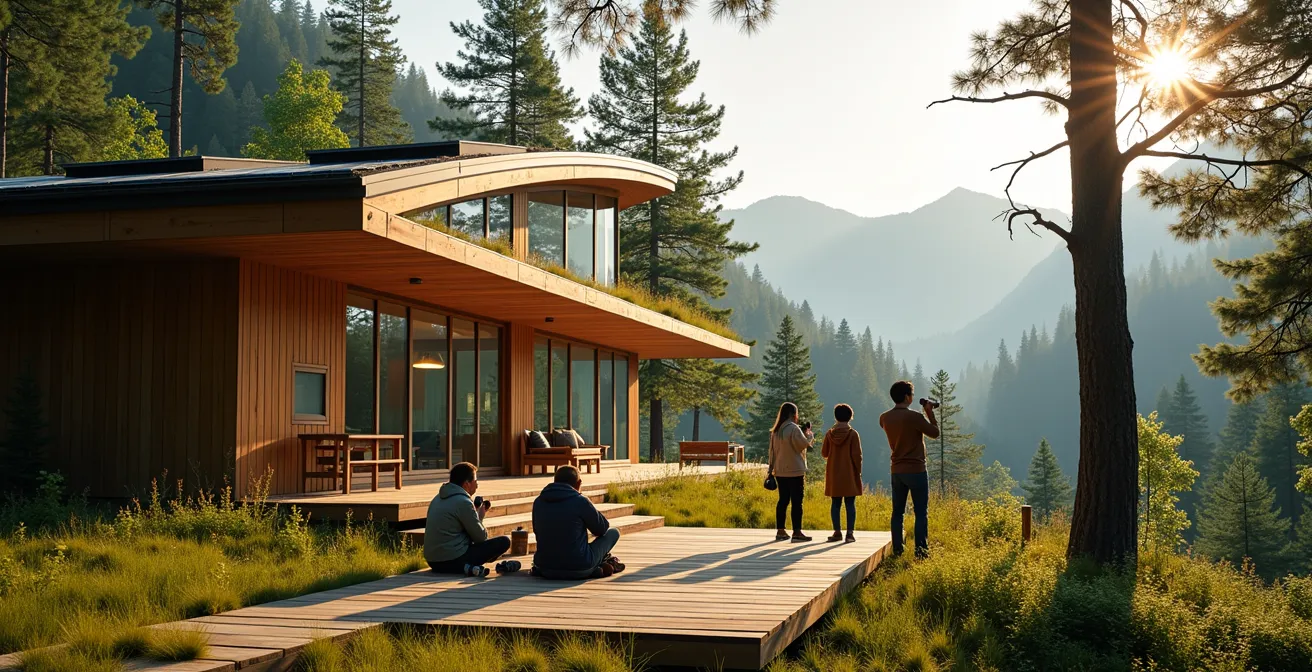
The premium price of an eco-lodge is a direct investment in superior, quantifiable comfort and exclusivity—not merely an environmental surcharge.
- Solid wood construction offers proven thermal and acoustic performance that plastic-based alternatives cannot match, directly enhancing your family’s well-being.
- True eco-lodges replace low-value amenities (like TVs) with high-value experiences and verified sustainability practices that protect you from “greenwashing.”
Recommendation: Evaluate potential eco-lodges based on their material science, performance metrics, and official certifications to ensure you’re paying for genuine quality, not just a label.
For the modern family, choosing a vacation spot has become a complex calculation. You’re willing to invest in sustainable options, but not at the expense of comfort and genuine value. The question lingers: is the premium price tag of an eco-lodge a justifiable expense or simply a “green tax” on good intentions? The common narrative pits ethics against experience, suggesting a rustic sacrifice is necessary for environmental responsibility. This often involves discussions around composting toilets or limited electricity, framing sustainability as a compromise.
But what if this entire premise is flawed? What if the very elements that make a lodge “eco” are the same ones that deliver a demonstrably superior, more luxurious experience for your family? This analysis moves beyond the surface-level appeal of “connecting with nature” to explore the hard science and tangible benefits behind authentic eco-accommodations. We will dissect the performance metrics that separate a true eco-lodge from a standard mobile home or a “greenwashed” hotel.
This guide will provide the evidence you need to make an informed investment. We will examine how material choices directly impact your family’s physical comfort during a heatwave, ensure a peaceful night’s sleep for even the lightest sleepers, and create a genuinely enriching environment for teenagers. By understanding these principles, you’ll be equipped to see the premium price not as a cost, but as a direct payment for engineered comfort, safety, and exclusivity.
To help you navigate this decision, this article breaks down the key performance indicators that define the true value of a premium eco-lodge. From thermal efficiency to acoustic privacy, we’ll explore what you are really paying for.
Summary: The Real Value of Investing in a Premium Eco-Lodge
- Why Wooden Eco-Lodges Stay Cooler Than Plastic Mobile Homes in Summer?
- The “No TV” Surprise: How to Prepare Teens for Low-Tech Accommodation?
- Eco-Lodge or Safari Tent: Which Offers Better Sound Insulation for Light Sleepers?
- The Hidden Plastic Problem in Some “Eco” Accommodations You Should Know
- When to Book an Eco-Lodge to Guarantee a Lake View Spot?
- The Heatwave Mistake That Ruins Camping Trips for Families with Toddlers
- Mobile Home or Canvas Tent: Which Accommodation Survives Atlantic Winds Best?
- How to maintain a Zero-Waste Lifestyle While Staying in a Luxury Campsite?
Why Wooden Eco-Lodges Stay Cooler Than Plastic Mobile Homes in Summer?
One of the most significant, yet often overlooked, luxury features of a genuine eco-lodge is its innate ability to regulate temperature. This isn’t magic; it’s the science of thermal mass. Unlike a plastic-clad mobile home that acts like a greenhouse, the solid wood walls of an eco-lodge absorb heat during the day and slowly release it at night. This natural cycle creates a far more stable and comfortable indoor environment, drastically reducing the need for aggressive, energy-hungry air conditioning.
The performance difference is not trivial. In fact, thermal mass studies demonstrate that log structures require up to 46% less energy for cooling during critical heat periods compared to conventional stick-frame constructions. For a family, this translates directly into superior comfort. While others are battling stuffy, overheated plastic boxes, your accommodation remains a cool sanctuary. This “engineered comfort” is a direct result of choosing natural, high-mass materials—a core principle of sustainable design.
This table clearly illustrates the functional superiority of wood, proving that sustainability is not a compromise but an upgrade in living quality. The material’s breathability also helps regulate humidity, preventing the damp, sticky feeling common in sealed, non-breathable structures.
| Property | Wooden Eco-Lodge | Plastic Mobile Home |
|---|---|---|
| Thermal Mass Capacity | High – stores & releases heat slowly | Low – minimal heat storage |
| Temperature Regulation | Natural day/night cycle | Rapid temperature fluctuations |
| Cooling Energy Savings | 24-46% reduction | Standard consumption |
| Material Breathability | Regulates humidity naturally | Non-breathable, traps moisture |
| VOC Emissions When Hot | None – natural material | Off-gasses toxic compounds |
The “No TV” Surprise: How to Prepare Teens for Low-Tech Accommodation?
For many families, the prospect of an accommodation without a television or reliable Wi-Fi is a major source of anxiety, especially with teenagers. However, premium eco-lodges reframe this absence not as a lack, but as a deliberate feature: offline luxury. The value proposition here is a curated disconnection, replacing passive screen time with active, memorable experiences. The key is to prepare your family to embrace this shift, turning a potential point of friction into a highlight of the trip.
Instead of viewing it as a restriction, frame it as an exclusive opportunity to engage with the environment in a way a standard hotel cannot offer. Many high-end eco-lodges facilitate this with unique on-site resources. This could be a library of naturalist guides, high-quality stargazing equipment, or workshops led by local artisans or ecologists. The focus shifts from consuming content to creating experiences, fostering skills like nature photography, creative writing, or collaborative discovery.
Preparing for this “digital detox” is crucial. By setting expectations and co-creating a plan, you empower your teens to see the value in unstructured time and analog activities. This approach transforms the accommodation from a simple place to sleep into an integral part of the adventure itself.
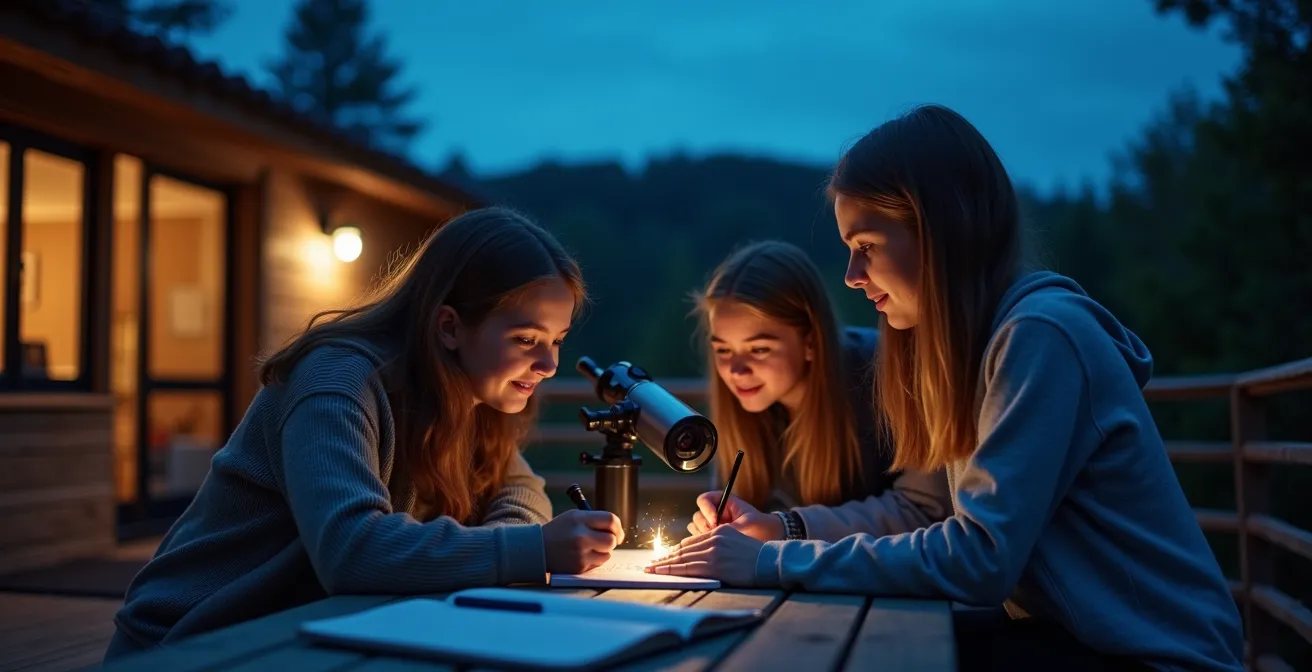
As this scene suggests, the right environment can make analog activities far more engaging than another night of scrolling. The goal is not to forbid technology, but to offer a compelling, high-quality alternative that feels like an upgrade, not a downgrade. Downloading offline nature identification apps or photography tutorials beforehand can bridge the gap, using technology to enhance real-world engagement rather than replace it.
Eco-Lodge or Safari Tent: Which Offers Better Sound Insulation for Light Sleepers?
A vacation can be quickly ruined by poor sleep. For light sleepers, noise from neighbors, wind, or wildlife is a primary concern. While a luxury safari tent offers a romantic connection to the outdoors, its thin canvas walls provide minimal acoustic protection. An eco-lodge constructed from solid logs, however, offers a fundamentally superior solution based on a simple principle of physics: mass law damping. The sheer density and mass of the wooden walls are incredibly effective at blocking and absorbing sound waves.
This isn’t just a subjective feeling; it’s a measurable performance metric. The solid construction of an eco-lodge provides a level of peace and quiet that fabric-based or lightweight structures simply cannot match. This is a critical point of value for families, as the quality of everyone’s sleep directly impacts the enjoyment of daytime activities. A quiet sanctuary to return to after a long day is a core component of a truly restful and luxurious vacation.
Case Study: Thermal Mass and Acoustic Performance
Scientific analysis confirms the dual benefit of high-mass walls. As noted in studies on building materials, “The amplitude reduction [of sound and temperature fluctuations] will be considerably greater for the masonry [or solid log] residence than for the wood-frame residence, owing to the large heat capacity of the masonry [or log] material.” This demonstrates that the same property that keeps an eco-lodge cool—its thermal mass—also makes it significantly quieter, providing superior sound blocking compared to fabric-based safari tents.
For any family prioritizing rest, especially those with young children or light sleepers, understanding the acoustic performance of an accommodation is essential. The premium paid for an eco-lodge is an investment in uninterrupted sleep and a peaceful environment, which is one of the most valuable luxuries of all. To ensure you get what you pay for, it’s wise to investigate these details before booking.
Your Pre-Booking Sound Assessment Checklist
- Ask about wall construction specifics: inquire if it’s solid log versus a timber frame with insulation.
- Request the minimum distance between individual lodge units to gauge potential noise from neighbors.
- Inquire about the property’s evening quiet hours policy and how it is enforced.
- Check if the lodge units are fitted with sound-rated windows and doors for additional insulation.
- Verify the floor and ceiling construction to assess potential impact noise transmission from other units.
The Hidden Plastic Problem in Some “Eco” Accommodations You Should Know
In the growing market of sustainable travel, the term “eco” is often used more as a marketing buzzword than a genuine commitment. This practice, known as greenwashing, can trick well-intentioned families into paying a premium for a product that is sustainable in name only. One of the most obvious red flags is the prevalence of single-use plastics. An accommodation that calls itself “eco” but provides toiletries in tiny plastic bottles, water in plastic cups, and coffee via single-use pods is failing a basic sustainability test.
Authentic eco-lodges understand that luxury and sustainability are intertwined. They invest in systems that eliminate waste, such as bulk dispensers for high-quality, organic soaps and shampoos, providing filtered water in glass bottles, and using natural, biodegradable textiles instead of polyester. These details are not just about environmental ethics; they are indicators of a deeper commitment to quality and guest well-being. Choosing natural fibers and avoiding plastics also reduces exposure to VOCs and other chemicals that can be off-gassed by synthetic materials, contributing to a healthier indoor environment.
For the discerning family, learning to spot these differences is crucial. The presence of a recognized third-party certification (like Green Key or being a member of the Global Sustainable Tourism Council – GSTC) is a strong signal of authenticity. Indeed, research shows that nearly half of eco-conscious travelers state that certified properties are more appealing, as it provides a trusted shortcut to verifying a property’s claims. An uncertified property simply stating it is “eco-friendly” requires much closer scrutiny.
This comparative table serves as a quick reference guide to help you distinguish a genuine investment in sustainability from a superficial marketing claim.
| Feature | Genuine Eco-Lodge | Greenwashed Property |
|---|---|---|
| Toiletries | Bulk dispensers, organic products | Single-use plastic bottles |
| Drinking Vessels | Glass bottles, ceramic cups | Plastic-lined paper cups |
| Textiles | Natural fibers (cotton, wool, linen) | Polyester/acrylic blankets |
| Coffee Service | French press, reusable filters | Single-use pods |
| Waste System | Multi-stream recycling/compost | Single general waste bin |
| Certification | GSTC, Green Key, or equivalent | Self-declared ‘eco-friendly’ |
When to Book an Eco-Lodge to Guarantee a Lake View Spot?
The most desirable spots at any premium location—those with panoramic lake views or complete privacy—are a finite resource. At top-tier eco-lodges, these units are often the first to be booked, reflecting a core principle of luxury: exclusivity. Securing one of these prime locations is not a matter of luck but of strategic planning. The demand for these unique experiences means that last-minute booking is rarely an option.
The booking window for these coveted spots is often surprisingly long. According to industry insiders, popular eco-lodges report that guests typically book premium spots 4-5 months in advance, and sometimes even earlier for peak seasons. This is because the value is tied not just to the structure itself, but to its unique placement within the natural landscape. You are paying for the sunrise over the water, the private access to the shore, and the feeling of being completely immersed in nature—benefits a standard room can never offer.
To increase your chances, savvy travelers employ several tactics. Subscribing to lodge newsletters can provide early access to booking calendars, and targeting the shoulder seasons (late spring and early autumn) often yields better availability without compromising on the view. Being flexible with your dates and inquiring about waitlists can also open up opportunities. Ultimately, the need for advance planning is further proof of the lodge’s value; if the best spots were always available, they wouldn’t be a premium product.
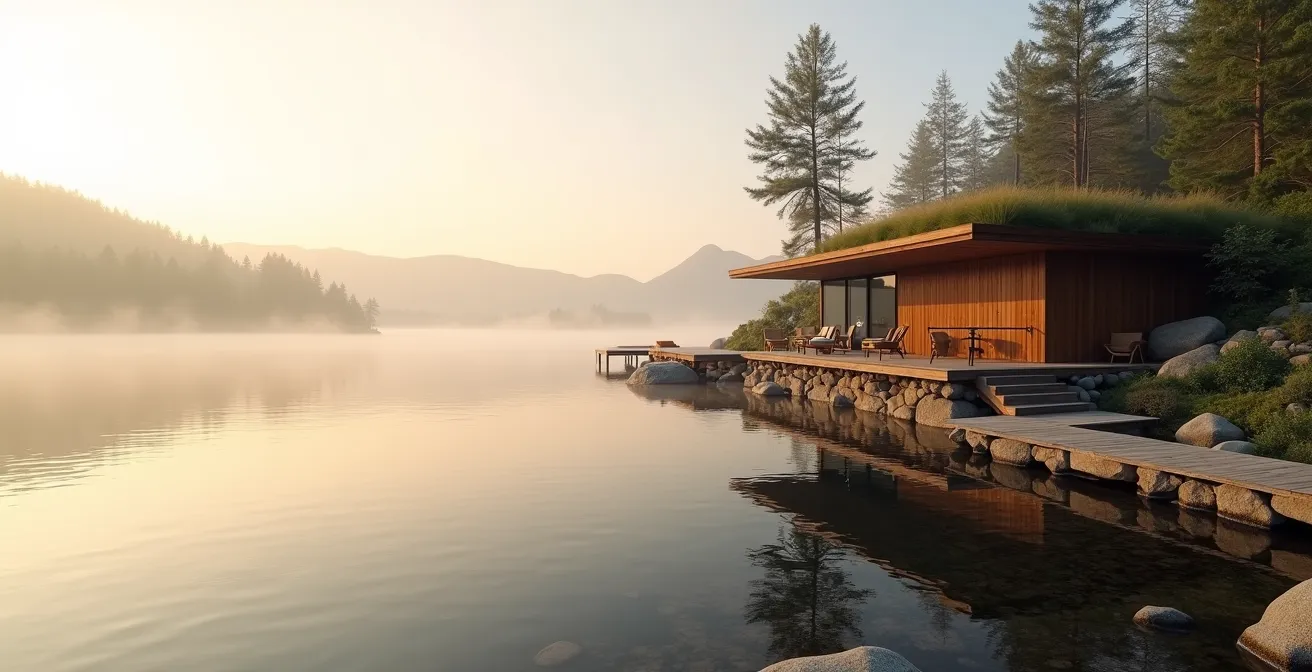
The experience captured in this image—serenity, privacy, and unparalleled beauty—is the return on your investment. It’s a sensory luxury that justifies both the price and the foresight required to secure it. This is the tangible outcome of choosing a premium, well-positioned eco-lodge over a generic alternative.
The Heatwave Mistake That Ruins Camping Trips for Families with Toddlers
For families with toddlers, safety and comfort are non-negotiable. One of the most common and dangerous mistakes during summer travel is underestimating the impact of a heatwave on your choice of accommodation. A plastic mobile home or a basic cabin with poor insulation can quickly become dangerously hot, posing a real health risk to small children who are more vulnerable to heat-related illnesses. The vacation is effectively ruined as you’re forced to spend the hottest parts of the day seeking refuge elsewhere.
This is where the “engineered comfort” of a wooden eco-lodge becomes a critical safety feature. As established, the high thermal mass of solid wood walls acts as a natural buffer against extreme external temperatures. During a heatwave, the interior remains significantly cooler and more stable, providing a safe and comfortable haven for a toddler’s essential afternoon nap. This isn’t just a minor convenience; it’s a fundamental aspect of a successful family trip in a hot climate. The ability to comfortably use your accommodation throughout the day is a key part of the value you are paying for.
The Value of Family-Focused Design
The appeal of sustainable tourism for families goes beyond just the environment. As industry analysis highlights, these locations often provide a safer, community-focused setting where children can experience nature. Crucially, “most sustainable resorts and homestays tailor services and activities to diverse family members’ needs, from meals to amusement.” This focus on holistic family well-being means an eco-lodge is more likely to have considered factors like heat safety, non-toxic materials, and amenities that cater to the youngest guests, making it a more reliable and less stressful choice.
Choosing an eco-lodge is therefore not just an environmental decision but a parental one. You are investing in an environment designed for well-being, where the material science of the building contributes directly to your family’s safety and comfort. The mistake is viewing all accommodations as equal, when in reality, their performance during extreme weather can be worlds apart.
Mobile Home or Canvas Tent: Which Accommodation Survives Atlantic Winds Best?
Coastal vacations, especially along rugged coastlines like the Atlantic, often come with the challenge of high winds. This is another scenario where the choice of accommodation dramatically impacts your experience. A canvas tent, no matter how luxurious, will struggle in strong gales, resulting in constant flapping noises that make sleep impossible. A standard mobile home may offer more protection, but its lightweight construction can lead to creaking, rattling, and a general feeling of instability that disrupts peace and sleep.
Once again, the solid, high-mass construction of an eco-lodge provides a superior solution. The sheer weight and structural integrity of the building mean it remains stable and, crucially, quiet. The same mass that blocks sound from neighbors also dampens the noise of the wind, creating a peaceful sanctuary even when a storm is raging outside. This is a level of comfort and security that lighter alternatives simply cannot provide.
This point is validated by engineering experts who study wood as a building material. As a University of Maryland Wood Engineering Study analysis confirms:
The sheer mass of solid wood walls in an eco-lodge is fundamentally better at blocking wind noise and maintaining structural integrity compared to lightweight alternatives.
– Engineering Analysis, University of Maryland Wood Engineering Study
The following table breaks down the performance of each accommodation type during windy conditions, showing a clear hierarchy of comfort and safety.
| Factor | Canvas Tent | Mobile Home | Eco-Lodge |
|---|---|---|---|
| Structural Stability | Poor – fabric flapping | Moderate – anchoring issues | Excellent – solid foundation |
| Noise Level in Wind | Very High – constant flapping | High – creaking, rattling | Low – mass dampens sound |
| Sleep Quality | Severely compromised | Disrupted by movement | Peaceful, stable |
| Safety Rating | Risk of collapse | Risk of damage | Engineered for storms |
| Insurance/Liability | Limited coverage | Standard coverage | Full protection |
Key Takeaways
- An eco-lodge’s premium price is an investment in superior performance metrics—better thermal regulation, sound insulation, and structural safety.
- True sustainability is identifiable through actions like eliminating single-use plastics and obtaining third-party certifications, protecting you from “greenwashing.”
- The value of an eco-lodge often lies in what it removes (noise, temperature swings, screens) as much as what it provides, creating a state of “sensory luxury.”
How to maintain a Zero-Waste Lifestyle While Staying in a Luxury Campsite?
For families committed to a low-impact lifestyle, the idea of maintaining zero-waste principles on vacation can seem daunting. However, a high-quality eco-lodge can be a powerful partner in this endeavor, rather than an obstacle. These properties are increasingly designed as holistic systems that integrate waste reduction into their core operations. This moves beyond simple recycling bins into a collaborative approach to sustainability.
The key is to view yourself as a partner with the facility. Before you even pack, research the lodge’s infrastructure. Do they have a composting program for food scraps? Do they partner with a local farm-to-table restaurant that minimizes packaging? Many premium lodges now provide bulk staples like oils, grains, and soaps, allowing you to leave your own packaged items at home. By packing a simple “zero-waste kit”—with reusable containers, cloth bags, and solid soap bars—you can seamlessly integrate into their system.
This collaborative model is the future of sustainable luxury. It transforms the guest from a passive consumer into an active participant in a positive-impact vacation. This aligns with the massive growth in the sector, as the ecotourism market’s projected growth to $829.8 billion by 2035 shows a profound global shift toward more meaningful travel. Participating in on-site conservation projects or using the lodge’s connections to shop at local, package-free farmers’ markets are ways to deepen this partnership.
Ultimately, a luxury eco-lodge doesn’t force you to compromise your values. Instead, it provides the high-end infrastructure and opportunities to live them more fully, even while on holiday. The premium you pay is for access to this well-designed, supportive ecosystem, making a zero-waste lifestyle feel not like a chore, but like an effortless and integral part of a luxury experience.
To truly get the most value from your investment, the next logical step is to start evaluating potential lodges not just on their photos, but on the tangible performance metrics and sustainable systems they have in place. Begin your search today by applying these principles to find an accommodation that delivers genuine, quantifiable luxury.