For a family vacation, the best value isn’t the lowest nightly rate but the highest “amenity parity” and “spatial ROI” for your money.
- Luxury campsites now match hotels on key comforts like en-suite bathrooms and quality linens while offering vastly superior space.
- The typical price difference between 3-star and 4-star campsites is often justified by family-critical amenities like water parks and kids’ clubs.
Recommendation: Calculate value based on cost per square meter and included services, not just the base price. A high-end mobile home often provides a better return on investment than two cramped hotel rooms.
For parents planning the annual August getaway, the accommodation dilemma is a familiar source of tension. Do you book two cramped, costly hotel rooms to get the convenience of daily service? Or do you gamble on a campsite, trading perceived comfort for a bit more space and a lower headline price? This debate often stalls on the outdated premise that it’s a simple choice between budget-friendly nature and comfortable, expensive service.
The common wisdom pits the hassle of camping against the ease of a hotel. However, this binary view completely misses the evolution of the modern holiday market. The rise of luxury mobile homes and 5-star outdoor resorts has fundamentally changed the equation. The real question is no longer about “if” you can be comfortable camping, but about quantifying the specific value you receive for every pound or euro spent. This is where a financial planner’s mindset becomes crucial.
But what if the decision wasn’t about lifestyle, but about a clear-eyed financial calculation? The real question is: at what point does a luxury campsite offer better quantifiable value—in space, privacy, and services—than a hotel? This guide treats your vacation choice like a financial investment. We will move beyond vague notions of “comfort” and instead analyze the “amenity parity” and “value density” of each option. Forget the romanticism; it’s time for a mathematical breakdown.
This analysis will dissect the specific features that now blur the lines between a hotel stay and a high-end camping experience. We’ll put a price on privacy, calculate the return on investment of a dishwasher, and determine if high-speed Wi-Fi in the woods is a myth or a bankable asset. By the end, you will have a clear framework to decide which option truly offers the best value for your family’s precious holiday budget.
Summary: A Financial Planner’s Value Analysis of Camping vs. Hotels
- Thread Count in a Tent: Do Luxury Campsites Really Provide Hotel Linens?
- Private En-Suite Bathrooms: Why You Should Never Compromise on This Feature
- Daily Cleaning vs End-of-Stay: What to Expect in 5-Star Outdoor Resorts?
- High-Speed Wi-Fi in the Woods: Myth or Reality in French Campsites?
- Why Your First Outdoor Trip Should Be a Weekend, Not a Fortnight
- Is the Price Jump from 3 to 4 Stars Justified by Amenities?
- Dishwasher or Not: Is It Worth the Extra 100 € Per Week?
- Why Private Mobile Homes Are Safer Than Hotels During Viral Outbreaks?
Thread Count in a Tent: Do Luxury Campsites Really Provide Hotel Linens?
One of the most persistent arguments for hotels is the promise of crisp, clean, high-quality sheets. For many families, the thought of sleeping on anything less is a deal-breaker. The hotel industry has set a standard, with marketing that often touts high thread counts as a hallmark of luxury. However, the reality is that most hotels actually choose sheets with a thread count between 200-400, prioritizing durability and a crisp feel over astronomically high numbers.
This is where the concept of amenity parity comes into play. Premium and 5-star campsites have recognized this psychological barrier and now actively compete on linen quality. It’s no longer uncommon for high-end mobile homes or glamping tents to include “hotel-quality” linen packs as standard or as a reasonably priced add-on. These packs often feature professionally laundered, high-percale cotton sheets that are indistinguishable from what you’d find in a mid-range hotel. The key difference is transparency: campsites often specify what you’re getting, whereas hotels rely on a general assumption of quality.
From a financial planner’s perspective, paying a small, one-time fee for a linen pack in a spacious mobile home can offer a higher return on comfort than the bundled, opaque cost of linens in a cramped hotel room. You are paying for a specific, guaranteed standard of comfort, achieving parity with the hotel experience in the one area that matters most at the end of the day.

As the image demonstrates, the focus in modern camping is on tactile quality and natural comfort, proving that a good night’s sleep is no longer the exclusive domain of traditional hotels. The value proposition shifts from the “promise” of hotel luxury to the “proof” of campsite quality.
Private En-Suite Bathrooms: Why You Should Never Compromise on This Feature
If there’s one feature that defines the line between “roughing it” and a civilized holiday, it’s the bathroom. The thought of shared, public shower blocks is often the single biggest deterrent for families considering a campsite. For a family of four, especially with mixed-gender children, the privacy, security, and convenience of an en-suite bathroom is not a luxury—it’s a logistical necessity. This is a non-negotiable feature where you should never compromise, and thankfully, you no longer have to.
The modern luxury mobile home has made the shared-ablutions stereotype obsolete. These accommodations are designed with family dynamics in mind, frequently offering not just one, but two complete, private bathrooms. This isn’t just about achieving amenity parity with a hotel; it’s about surpassing it. A standard family hotel room offers one bathroom for four people, creating morning and evening bottlenecks. A premium mobile home, in contrast, can offer a master en-suite and a second bathroom for the children, effectively eliminating this common source of family friction.
A concrete example proves this point. The premium mobile homes at Camping La Vallée in France are a case study in modern design, featuring two full bathrooms, each equipped with a WC, sink, and a hot-water shower. This setup delivers a level of privacy and convenience that even two adjoining hotel rooms might not match, as it’s all contained within your single, private living space.
Case Study: The Superior Spatial ROI of Premium Mobile Homes
An analysis of premium mobile homes, such as those at Camping La Vallée, demonstrates that high-end camping accommodations can match or exceed hotel bathroom standards. Units featuring two complete bathrooms with WC, sink, and shower offer a significant logistical advantage for families. This “dual-bathroom” setup provides complete privacy and eliminates the “friction cost” of morning queues, a value proposition that a single, larger hotel family suite often cannot deliver at a comparable price point.
From a value perspective, you are investing in reduced stress and increased personal space. When comparing a €150/night mobile home with two bathrooms to a €200/night hotel stay requiring two separate rooms (and two separate keys, and two separate locations), the mobile home often provides a far greater “Spatial ROI” and functional value.
Daily Cleaning vs End-of-Stay: What to Expect in 5-Star Outdoor Resorts?
One of the primary draws of a hotel is the allure of “invisible service”—returning after a long day to a freshly made bed, clean bathroom, and empty bins. For many parents, this release from daily chores is the very definition of a vacation. Conversely, the idea of having to clean on holiday is a major argument against self-catering. However, the modern campsite market has responded with a level of service granularity that allows families to precisely choose—and pay for—the level of service they actually need.
Unlike the all-inclusive (and often inefficiently priced) daily service of a hotel, 5-star outdoor resorts typically offer a tiered menu of cleaning options. This a la carte approach empowers you, the family finance planner, to make a conscious trade-off between cost and convenience. You’re not forced into a one-size-fits-all package. Instead of paying for a daily towel change you may not need, you can opt for a mid-week clean or simply pay for the comprehensive end-of-stay cleaning service, which is often included in the price of premium mobile homes.
This model is more cost-effective. Given that European camping prices for 3-star+ sites now average around €52 per night, the savings from forgoing daily cleaning can be substantial over a two-week holiday, often amounting to several hundred euros that can be reallocated to activities or dining out. Many families find that a quick 10-minute tidy-up each morning is a small price to pay for the immense benefit of having a larger living space, a private kitchen, and an outdoor terrace.
To make the most informed decision, it’s crucial to audit your family’s actual needs versus wants. The following checklist helps you quantify what level of service you truly require, allowing you to choose the most cost-effective option.
Your Family’s Service Level Audit: Choosing the Right Cleaning Package
- Assess Daily Habits: Honestly evaluate your family’s tidiness. Do you need a full daily reset, or is a quick wipe-down and bed-making session sufficient?
- Identify Pain Points: Is your main concern laundry (towels/linens), dishes, or general tidiness? Target services that solve your biggest problem.
- Review the Tiers: Compare the “Standard” (end-of-stay clean), “Plus” (mid-week service), and “Premium” (daily refresh) packages offered by the campsite.
- Calculate the ROI: Determine the weekly cost difference between tiers. Is paying an extra €150 for daily towel changes worth it, or could that money be better spent elsewhere?
- Explore On-Demand: Check if the campsite offers app-based, a la carte services like grocery delivery or BBQ cleaning, allowing you to pay only for what you use, when you use it.
High-Speed Wi-Fi in the Woods: Myth or Reality in French Campsites?
For the modern family, connectivity is not a luxury; it’s the fourth utility after water, gas, and electricity. The need to check work emails, entertain teenagers with streaming services, or upload holiday photos makes reliable internet a non-negotiable. For years, the promise of “campsite Wi-Fi” was a cruel joke—a weak, overloaded signal available only at the reception area. This single factor has pushed countless families towards hotels, where reliable internet is a given. However, this assumption is now dangerously outdated.
The reality, especially in the competitive European and French campsite market, is that high-speed internet is a key battleground for attracting families. Top-tier sites are investing heavily in infrastructure, moving far beyond a single shared hotspot. Many premium campsites now boast fiber-optic connections run directly to individual pitches or mobile homes, offering speeds and reliability that are on par with, or even better than, urban hotels. This represents a huge leap in amenity parity, transforming the mobile home into a viable remote workspace or a fully-equipped entertainment hub.
Furthermore, for more remote or rugged locations, the proliferation of satellite internet solutions like Starlink is a game-changer. These systems can provide high-speed internet (50-200 Mbps) virtually anywhere, meaning even “off-the-grid” luxury experiences no longer require a digital detox. While basic Wi-Fi is often included in the rental price, a dedicated high-speed connection may come at a premium—typically €5 to €15 per day. From a financial planning perspective, this is a clear, quantifiable cost for a critical service. It’s an expense you can budget for, unlike the hidden costs and variable quality of some hotel Wi-Fi systems.

The image of a laptop against a forest backdrop is no longer a fantasy. It’s a daily reality for many, proving that a productive “workation” or a seamlessly connected family holiday is entirely possible without being confined to a hotel room.
Why Your First Outdoor Trip Should Be a Weekend, Not a Fortnight
For a family new to the world of high-end camping, the temptation is to dive in headfirst and book a two-week summer holiday. From a financial planner’s standpoint, this is a high-risk investment. Committing to a fortnight without first testing the waters exposes you to significant “learning curve” challenges that can sour the experience. The smarter strategy is to treat your first trip as a pilot program: a short, two or three-night weekend getaway.
This approach minimizes both financial exposure and potential frustration. As one in-depth analysis highlights, a weekend trip carries an average total setup cost of $100-150. This is a manageable sum to “risk” on a new experience. In contrast, committing to a 14-day trip could lock you into over $463 in campground fees alone, before you even know if the lifestyle suits your family. A short trip allows you to test your family’s comfort levels, understand the logistics of a mobile home, and identify any missing essentials with minimal investment.
Cost Analysis: Minimizing Risk with a Pilot Trip
According to an in-depth analysis from SmallCarCamp, a weekend camping trip (2-3 nights) is the ideal low-risk trial for families. The initial setup and fee costs are minimal, averaging around $100-150. This is a stark contrast to committing to a 14-day trip, which can immediately incur $463 in campground fees alone. This “test weekend” strategy allows families to assess their comfort and enjoyment before making a significant financial and time commitment, maximizing the chances of a successful long-term switch from hotels.
Moreover, the “friction cost” of setup and teardown is often overestimated for modern camping and underestimated for hotels. Many assume camping involves hours of work, but with modern gear, the reality is far different. As one experienced family camper noted, their nightly setup takes a mere 3 minutes, extending to a maximum of 13 minutes for a full setup with awnings. This is often less time than it takes to check into a hotel, wait for elevators, and haul luggage to a room, which they timed at over 20 minutes.
We take about 3 minutes to set up to camp if we’re just stopping for the night… a maximum of 13 minutes or so to set up [with awnings]. At hotels, it usually takes at least 20 minutes, by the time you register and take your stuff to the room.
– Family Camper, Overland Bound Forums
By starting with a short trip, you can master these quick setup routines in a low-pressure environment, ensuring your first major outdoor holiday is efficient and enjoyable from day one.
Is the Price Jump from 3 to 4 Stars Justified by Amenities?
When browsing campsite options, the star-rating system provides a quick reference for quality, but it also comes with a corresponding price increase. As a family finance planner, the key question is whether the extra cost for a higher star rating delivers a tangible return on investment for your family’s enjoyment. The data shows a clear price differential; in Europe, the price difference between 3-star and 4-star campsites ranges from an average of €38 to €52 per night. Is that €14 nightly jump a worthwhile expense or an unnecessary luxury?
The answer lies in a granular analysis of what that extra money actually buys. While a 3-star site offers the basics for a comfortable stay, a 4-star site invests in amenities that are specifically designed to enhance a family holiday. The upgrade is rarely about the pitch itself, but about the on-site ecosystem that reduces the need to spend money and time off-site. For a family with children, these upgrades often represent a massive increase in value.
The jump from a basic pool to a full-fledged water park with slides can be the difference between kids being bored after an hour and being entertained for the entire day. The move from a simple playground to a structured kids’ club with supervised activities provides parents with invaluable free time. An on-site restaurant and evening entertainment eliminate the nightly stress of finding and travelling to a family-friendly place to eat. When you add up the cost and hassle of sourcing these experiences off-site, the €14 premium for a 4-star facility often looks like a bargain.
The following table, based on common industry standards, breaks down exactly what you’re paying for when you level up. It allows you to make a clear-eyed assessment of whether the added features justify the cost for your specific family needs.
| Feature | 3-Star Campsite | 4-Star Campsite | Value Assessment |
|---|---|---|---|
| Pool | Basic pool | Water park/Multiple pools | Worth it for families with children |
| Restaurant | Snack bar | Full restaurant + bar | Convenience factor high |
| Entertainment | Playground only | Kids club + Evening shows | Essential for family holidays |
| Pitch Size | 80-100m² | 100-150m² | Noticeable comfort difference |
Dishwasher or Not: Is It Worth the Extra 100 € Per Week?
In the hierarchy of holiday luxuries, the dishwasher ranks surprisingly high for parents. The simple act of not having to wash dishes three times a day can transform the entire feeling of a self-catering holiday from a chore into a genuine break. Many premium mobile homes now offer a compact dishwasher as an optional or included feature, often for a supplemental cost of around €100 per week. From a purely financial perspective, this might seem like an indulgence. But from a time-value-of-money perspective, it could be the best investment you make.
Let’s do the math. Assume washing and drying dishes after each meal takes 20 minutes. For a family of four, that’s one hour per day dedicated to a mundane chore. Over a one-week holiday, that’s seven hours of your precious vacation time spent at the sink. The question then becomes: is one full day of your working life (or seven hours of relaxation) worth €100? For most working parents, the answer is a resounding yes. You are essentially buying back time that can be spent with your children, reading a book, or simply enjoying the sunset from your terrace.
This isn’t just about convenience; it’s about optimizing your “relaxation ROI.” The cumulative effect of small daily chores can lead to decision fatigue and a feeling that you haven’t truly had a break. Eliminating one of the most persistent chores can have an outsized impact on your overall well-being. There’s also a secondary, environmental benefit; modern compact dishwashers are incredibly efficient, and some studies suggest that using a dishwasher can save up to 27 gallons of water compared to hand washing for the same number of dishes.
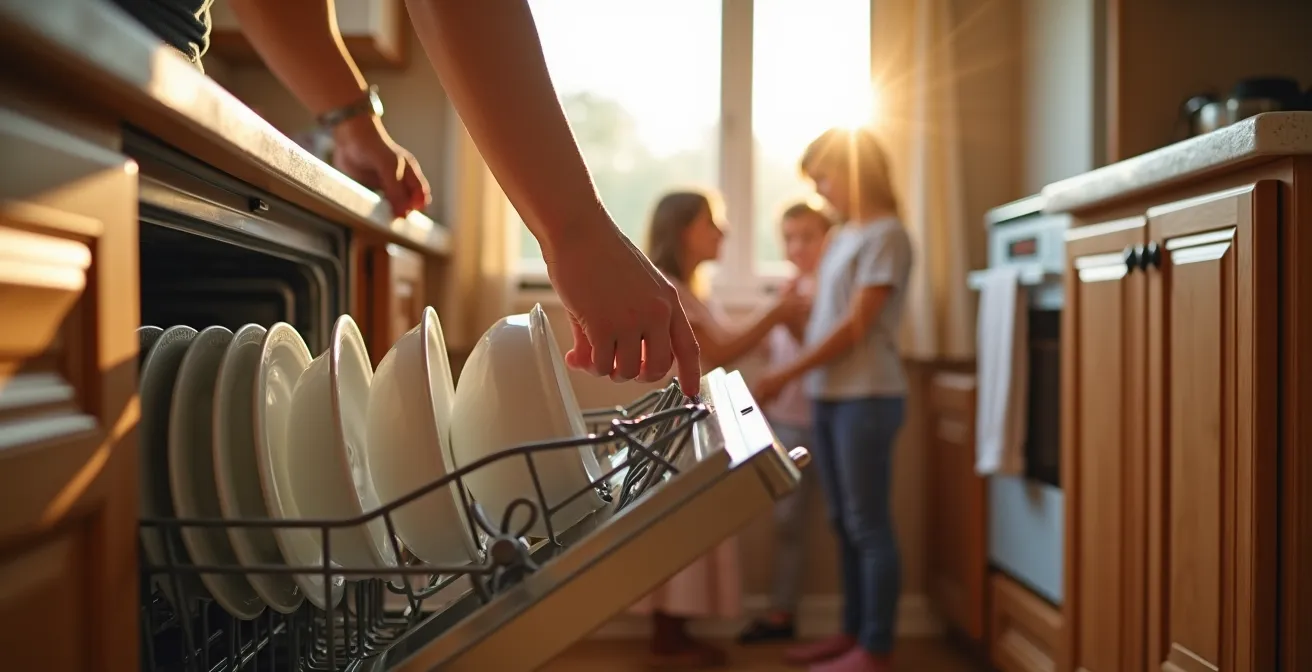
This image of an efficient, modern camping kitchen captures the essence of the value proposition: less time on chores, more time for family. It’s a small upgrade that delivers a significant improvement in holiday quality of life.
Key takeaways
- Modern luxury camping offers “amenity parity” with mid-range hotels, from private bathrooms to quality linens.
- The true value calculation for a family is “Spatial ROI”: a spacious mobile home with a terrace often outweighs a cramped hotel room at a similar price point.
- “Service Granularity” in campsites allows for a more tailored and cost-effective holiday than the fixed packages of hotels.
Why Private Mobile Homes Are Safer Than Hotels During Viral Outbreaks?
The global landscape of travel has been permanently altered by a heightened awareness of health and safety. For families, this adds another layer of complexity to the holiday decision. In this context, the structural advantages of a private mobile home over a hotel become starkly apparent. During a period of concern over viral transmission, a mobile home offers a naturally self-contained and isolated environment that a hotel simply cannot replicate.
Consider the “friction points” in a typical hotel stay: crowded lobbies, shared elevators, long enclosed corridors, and dining rooms with hundreds of other guests. Each of these is a potential vector for transmission. A mobile home, by contrast, is a standalone unit. Your family has a private entrance, private kitchen, private bathroom, and a private outdoor space. You control your environment completely. You are not forced into close contact with other guests, and your airflow is not shared through a centralized HVAC system. This inherent social distancing is a powerful, built-in safety feature.
Beyond the safety aspect, the financial argument remains compelling, offering peace of mind for both health and wallet. A detailed cost comparison found that RV trips cost around $5,627 for 14 days versus $8,801 for comparable hotel stays, showing a 36% savings. This significant saving, combined with a demonstrably safer and more private environment, makes a powerful case for the modern campsite. It’s an investment in both your family’s well-being and your financial health.
Ultimately, the choice offers more than just safety; it provides a more profound sense of escape and control, which has become a valuable commodity in itself.
More than half (58%) think camping offers a more significant break from the everyday routine compared to other types of travel like flying or hotel stays
– Campspot Research Team, 2024 Camping Trends Outlook
This feeling of a “significant break” is amplified by the autonomy and security a private mobile home provides, making it the smarter, safer, and often more valuable choice for a family of four in the modern era.
Frequently asked questions about Camping vs Hotel: Which Offers Better Value for a Family of 4 in August?
Do luxury campsites offer reliable internet?
Many premium campsites now offer fiber-optic connections to individual units, with speeds comparable to urban hotels.
What about remote locations?
Satellite internet solutions like Starlink are increasingly being installed at remote luxury camping sites, offering 50-200 Mbps speeds.
Is there a premium for high-speed internet?
Basic Wi-Fi is often included in the site fee, but high-speed dedicated connections may cost €5-15 per day extra.