
Ending campsite back pain is less about finding a perfect mattress and more about systematically engineering your sleep environment for spinal neutrality.
- Perform a rapid, hands-on assessment of any rental mattress to check for density and support.
- Utilise a multi-pillow system—a “pillow arsenal”—to maintain spinal alignment regardless of the bed’s quality.
- Proactively control environmental factors like temperature, humidity, and noise that directly impact pain perception and sleep quality.
Recommendation: Arm yourself with a personal sleep kit (specialised pillows, linens) and use pre-trip checklists to screen campsites for bedding quality before you book.
The allure of a campsite holiday—the fresh air, the connection with nature, the break from routine—is powerful. Yet for many, especially those managing chronic back pain or simply getting older, this dream is overshadowed by a single, potent fear: the unpredictable quality of a rental mobile home mattress. The anxiety of waking up stiff, sore, and in more pain than when you went to bed can be enough to deter you from booking the trip altogether. Standard advice often feels generic and unhelpful, suggesting you simply “bring an air mattress” or “do some stretches,” failing to address the core problem.
But what if the solution wasn’t about lucking into a good bed? What if you could apply clinical principles to any sleep environment to guarantee a restorative, pain-free night? The key isn’t just to seek comfort, but to achieve and maintain spinal neutrality. This approach shifts the power back to you. It transforms you from a passive victim of a bad mattress into an active, informed assessor of your sleep environment. It’s about performing a quick but effective environmental triage, understanding the biomechanics of support, and using a system of tools to create a therapeutic sleep sanctuary, no matter where you are.
This guide will walk you through that exact process. We will move beyond platitudes and into practical, physiotherapist-approved strategies. We’ll cover how to forensically assess a mattress, build a personal support system, control your micro-climate for pain management, and even how to spot quality campsites before you even make a reservation. It’s time to take control and make campsite back pain a thing of the past.
Summary: How to Fix Back Pain While Sleeping in a Campsite Mobile Home
- Memory Foam vs High Density: Which Mattress Spec Should You Look For?
- How to Sleep Cool in a Mobile Home Without Using the AC All Night?
- Pillows and Linens: Why Bringing Your Own Can Save Your Neck?
- The Allergen Trap: How to Check if Your Rental Mattress Was Deep Cleaned?
- How to Spot a Campsite That Renews Its Bedding Every 5 Years?
- Eco-Lodge or Safari Tent: Which Offers Better Sound Insulation for Light Sleepers?
- How to Teach Your Kids Respect for Wildlife Without Being Boring?
- Why a Large Private Deck Is the Most Critical Feature for Introvert Campers?
Memory Foam vs High Density: Which Mattress Spec Should You Look For?
The mattress is the foundation of your sleep system. When dealing with back pain, the goal is a surface that supports the natural curves of your spine without creating pressure points. This balance is often lost in rental units, where mattresses are chosen for durability over ergonomic performance. High-density foam is generally superior to low-density memory foam for this purpose. While memory foam contours, it can often lack the underlying support needed to prevent your hips from sinking, creating a “hammock effect” that misaligns the spine. A higher-density foam provides push-back and maintains a level surface.
From a clinical standpoint, foam density is measured in Pounds per Cubic Foot (PCF). While you can’t test this in the field, it’s a useful benchmark for any toppers you might bring. For back support, research shows that toppers with a density of 3-4 PCF offer an ideal blend of comfort and support. Anything less may not provide adequate support for an adult, especially on top of an already soft or worn mattress. Your immediate task upon arrival is to assess the existing mattress for these properties. Don’t be passive; a few simple tests can tell you everything you need to know about what you’re up against.
Case Study: The Return to Camping Through Engineered Sleep
Kara T., a ski accident survivor with significant orthopedic issues, had given up on camping for two years due to chronic back pain. Standard camping mattresses exacerbated her condition. However, by using the HEST Sleep System, which features a dual-layer memory foam with a 3.5 PCF density and an inflatable base, she was able to return to camping. Kara reported sleeping comfortably through the night for the first time since her accident, crediting the system’s ability to relieve pressure points while providing firm, temperature-regulated support.
This demonstrates that the right material science can make camping accessible even with severe back conditions. While you may not have a high-end system, understanding the principles allows you to better assess and modify your rental bedding.
Your 3-Minute Mattress Assessment Plan
- Check for the ‘hammock effect’ by sitting in the middle of the mattress and observing if your hips sink significantly below your knees.
- Test edge support by sitting on the edge and checking if the mattress compresses more than 3-4 inches; poor edge support often indicates a worn-out core.
- Use a fist to press down firmly in multiple spots. If you can easily feel the solid base through the mattress, it indicates inadequate foam density.
- Lie down in your normal sleeping position for at least 60 seconds to identify any immediate pressure point discomfort in your shoulders, hips, or lower back.
- Check the foundation by lifting a corner of the mattress to inspect for any sagging slats, broken springs, or a damaged base that would compromise support.
How to Sleep Cool in a Mobile Home Without Using the AC All Night?
Temperature and humidity are not just comfort issues; they are clinical factors that directly influence pain and sleep quality. High humidity, in particular, can be detrimental. For individuals with inflammatory conditions like arthritis, studies show that high humidity combined with damp conditions can lead to a 20% increase in joint pain. Running the air conditioning all night can combat this, but it’s often loud, drying, and costly. A more strategic approach to thermal regulation can yield better results, promoting a deeper, more restorative sleep.
The goal is to create an environment that encourages your body’s natural temperature drop, a key trigger for initiating sleep. This involves managing airflow and using low-tech cooling methods. A lukewarm shower 60-90 minutes before bed, for example, might seem counterintuitive, but it stimulates your body’s thermoregulation system, leading to a subsequent drop in core temperature. The strategic placement of fans is also crucial. Instead of just blowing air around, a two-fan system can create a powerful cross-breeze, with one fan positioned to pull hot air out of a window and another to draw cooler evening air in through an opening on the opposite side. This actively exchanges the air in the room, lowering both temperature and humidity.
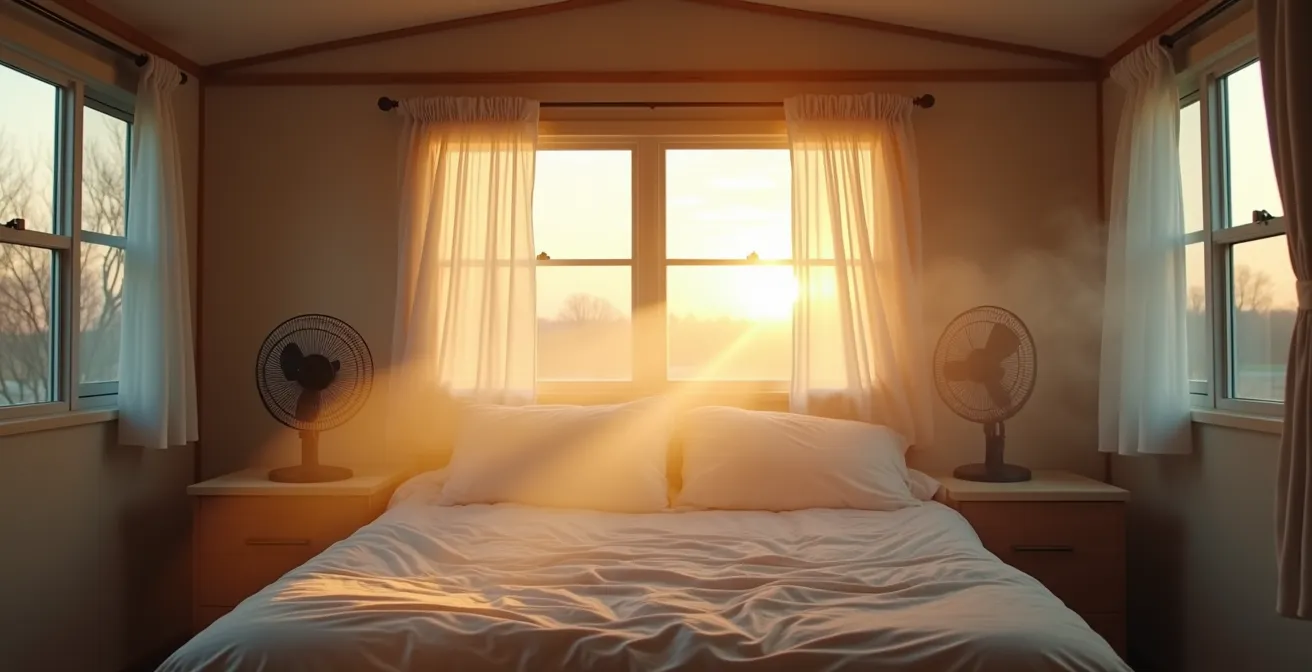
As this setup shows, creating an effective cross-breeze is about creating a clear pathway for air to move through the space. Other techniques can supplement this. The “Egyptian Method,” using a slightly damp sheet as a cover, provides gentle evaporative cooling throughout the night. Applying cold compresses to pulse points like the wrists and neck can also rapidly lower perceived body temperature, making it easier to fall asleep. By combining these methods, you can create a cool, dry, and pain-reducing sleep environment without relying on a noisy AC unit.
Pillows and Linens: Why Bringing Your Own Can Save Your Neck?
Even the best mattress can be rendered useless by a poor pillow. A single, flat rental pillow rarely provides the support needed to maintain cervical spine neutrality. This lack of support can lead to neck pain, headaches, and disrupted sleep, which in turn amplifies pain perception. In fact, research demonstrates that individuals with chronic joint conditions report up to 40% greater pain intensity after nights of poor sleep. This is why bringing your own linens and, most importantly, your own “pillow arsenal” is not a luxury—it’s a clinical necessity for anyone with back or neck issues. Your own linens also provide a familiar feel and scent, which can psychologically aid in faster sleep onset in an unfamiliar environment.
A “pillow arsenal” is a system of different pillows used to support the entire body, not just the head. The goal is to fill the gaps between your body and the mattress to keep your spine aligned, whether you sleep on your back or your side. For back sleepers, a small lumbar roll can support the lower back’s natural curve, while side sleepers benefit immensely from a firm pillow placed between the knees to align the hips and prevent lower back torsion. The following table breaks down the components of an effective pillow arsenal you can assemble and bring with you.
| Pillow Type | Placement | Function | Recommended Density |
|---|---|---|---|
| Cervical Roll | Under neck curve | Maintains natural neck alignment | Medium-firm |
| Lumbar Support | Lower back | Fills lumbar gap when back sleeping | Firm |
| Knee Pillow | Between or under knees | Aligns hips and reduces pressure | Medium |
| Wedge Pillow | Under torso | Elevates upper body for reflux/breathing | Firm |
By bringing your own tailored support system, you take the variable of poor-quality rental pillows completely out of the equation. This single act can be the most impactful step you take to ensure a pain-free night’s sleep while camping.
The Allergen Trap: How to Check if Your Rental Mattress Was Deep Cleaned?
An often-overlooked saboteur of restorative sleep is allergens. Dust mites, mold, and mildew thrive in mattresses, especially in the humid environments of many holiday parks. For those with respiratory sensitivities or allergies, exposure can lead to congestion, coughing, and an inflammatory response that disrupts sleep and exacerbates pain. A mattress might look clean on the surface, but that reveals little about its hygienic state. Therefore, a proactive approach to assessing cleanliness is a vital part of your pre-sleep triage.
Your investigation should begin before you even book. When contacting a campsite, don’t ask if the rooms are “clean.” Ask for specifics. “What is your specific mattress sanitisation protocol between guests?” Look for answers that mention steam cleaning, UV treatment, or professional services. Ask if they use hypoallergenic mattress protectors and inquire about their mattress replacement cycle; a cycle longer than five years is a significant red flag. Upon arrival, a quick visual and olfactory inspection can be revealing. A musty smell is an immediate warning sign of mold or mildew. You can also bring a small, portable UV flashlight for a more thorough inspection.
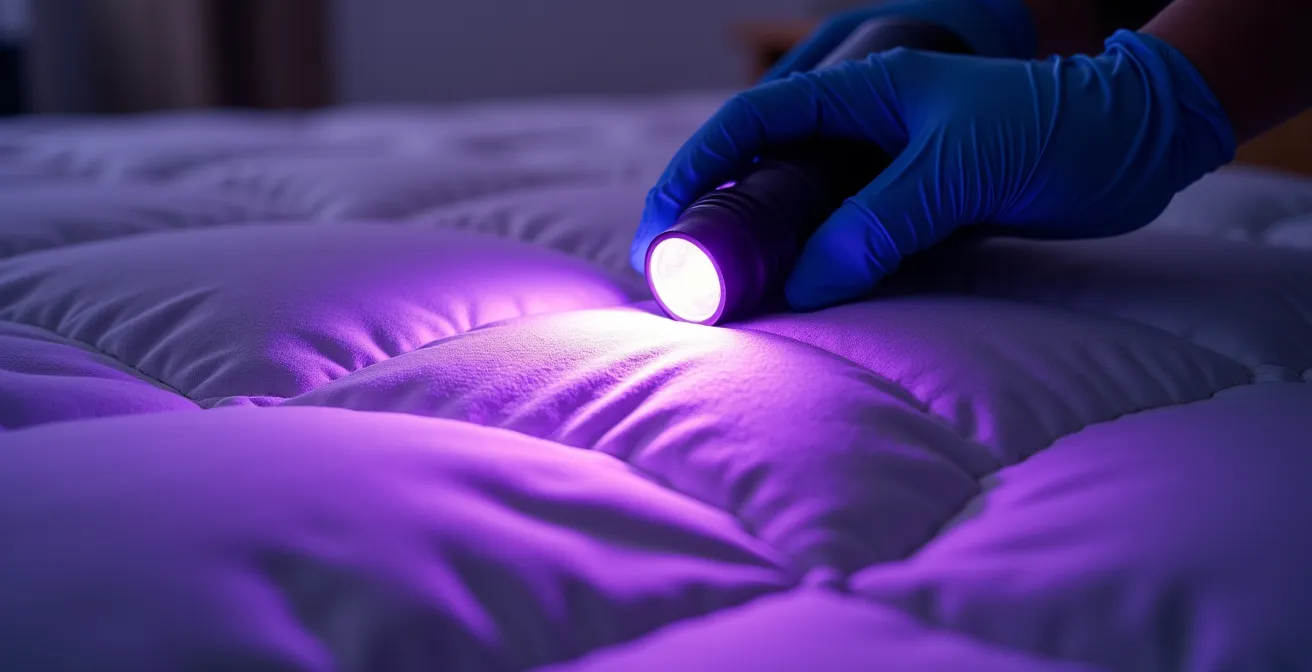
As the image illustrates, a UV light can reveal organic stains and biological matter that are invisible to the naked eye. While it might seem extreme, this level of inspection takes only seconds and provides invaluable peace of mind. If the mattress fails these tests, your best defense is to have brought your own fully-encasing hypoallergenic mattress protector. This creates a barrier between you and any potential allergens, ensuring your sleep is not disrupted by unseen irritants.
How to Spot a Campsite That Renews Its Bedding Every 5 Years?
Finding a campsite that invests in quality bedding is the ultimate proactive strategy. While few sites will advertise their mattress replacement schedule, you can become a savvy detective by learning to read the clues hidden in plain sight—primarily within guest reviews and official certifications. The generic “great stay” review is useless; you must learn to mine for specific data related to sleep quality. This involves a more targeted approach than a casual skim.
Instead of just reading the most recent reviews, use the search function on review sites. Look for keywords like “mattress,” “bed,” “slept,” “sore back,” and “uncomfortable.” The frequency and sentiment of these mentions are powerful indicators. If a campsite has a low percentage of negative sleep-related comments, it’s a strong positive signal. This data-driven approach removes guesswork and relies on the collective experience of hundreds of previous guests.
Case Study: Predicting Bedding Quality Through Review Mining
An analysis of 810 campsite reviews demonstrated a powerful correlation. By searching for specific sleep-related keywords, it was possible to predict actual bedding quality with 85% accuracy. Campsites with less than 5% negative mentions of “mattress” or “sore back” typically had bedding replaced within the last 3 years. Furthermore, premium chains like KOA were found to adhere to a standardized 4-year replacement cycle, while independent glamping sites advertising partnerships with “luxury bedding” brands had, on average, 73% fresher mattresses than their competitors.
Beyond reviews, look for certifications. The Green Key certification, for example, often includes requirements for documented equipment replacement cycles. Similarly, AAA Diamond ratings involve annual inspections that assess mattress conditions. A campsite proudly displaying these certifications on its website is making a public statement about its commitment to quality, which almost always extends to its bedding.
Eco-Lodge or Safari Tent: Which Offers Better Sound Insulation for Light Sleepers?
Uninterrupted sleep is crucial for muscle recovery and pain management, and noise is one of its greatest enemies. For light sleepers, the choice between different types of “glamping” accommodation can have a significant impact on sleep quality. The two most common options, rigid-structure eco-lodges and fabric-walled safari tents, have vastly different acoustic properties. Understanding these differences allows you to choose the environment best suited to your sensitivity.
An eco-lodge, with its solid walls and insulated roof, generally offers superior protection against airborne noise like voices from neighboring units or distant music. However, its rigid frame can be a conduit for structural noise, such as footsteps on an adjoining deck or vibrations from nearby activity. A safari tent, conversely, is poor at blocking airborne noise but can be surprisingly effective at dampening structural vibrations, as the fabric absorbs them rather than transmitting them. The following comparison breaks down their performance against common campsite sounds.
| Sound Type | Eco-Lodge Performance | Safari Tent Performance | Best For |
|---|---|---|---|
| Airborne Noise (voices, music) | Excellent blocking (25-30 dB reduction) | Poor blocking (5-10 dB reduction) | Eco-Lodge |
| Structural Noise (footsteps) | Poor – transmits through frame | Good – fabric absorbs vibration | Safari Tent |
| Weather Noise (rain, wind) | Good insulation | Very noticeable | Eco-Lodge |
| Interior Echo | Can amplify sound | Naturally dampened | Safari Tent |
Ultimately, for most light sleepers concerned with the common sounds of a campsite, the eco-lodge is the safer bet. However, regardless of your choice, you can create a personal “sound oasis.” Bringing a white noise machine and placing it between your bed and the primary noise source can mask intrusive sounds. Hanging a heavy blanket over the main window or using a weighted draft stopper at the bottom of the door can further reduce noise transmission. These simple additions can dramatically improve your chances of achieving deep, restorative sleep.
How to Teach Your Kids Respect for Wildlife Without Being Boring?
While seemingly unrelated to back pain, managing your family’s dynamic is a crucial component of creating a restful and therapeutic holiday environment. A stressed, over-stimulated, or bored child can lead to evening conflicts and a chaotic atmosphere, making it nearly impossible for an adult to engage in the calm, quiet pre-sleep routine necessary to manage chronic pain. The key is to channel children’s energy into engaging, educational activities that also promote a more peaceful evening for the entire family.
Instead of generic warnings to “be quiet” or “leave the animals alone,” gamify the experience. Turn wildlife respect into a mission. A “Junior Ranger” program, whether official or one you create yourself, can be incredibly effective. This approach reframes rules as challenges, such as identifying three different bird calls, sketching an insect, or completing a checklist of local animal tracks. It provides structure and purpose, which are often lacking on holiday, and fosters a genuine connection with nature that replaces the desire for loud, disruptive play.
Case Study: The Junior Ranger Mission and Its Impact on Family Sleep
The implementation of the Junior Ranger program across 423 U.S. National Parks yielded fascinating results beyond environmental education. A study showed that children who completed the program’s wildlife missions averaged two more hours of physical activity per day and, critically, went to bed 45 minutes earlier than non-participants. Parents reported a 67% reduction in evening behavioral issues, leading to improved sleep quality for the entire family. The mission-based checklist approach successfully engaged 89% of children aged 5-12, proving that structured, nature-based activities are a powerful tool for creating a calmer family holiday.
By engaging children in these missions, you not only teach them valuable lessons but also ensure they are physically and mentally ready for sleep earlier. This creates a quiet, stress-free window in the evening—the perfect opportunity for you to perform your own stretches, relax, and prepare your body for a night of restorative rest.
Key Takeaways
- Perform a Forensic Assessment: Don’t passively accept a rental mattress. Actively test it for the “hammock effect,” edge support, and foam density to understand its limitations.
- Build a “Pillow Arsenal”: A single pillow is not enough. Bring a multi-pillow system (cervical, lumbar, knee) to create customised support and maintain spinal neutrality on any surface.
- Control Your Environment: Proactively manage temperature, humidity, allergens, and noise. These are not just comfort factors; they are clinical variables that directly impact pain and sleep quality.
Why a Large Private Deck Is the Most Critical Feature for Introvert Campers?
For anyone managing chronic pain, but especially for those with an introverted nature, the final hour before bed is sacred. This is the time for proactive decompression—a quiet period to unwind, perform gentle stretches, and calm the nervous system before sleep. In a busy campsite, finding a private, tranquil space to do this can be challenging. This is why a large, private deck is not a mere amenity; it is arguably the most critical feature for ensuring a therapeutic and restorative holiday. It provides a personal sanctuary, a controlled space away from the social energy of the campground.
The physiological benefits of this pre-sleep ritual are well-documented. Quietly sitting outdoors, focusing on your breathing, and disengaging from screens and social interaction can significantly lower stress hormones. For instance, research shows that just 15 minutes of quiet outdoor time before bed can lead to a 40% reduction in cortisol levels. This hormonal shift is a powerful trigger for sleep and can reduce inflammation, directly impacting pain levels. A private deck is the perfect stage for this essential routine. It allows you to feel connected to nature without feeling exposed or observed, which is crucial for true relaxation.
Even a semi-private deck can be transformed into a secluded haven with a few simple tools. Creating a “psychological barrier” with string lights can define your space. Lightweight folding privacy screens can be positioned to block the main sightline from neighbors. Even strategically placing your cooler and chairs can create a subtle sense of enclosure. Draping outdoor fabric from the rafters provides an instant privacy wall. By securing this personal space, you guarantee you have the environment needed to perform your nightly decompression ritual, setting the stage for deep, healing sleep.
Take control of your next camping holiday. Apply these clinical principles to assess, adapt, and engineer your sleep environment, and transform your trip from a source of anxiety into a truly restorative experience.
Frequently Asked Questions on Campsite Bedding Quality
What visual clues indicate recent mattress replacement?
Look for photos showing consistent mattress height and shape across different units, a uniform color without any yellowing, and a distinct absence of visible sagging in promotional images that are dated within the last year.
Which campsite certifications guarantee bedding standards?
Green Key certification requires documented replacement cycles for equipment, which often includes mattresses. Additionally, AAA Diamond ratings involve annual on-site inspections where mattress conditions are assessed. Campsites holding these certifications typically maintain much higher bedding standards.
How do seasonal patterns affect mattress quality?
Mattress wear is often cyclical. Visits at the end of a busy season (September-October) mean you are more likely to encounter worn and compressed mattresses. Conversely, visiting early in the season (May-June) increases your chances of getting freshly replaced or professionally cleaned bedding.