
In a medical crisis in France, a multilingual concierge is more than a convenience; they are your personal crisis coordinator.
- They use established personal networks to get you access to medical care, bypassing queues and language barriers.
- They manage all logistical and administrative complexities, from insurance paperwork to coordinating transport, allowing you to focus on recovery.
Recommendation: When choosing your accommodation in France, prioritize campsites offering a dedicated, multilingual concierge service as a critical component of your travel safety plan.
The thought of a medical emergency abroad is a traveller’s greatest fear. In France, a country with a world-class but notoriously complex healthcare system, this anxiety is amplified for non-French speakers. You may know to call 15 for a medical emergency or 112 for the general European emergency line, and you have almost certainly purchased travel insurance. Yet, a significant gap exists between having these resources and navigating the stressful reality of a crisis on the ground: communicating with paramedics, understanding a diagnosis, or dealing with hospital administration.
While standard advice focuses on preparation, it often overlooks the single most effective asset available at high-end campsites: the human element. The multilingual concierge is frequently misunderstood as a simple booking agent for tours and restaurants. This perception misses their most critical function. In a moment of crisis, they transform from a convenience into an indispensable “system navigator,” a dedicated coordinator who can manage the intricate details of your emergency with an insider’s expertise.
But is their advice truly impartial? How far do their capabilities extend? This guide will deconstruct the role of the campsite concierge in a medical emergency. We will explore how their local networks provide unparalleled access, define the precise scope of their crisis support, and explain why establishing contact with them before you even arrive is one of the most important travel preparations you can make. It’s time to see the concierge not as a luxury, but as your most vital lifeline.
Summary: Navigating a Medical Crisis with Concierge Support
- Commission vs Advice: Do Concierges Recommend the Best or the Most Expensive Tours?
- Lost Luggage or Car Breakdown: What Can the Campsite Reception Actually Do?
- Restaurant Tables: Can the Concierge Get You into Fully Booked Bistros?
- Butler vs Concierge: Why You Shouldn’t Expect Room Service in a Campsite?
- Why You Should Email the Concierge 2 Weeks Before Arrival?
- Does Your Travel Insurance Cover Paddleboard Accidents in France?
- What Can a Security Guard Legally Do if Neighbors Are Noisy?
- Why Private Mobile Homes Are Safer Than Hotels During Viral Outbreaks?
Commission vs Advice: Do Concierges Recommend the Best or the Most Expensive Tours?
When it comes to restaurant or tour recommendations, a flicker of doubt is natural: is the concierge suggesting the best option, or the one that pays them a commission? However, this concern dissolves when the request shifts from leisure to a medical emergency. In a health crisis, the currency of a professional concierge is not commission; it’s trust and reputation. Their primary goal is to resolve the situation effectively and safely, relying on a curated network of proven, reliable medical professionals.
This is because their value is tied to their ability to solve complex problems, and a poor medical referral would irreparably damage their professional standing. A telling case study from Sydney involved a Les Clefs d’Or concierge who, during a holiday, leveraged his vetted medical network to secure an emergency pediatric appointment after hours. He made repeated personal calls, demonstrating that in a crisis, concierges activate relationships built on proven results, not financial incentives. This logic holds true in French campsites, where a concierge’s local knowledge includes knowing which doctors are not only skilled but also English-speaking and responsive to urgent requests from trusted contacts.
The stakes are simply too high. With 27% of all paid travel insurance claims in 2024 being for medical emergencies, concierges at high-end establishments are trained to act as serious crisis facilitators. Their recommendations are based on a single criterion: providing the fastest, most effective care for their guest. Their reputation, and your well-being, depend on it.
Lost Luggage or Car Breakdown: What Can the Campsite Reception Actually Do?
The campsite reception can certainly help with logistical headaches like lost luggage or coordinating with a local garage for a car breakdown. These are baseline services. However, their capabilities expand dramatically when a minor inconvenience escalates into a major medical emergency. In this scenario, the concierge or lead receptionist transitions from a simple helper to a full-spectrum crisis coordinator, managing a complex web of logistical tasks that would be overwhelming for a tourist in distress.
This coordination is far more than just calling an ambulance. It involves a precise and structured response designed to remove every possible barrier between you and the care you need.
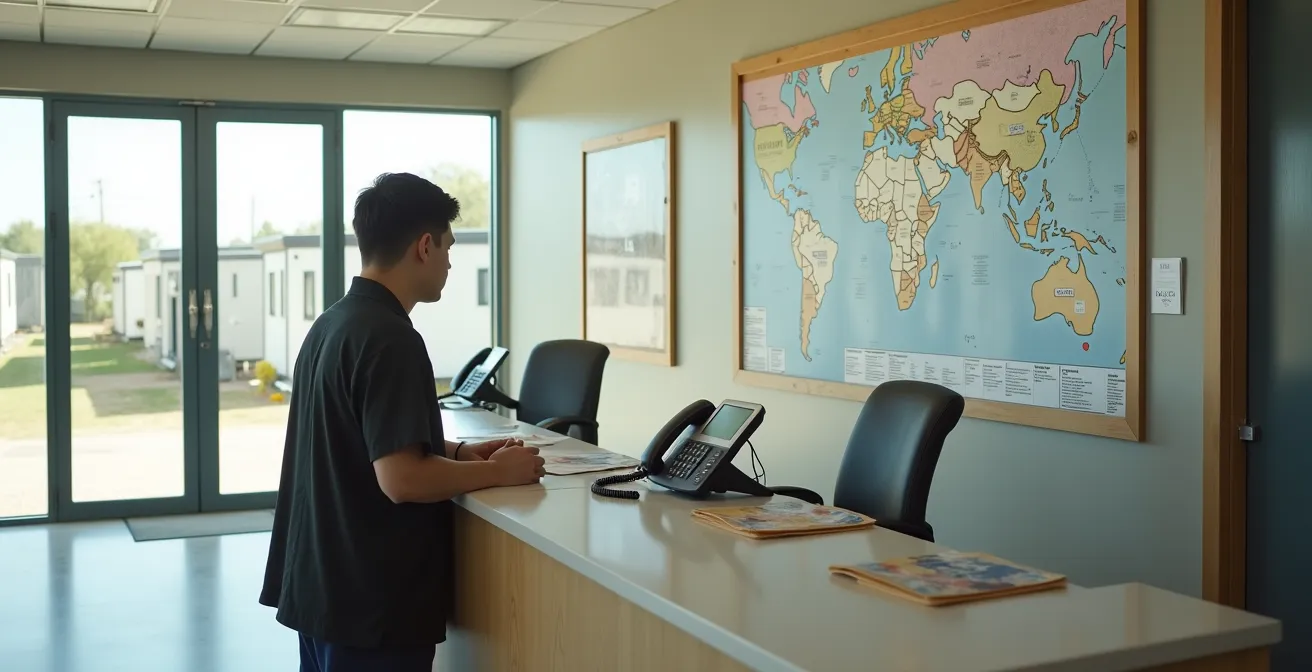
As the image suggests, the reception desk becomes the incident’s command center. The concierge’s role includes:
- Acting as the primary liaison with emergency services, providing the exact mobile home location to avoid any delays.
- Coordinating directly with your travel insurance provider, using their multilingual skills to bridge the communication gap.
- Facilitating emergency cash transfers if a clinic requires upfront payment, a common hurdle in some systems.
- Assisting with lost or inaccessible document replacement needed for hospital admission.
- Serving as an emergency message relay to notify family members back home.
- Arranging specialized medical transportation if a standard ambulance is insufficient.
This structured support system acts as a human firewall, protecting you from the chaos and allowing you to focus solely on the medical situation at hand.
Restaurant Tables: Can the Concierge Get You into Fully Booked Bistros?
A seasoned concierge’s ability to secure a table at a “fully booked” bistro isn’t magic; it’s the result of cultivated personal relationships. This same principle is exponentially more powerful when applied to the healthcare system. Getting an urgent appointment with a specialist or a local clinic can feel impossible for a tourist making a cold call. For a concierge, it’s about activating a trusted network. This power of personal access is their most significant, yet least understood, attribute.
As Dr. Michelle Nathan, an emergency medicine physician, points out in a travel safety report, the difference in effectiveness is night and day. Her expert opinion underscores this reality:
A concierge’s personal phone call to a clinic administrator they know is exponentially more effective than a tourist cold-calling a reception desk.
– Dr. Michelle Nathan, MD FAAEM, Emergency Assistance Plus Travel Safety Report 2024
This isn’t about skipping the line unfairly. It’s about a trusted professional vouching for the urgency and legitimacy of your situation to another professional. They can communicate the context in fluent French, explain the circumstances succinctly, and ensure you are routed to the appropriate care without getting lost in a frustrating phone tree. In a country where emergency travel statistics show that one in three travellers experience health issues abroad, this ability to bypass bureaucratic friction is not a luxury—it’s a critical function that saves precious time and reduces immense stress.
Butler vs Concierge: Why You Shouldn’t Expect Room Service in a Campsite?
The terms “butler” and “concierge” are often used interchangeably in the luxury travel world, but their roles, especially in an emergency, are fundamentally different. A butler is a provider of personal comfort and in-residence service; their focus is on your immediate convenience within your accommodation. A concierge, particularly in a high-end campsite context, is a facilitator of external services and a system navigator. Expecting one to perform the role of the other can lead to misunderstanding their true value.
In a medical crisis, you don’t need someone to fluff your pillows; you need a logistical expert who can interface with a complex, foreign system on your behalf. The concierge is trained for this role, possessing the language skills, local contacts, and procedural knowledge that a butler typically does not. This distinction becomes clear when comparing their capabilities in an emergency, as shown in a comparative analysis from travel insurance providers.
| Support Type | Concierge (Medical Facilitator) | Butler (Comfort Provider) |
|---|---|---|
| Medical referrals | 24/7 multilingual doctor network access | Not applicable |
| Prescription coordination | Arranges pharmacy delivery | Physical delivery only |
| Insurance liaison | Direct communication with providers | No insurance expertise |
| Emergency transport | Coordinates medical evacuation | Standard transport only |
| Document assistance | Hospital admission paperwork help | Basic administrative support |
As illustrated by the Cleveland Clinic’s Medical Concierge team, this role extends to highly practical support, such as arranging interpreters, sourcing special dietary foods, or even organizing childcare for family members during hospital visits. This is the work of a crisis coordinator, not a personal servant.
Why You Should Email the Concierge 2 Weeks Before Arrival?
The most effective way to leverage your campsite’s concierge is to empower them with information before a crisis ever occurs. A proactive email sent a couple of weeks before your arrival transforms them from a reactive helper into a prepared ally. This isn’t about burdening them with details; it’s about providing them with the necessary tools to act swiftly and effectively on your behalf should the need arise. It allows them to discreetly flag your file and be aware of any potential needs.
This pre-arrival briefing is especially critical for travellers with pre-existing conditions, allergies, specific medication needs, or those travelling with children. By providing this information upfront, you eliminate the frantic search for documents or the struggle to communicate complex medical history in a moment of panic. You are, in effect, setting up your own personalized emergency response plan with your on-site coordinator. A well-prepared traveller is a concierge’s most valuable partner in a crisis.
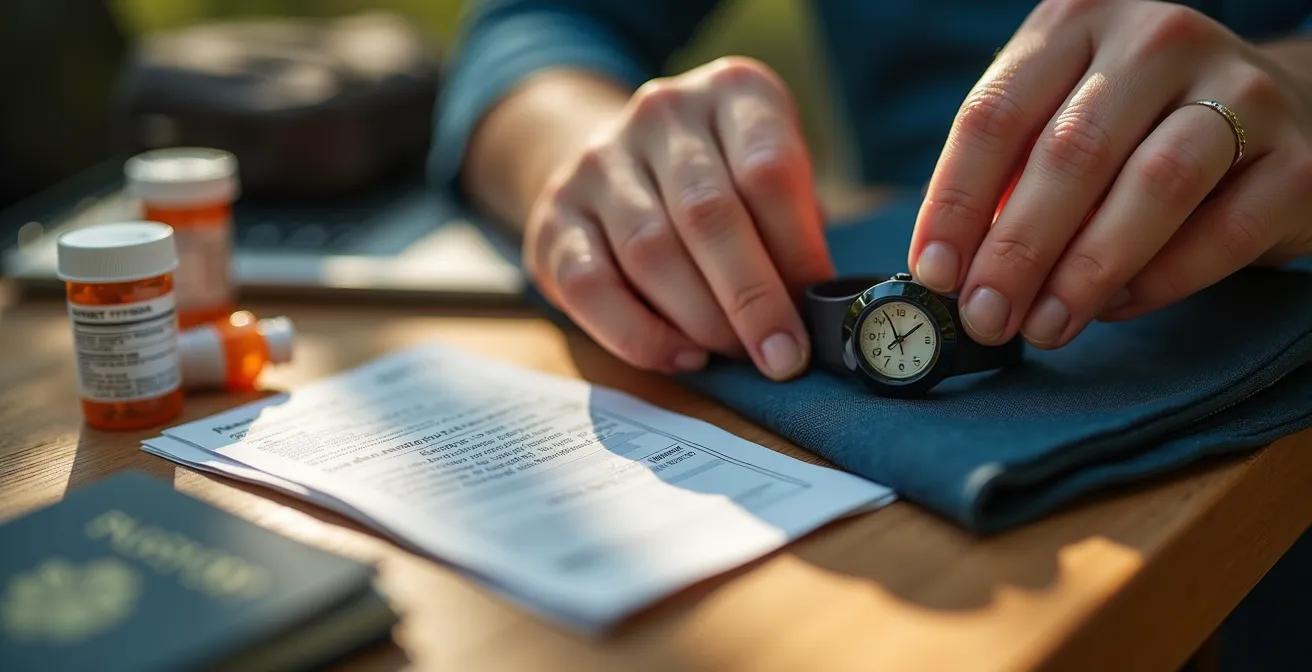
Your email doesn’t need to be long, but it should be precise. Compiling these details in a secure digital document that you can attach or reference is an excellent strategy.
Your Pre-Arrival Medical Briefing Checklist
- Current Prescriptions: List all medications, including their generic drug names, which are more universally recognized.
- Pre-existing Conditions: Clearly state any chronic conditions such as diabetes, heart conditions, severe allergies, or mobility issues.
- Contact Information: Provide the name and contact number for your primary doctor or any relevant specialists back home.
- Essential Medical Data: Note your blood type and details of any implanted medical devices like pacemakers or joint replacements.
- Insurance Details: Include your travel insurance company, policy number, and their 24/7 emergency contact number.
Does Your Travel Insurance Cover Paddleboard Accidents in France?
Whether your travel insurance covers a specific activity like a paddleboard accident is a crucial question, but it’s only the first step. The more pressing challenge during a real emergency is the gap between *being covered* and *successfully making a claim*. Insurance policies have strict protocols, require specific documentation, and often involve complex medical terminology. This is where a multilingual concierge becomes your most important advocate, acting as the critical bridge between the local hospital and your insurance provider.
This role is particularly vital in France. According to recent data, the challenge of navigating medical incidents here is significant, with nearly 25% of all medical evacuations in 2024 originating from Europe, and France leading as the top evacuation country. This highlights the sheer volume and complexity of medical incidents involving foreigners. A concierge provides what travel assistance teams call “dual fluency”: they can translate French medical reports into clear information for your insurance company and, in reverse, explain the insurance company’s requirements to the hospital administration.
Without this expert liaison, you risk critical miscommunications or missing paperwork that can lead to claim denials. The concierge ensures the right documents—medical reports, witness statements, facility contact details—are gathered and transmitted correctly within the crucial first hours of an incident. They don’t replace your insurance company’s assistance line, but they work in tandem with it, providing the on-the-ground, real-time support that a remote call center cannot.
Key Takeaways
- A concierge’s primary role in a medical crisis is crisis coordination, not providing comfort.
- Their power comes from a trusted, personal network of local medical professionals, ensuring access and quality.
- Proactively sharing your medical information before arrival is the best way to empower them to help you effectively.
What Can a Security Guard Legally Do if Neighbors Are Noisy?
A security guard’s role in handling a noise complaint is a matter of enforcing campsite rules. However, in a medical emergency, their function pivots to become a critical component of a site-wide, coordinated response orchestrated by the concierge. The concierge acts as the central communication hub, directing various on-site teams to ensure the emergency is managed efficiently, safely, and with respect for the guest’s privacy. The security team is not acting independently; they are the concierge’s eyes, ears, and hands on the ground.
This internal coordination is a well-rehearsed protocol at high-end campsites. When a medical alert is raised, the concierge doesn’t just call for an ambulance; they initiate an internal chain of command. Their first call is often to security, instructing them to proceed to the location, clear the access path for the emergency vehicle, and discreetly manage any onlookers. This prevents the chaos of a large ambulance trying to navigate narrow campsite roads or being blocked by parked cars, saving precious minutes.
The security guard’s legal authority in this context is to manage the site’s property and ensure the safety and order of the community. Under the concierge’s direction, this translates into securing the scene for emergency responders. They ensure that paramedics have a clear and quick path to your mobile home, provide a physical presence to deter curiosity from other guests, and help maintain a perimeter of privacy around you and your family during a vulnerable time. This seamless teamwork is a hallmark of a well-managed property.
Why Private Mobile Homes Are Safer Than Hotels During Viral Outbreaks?
During a viral outbreak, the physical separation offered by a private mobile home is an obvious advantage over a hotel with shared corridors and elevators. However, the true benefit lies in the concept of “supported isolation.” This is where the concierge service transforms your private space into a self-contained recovery unit, providing comprehensive logistical and medical support without requiring you to break quarantine. This model is invaluable not just for viral outbreaks, but for any contagious illness or post-procedure recovery.
The need for this kind of support is growing, as recent health emergency data shows that illness-related travel assistance cases surged by 26% in early 2024. In a hotel, isolation can mean being truly alone. In a high-end campsite, the concierge becomes your single point of contact, managing all your needs remotely. This protocol ensures safety for both you and the community while providing continuous care.
The supported isolation protocol includes a wide range of services, all coordinated by the concierge:
- Arranging no-contact delivery of prescription medications and other medical supplies directly to your mobile home.
- Coordinating food and grocery deliveries that respect any dietary restrictions.
- Facilitating telemedicine consultations with local, English-speaking doctors.
- Managing all communication with your travel insurance to authorize coverage for an extended stay or medical care.
- Providing vetted local health updates to filter out misinformation and reduce anxiety.
- Arranging safe, isolated transport for essential medical appointments if required.
This comprehensive support system ensures that isolation does not mean helplessness. It allows you to recover in a secure, private environment while having every essential need managed by a dedicated professional.
Ultimately, when travelling in France, preparing for the unexpected is paramount. Choosing accommodation that offers a professional, multilingual concierge service is not a matter of luxury; it is a strategic decision that provides you with a personal crisis manager. Ensure this vital resource is part of your next holiday plan.
Frequently Asked Questions on Campsite Emergency Coordination
How does the concierge coordinate with security during a medical emergency?
The concierge acts as the central communication hub, directing security to ensure clear ambulance access to specific mobile homes, managing crowd control, and maintaining guest privacy during the emergency response.
What is the campsite’s internal emergency response chain?
When a medical alert is raised, the concierge immediately notifies security to prepare site access, contacts emergency services with precise location details, and coordinates with management to ensure all staff are aligned in their response roles.
How is guest privacy protected during medical emergencies?
The concierge works with security to establish discrete perimeters, manages information flow to prevent speculation, and ensures only essential personnel have access to the emergency scene while maintaining confidentiality.