The true value of a family camping trip isn’t found in perfect photos, but in the measurable growth of family bonds and resilience.
- Shared challenges and even arguments are not failures, but catalysts for connection and problem-solving.
- Documenting feelings through journaling or conversation is as vital as capturing images for building a lasting positive narrative.
Recommendation: Shift from passively hoping for a good time to actively measuring your “Return on Emotion” to understand and appreciate the trip’s deep, lasting impact.
You’re home. The car is unpacked, a mountain of laundry looms, and a layer of fine dirt seems to cover everything. As a parent, you look at the aftermath of the family camping trip and ask the fundamental question: “Was it all worth it?” The stress of packing, the long drive, the inevitable squabbles—did they culminate in a genuinely good time? We often try to answer this by scrolling through photos or asking the kids if they had fun. But these metrics are superficial and fail to capture the trip’s true impact.
The real question isn’t just “did we have fun?” but “what was our Return on Emotion?” This concept, borrowed from the world of investment, provides a framework for measuring the positive emotional and relational gains from the shared experience, weighed against the investment of time, money, and yes, even stress. It’s about moving beyond the simple tally of smiles and seeing the deeper value created through shared challenges, digital detoxes, and focused time together. This isn’t about judging the trip as a success or failure, but about understanding its contribution to your family’s story and well-being.
This guide offers a happiness researcher’s perspective on how to calculate that emotional return. We will explore how to reframe challenges like bad weather, manage the inevitable “Day 3 argument,” and use specific documentation techniques to build a portfolio of positive memories. By the end, you will have a new lens through which to view your family adventures, one that helps you see the profound value hidden within the beautiful chaos of a camping trip.
To help you navigate this new perspective, this article breaks down the key components of measuring your trip’s “Return on Emotion.” The following sections provide practical strategies and insights to transform how you plan, experience, and remember your family’s time outdoors.
Summary: A Framework for Your Camping Trip’s Emotional ROI
- The Instagram Trap: How to Enjoy Your Trip Even if It Rains?
- The Post-Camping Comedown: How to Keep the Holiday Spirit Alive at Home?
- Photos or Journaling: Which Is the Best Way to Document Your Trip?
- The “Day 3 Argument”: Why It Happens and How to Move Past It?
- Why You Should Book Next Year’s Trip While You Are Still on the Campsite?
- Board Games vs Screens: How to Rebuild Family Bonds in 7 Days?
- The “No TV” Surprise: How to Prepare Teens for Low-Tech Accommodation?
- Map Reading: Why Choosing Your Exact Pitch Number Matters?
The Instagram Trap: How to Enjoy Your Trip Even if It Rains?
The pressure to curate a perfect, sun-drenched holiday album for social media can create a significant emotional deficit. When reality—like a relentless downpour—doesn’t match the expectation, it’s easy to feel like the trip is a failure. This is the Instagram Trap. The first step in calculating a true Return on Emotion (ROE) is to detach from the visual outcome and embrace the sensory experience. Rainy days aren’t a bug; they are a feature of outdoor life, offering a unique set of memories that perfect weather cannot.
The goal is to shift your focus from what the trip *looks* like to what it *feels* like. The sound of rain on the tent, the earthy smell of a damp forest, and the shared coziness of being sheltered together are powerful sensory inputs that build strong emotional memories. In fact, the simple act of being in a natural environment, regardless of the weather, has measurable benefits. For instance, Mayo Clinic research shows that exposure to nature can regulate the sympathetic nervous system in as little as 5 minutes, calming the body’s stress response. A rainy day forces a slowdown, creating an opportunity for connection that a busy, sunny day might not allow.
Instead of lamenting the clouds, lean into the moment with planned activities that celebrate the conditions. These moments of shared, simple joys often yield a higher ROE than a picture-perfect sunset. Consider these options:
- Create a ‘Rain Diary’ documenting the unique sounds and smells of rain on your tent.
- Set up a covered tarp area outside the tent for outdoor play even in a drizzle.
- Organize tent-based games like charades or storytelling competitions.
- Use the rain as an opportunity to teach kids about weather patterns and nature’s water cycle.
- Make hot chocolate and have a cozy reading session inside the tent.
By reframing rain as an opportunity rather than an obstacle, you transform a potential emotional loss into a significant gain, banking valuable memories of resilience and togetherness.
The Post-Camping Comedown: How to Keep the Holiday Spirit Alive at Home?
The abrupt transition from the open freedom of the campsite to the structured demands of home often triggers a “post-camping comedown.” This feeling of loss or nostalgia is a sign that the trip had a high emotional value, but it can also erase some of the positive feelings if not managed correctly. The key to preserving your trip’s ROE is a process called memory integration: actively converting the experiences into lasting, positive family narratives and tangible reminders.
This process begins the moment you get home. Instead of letting the memories fade into a digital folder, work together as a family to create “emotional artifacts.” These are objects and stories that anchor the positive feelings of the trip in your daily life. An emotional artifact can be anything from a smooth stone found by a river to a shared inside joke that emerged around the campfire. The act of collecting and curating these artifacts transforms the end of the trip into the beginning of its long-term emotional payoff.
A wonderful way to practice memory integration is by creating a dedicated memory box. This simple, collaborative activity keeps the holiday spirit alive and reinforces the value of the shared experience.
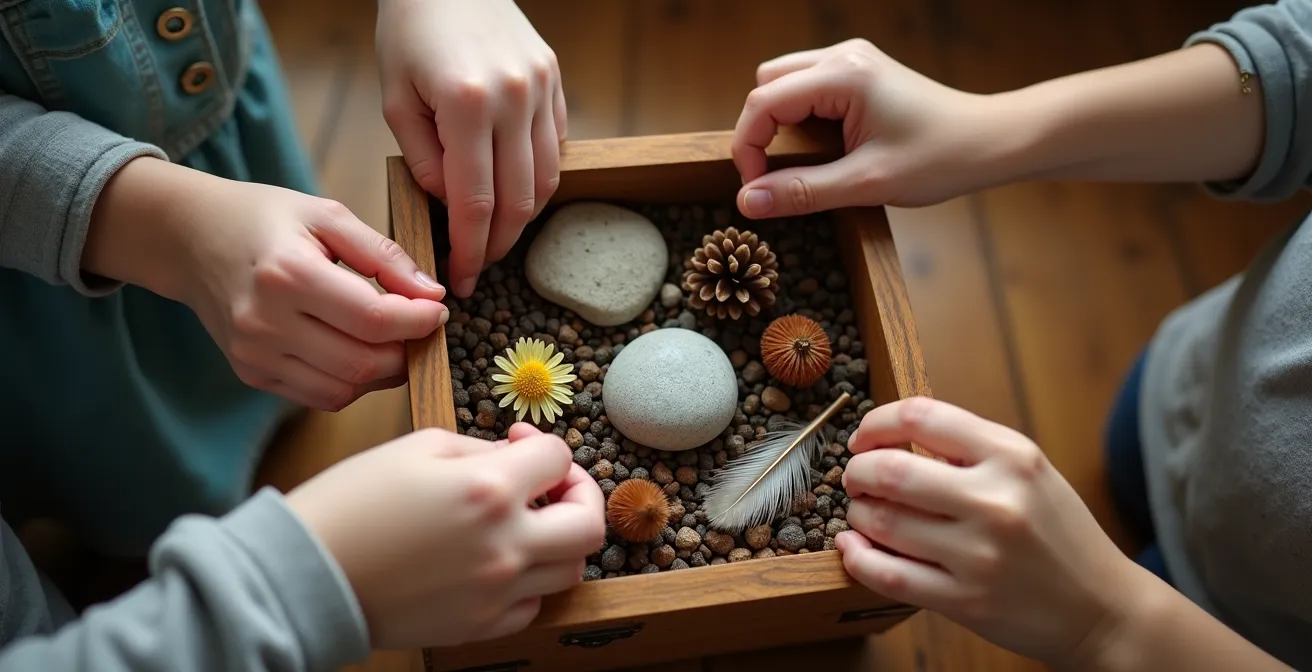
As you can see, the focus is on the textures and stories behind each object—the pressed wildflower, the unique pine cone, the feather. Each item becomes a chapter in your family’s story, a physical touchstone for a happy memory. This ritual solidifies the trip’s positive impact and provides an ongoing source of joy, ensuring the ROE continues to grow long after the tents are packed away.
Photos or Journaling: Which Is the Best Way to Document Your Trip?
When measuring the ROE of a trip, documentation is crucial. It’s the process by which fleeting moments are converted into lasting assets. However, parents often wonder which method is superior: the instant visual capture of photography or the deep reflection of journaling? The answer is that they serve different, equally important functions in building your family’s emotional portfolio. One is not better than the other; they simply measure different aspects of the experience. Photography is excellent for capturing “public ROE”—shareable, joyful moments—while journaling is the primary tool for understanding “private ROE”—individual growth, emotional processing, and personal insights.
Choosing the right tool depends on the moment you want to preserve. A stunning group photo at a viewpoint captures a collective peak experience. A journal entry, on the other hand, can capture the quiet gratitude felt while watching your children work together to build a fire, or the personal challenge of overcoming a fear of the dark. A complete emotional record often uses a hybrid approach, combining quick snapshots with brief written or even audio-recorded reflections. This creates a multi-sensory and emotionally rich archive of the trip.
To help you decide which method to use, it’s useful to compare their strengths and purposes. The following table, based on insights about camp experiences, breaks down the key differences, helping you build a more complete ROE portfolio. According to an analysis of camp impact studies, a mix of documentation methods leads to a richer post-camp reflection.
| Method | Strengths | Best For | Time Required |
|---|---|---|---|
| Photos | Instant capture, visual memories, easy sharing | Public ROE, group moments | Seconds per capture |
| Journaling | Deep reflection, emotional processing, private thoughts | Private ROE, individual growth | 10-15 minutes daily |
| Audio Recording | Captures ambient sounds, emotions in voice | Sensory memories | 30 seconds – 2 minutes |
| Hybrid Method | Complete emotional record, multi-sensory | Full ROE portfolio | 5-10 minutes combined |
Ultimately, a balanced approach yields the highest emotional return. Encourage family members to use the method they feel most comfortable with. A teen might prefer taking photos, while a younger child might enjoy drawing their favorite moment. The collective result is a richer, more nuanced story of your time together.
The “Day 3 Argument”: Why It Happens and How to Move Past It?
Almost every family that camps recognizes it: the “Day 3 Argument.” It’s that point in the trip when patience wears thin, the novelty has faded, and minor irritations suddenly flare into a full-blown conflict. For many parents, this feels like a major failure—a sign the trip isn’t working. However, from a happiness research perspective, this moment is not only predictable but essential. It’s a critical juncture where a trip’s ROE can either plummet or skyrocket. The argument happens because Day 3 is often when the family has fully detached from home routines but has not yet settled into the new rhythm of outdoor life. It’s a liminal space of discomfort, and that discomfort is a catalyst for change.
The key is to reframe this conflict not as a problem, but as an opportunity. It’s the moment the family is forced to stop operating on autopilot and start actively communicating and problem-solving together. Shared challenges are the forge in which family bonds are strengthened. As one expert in therapeutic communities explains, these moments are the very purpose of a trip like this. As noted by Dr. R. Morrow in Therapeutic Communities: The International Journal:
Camping is a tool for relationship maintenance. The shared challenge of outdoor living creates opportunities for families to work through difficulties together, strengthening their bonds through resolution rather than avoidance.
– Dr. R. Morrow, Therapeutic Communities: The International Journal
Moving past the argument successfully requires having a plan in place *before* it happens. By anticipating the tension, you can equip your family with the tools to navigate it constructively. This turns a potential disaster into a powerful lesson in emotional regulation and resilience, dramatically increasing the trip’s long-term ROE.
Your Action Plan: Conflict Resolution Strategies for Camping
- Establish a family ‘safe word’ before the trip that anyone can use to pause escalating tensions.
- Create a ‘cooling off’ protocol—take a 10-minute solo walk when tensions rise.
- Schedule regular check-ins where each person shares one challenge and one joy.
- Use the ‘sandwich method’ for addressing issues: appreciation-concern-appreciation.
- Implement a rotating ‘decision maker’ role so everyone feels heard and empowered.
Why You Should Book Next Year’s Trip While You Are Still on the Campsite?
It might seem counterintuitive, but one of the most effective ways to maximize the ROE of your current trip is to start planning the next one. The final days at a campsite are often a period of peak positive emotion. The initial challenges have been overcome, the family has found its rhythm, and everyone is enjoying the fruits of their collective effort. Capitalizing on this emotional high by planning the next adventure is a powerful psychological strategy known as creating anticipatory joy.
Anticipatory joy is the happiness we derive from looking forward to a future event. Research shows that the period of anticipation can be one of the most enjoyable parts of a vacation, sometimes even more so than the trip itself. By discussing and booking next year’s trip while still basking in the glow of the current one, you effectively extend the emotional benefits. Instead of the trip ending with a sense of finality and a return to the mundane, it concludes with a new promise of future fun and connection. This bridges the gap between holidays and mitigates the post-camping comedown.
This on-site planning session also serves as a real-time review of what worked and what didn’t. It’s the perfect moment to discuss as a family what everyone loved about the current campsite, what kind of activities they’d like to try next, and what they’d do differently. This collaborative process empowers every family member and ensures the next trip is even more tailored to everyone’s desires, further boosting its potential ROE.
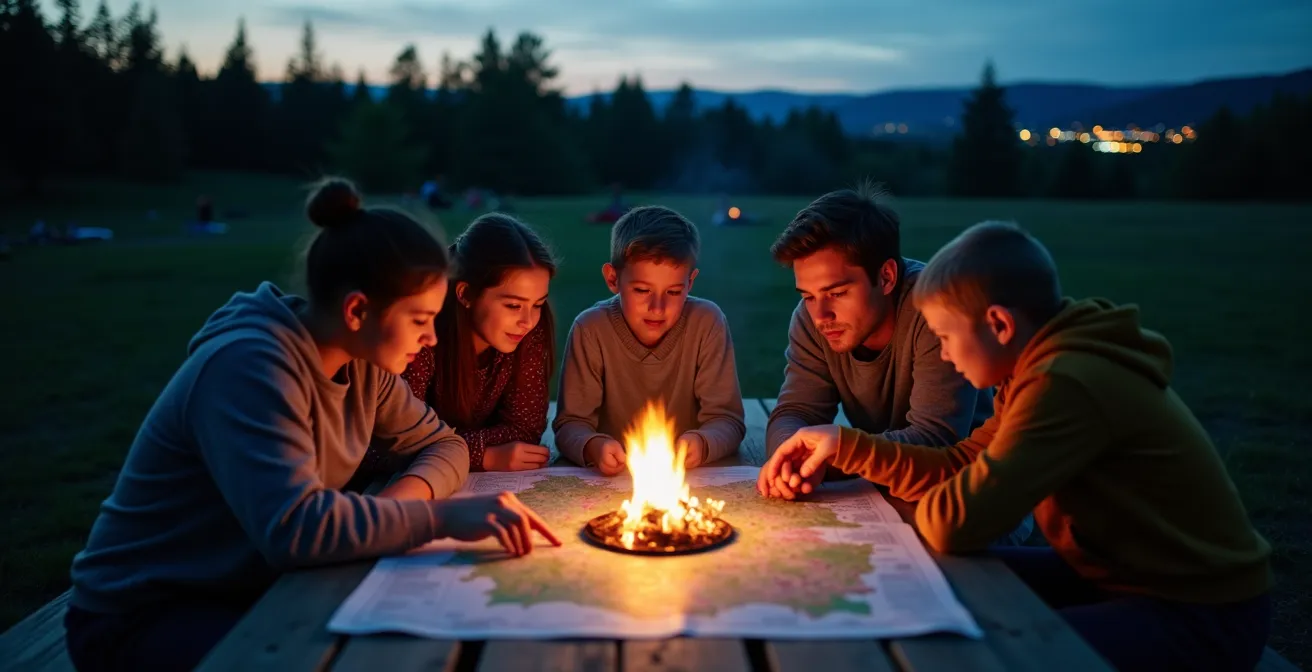
Gathering around the campfire with a map isn’t just about logistics; it’s a ritual that transforms the end of one adventure into the beginning of the next. It cements the positive feelings of the present moment and projects them into the future, creating a continuous cycle of positive family experiences.
Board Games vs Screens: How to Rebuild Family Bonds in 7 Days?
In our hyper-connected world, one of camping’s most significant contributions to family ROE is the forced digital detox. Removing screens from the equation eliminates a primary source of distraction and isolation, creating a vacuum that must be filled with something else: each other. This is where the humble board game, card deck, or campfire story becomes an invaluable tool for rebuilding bonds. These analog activities require eye contact, shared rules, friendly competition, and direct communication—the very building blocks of strong relationships.
The absence of digital entertainment forces a level of engagement that is rare in everyday life. It prompts conversations that wouldn’t otherwise happen and encourages creative, collaborative play. This structured, face-to-face interaction is not just fun; it’s therapeutic. In fact, the environment itself is conducive to this process. Sheffield Hallam University research found that 88% of campers report that camping is a great way to de-stress and escape the pressures of everyday life. By removing the primary stressor of constant digital notifications, you create the ideal conditions for connection to flourish.
Case Study: The Impact of Screen-Free Family Bonding
Research analyzing the effects of removing digital distractions during camping consistently shows a marked improvement in face-to-face family interaction. Families who limit technology report having deeper, more meaningful conversations, engaging in more creative play, and forging stronger emotional connections. The absence of screens compels family members to engage directly with one another, leading to the development of healthier communication patterns that often persist even after they return home. The shared focus required by a board game or a group storytelling session becomes a practical exercise in re-establishing connection.
A seven-day camping trip provides a unique opportunity to reset your family’s communication defaults. The first few days might feel awkward as everyone adjusts, but by the end of the week, you’ll notice a natural shift towards more direct interaction, shared laughter, and a renewed sense of togetherness. This rebuilt bond is one of the most durable and valuable returns you can get from your emotional investment in the trip.
The “No TV” Surprise: How to Prepare Teens for Low-Tech Accommodation?
For parents of teenagers, the idea of a “no-tech” or “low-tech” camping trip can be a source of major anxiety. The “No TV” surprise can feel like a punishment to a teen, leading to resistance and a negative start to the trip, which can severely damage your potential ROE. The key to a successful low-tech trip with teens is not to spring it on them, but to frame it as an opportunity for empowerment and to manage the transition carefully. The goal is to get their buy-in by shifting the focus from what they are *losing* (constant connectivity) to what they are *gaining* (new skills, responsibility, and a different kind of fun).
Preparation is everything. Start the conversation weeks before the trip, gradually reducing screen time to ease the shock to their system. Most importantly, give them a genuine stake in the trip’s success by assigning them meaningful roles. A teen who is designated as the “Fire Master” or “Navigation Chief” has a sense of purpose and importance that transcends the need for digital validation. When they are participants in creating the experience, they are far less likely to feel like passive observers being dragged along. This strategy of involvement fosters a sense of competence and contribution, two powerful drivers of self-esteem and happiness.
Instead of banning technology outright, which can feel punitive, create a structured plan for its limited use. Allowing a daily “photo hour” gives them an outlet to document their experience in a way that feels natural to them, while still preserving the largely screen-free environment. Planning one activity per day that is entirely their choice also ensures they feel heard and respected. By involving them in the planning and execution, you transform the digital detox from a restriction into a shared challenge, increasing their personal ROE and, by extension, the entire family’s.
Key Takeaways
- Measuring “Return on Emotion” (ROE) provides a deeper, more meaningful way to assess a trip’s value beyond superficial metrics.
- Challenges like bad weather and family arguments are not failures, but crucial opportunities to build resilience and strengthen bonds.
- Proactive planning, from choosing the right pitch to preparing teens for a digital detox, is essential for maximizing positive emotional outcomes.
Map Reading: Why Choosing Your Exact Pitch Number Matters?
After exploring the psychological and emotional components of a successful trip, the final piece of the ROE puzzle is intensely practical: your physical location. It may seem like a minor detail, but choosing your exact pitch number by carefully reading the campsite map can have an outsized impact on your family’s comfort, safety, and overall happiness. This single decision affects everything from your quality of sleep to your level of privacy and convenience. It is the physical foundation upon which your emotional experience is built. A poorly chosen site can introduce a constant stream of low-level stressors that slowly erode your ROE.
The perfect pitch is a balance between “prospect” (good views, open space) and “refuge” (privacy, shelter from wind or sun). A site right next to the restrooms might seem convenient for families with small children, but the constant foot traffic and noise can be disruptive. A beautiful, isolated spot might offer great views but could be a long, dark walk from facilities at night. Reading the map allows you to strategically place your family in a location that minimizes friction and maximizes comfort. Consider factors like proximity to playgrounds, distance from high-traffic paths, the direction of the morning sun for drying gear, and the availability of afternoon shade for cooling down.
Study: The Impact of Campsite Selection on Satisfaction
An analysis of family camping experiences by KOA highlights this point perfectly. The study revealed that families who took the time to carefully select their campsite based on factors like shade, privacy, and proximity to facilities reported 40% higher satisfaction rates compared to those who were randomly assigned a spot. This demonstrates a direct, measurable link between a simple planning action and the overall emotional outcome of the trip. Choosing the right pitch is a low-effort, high-reward investment in your family’s happiness.
Taking ten minutes to study the campsite map before booking is one of the highest-leverage activities you can do to ensure a positive ROE. It’s a tangible action that addresses dozens of potential future problems, leaving you and your family free to focus on what truly matters: connecting with each other and the outdoors.
To fully embrace this framework, the next step is to start applying this “Return on Emotion” lens to your own family adventures, transforming how you plan, experience, and remember your precious time together.
Frequently Asked Questions on How to Measure the “Return on Emotion” of a Family Camping Trip?
What’s the ideal distance from facilities for families with young children?
The ideal spot is within 50-100 meters of the restrooms. This is close enough for quick, easy trips, especially at night, but not directly adjacent, which helps you avoid the noise and light from constant foot traffic.
Should we prioritize morning sun or afternoon shade?
For optimal comfort, aim for a balance of both. Morning sun is incredibly helpful for drying out dew-covered gear and warming up the tent, which boosts everyone’s mood. However, afternoon shade is crucial for providing a comfortable retreat from the peak heat of the day.
How important is the pitch’s ground condition?
The ground condition is critical for a good night’s sleep and overall comfort. Look for a pitch that is as level as possible to avoid sliding around in your sleep. A slight elevation is also beneficial as it helps prevent water from pooling under your tent if it rains. Finally, a grassy surface provides natural cushioning and is much more pleasant than bare dirt or gravel.