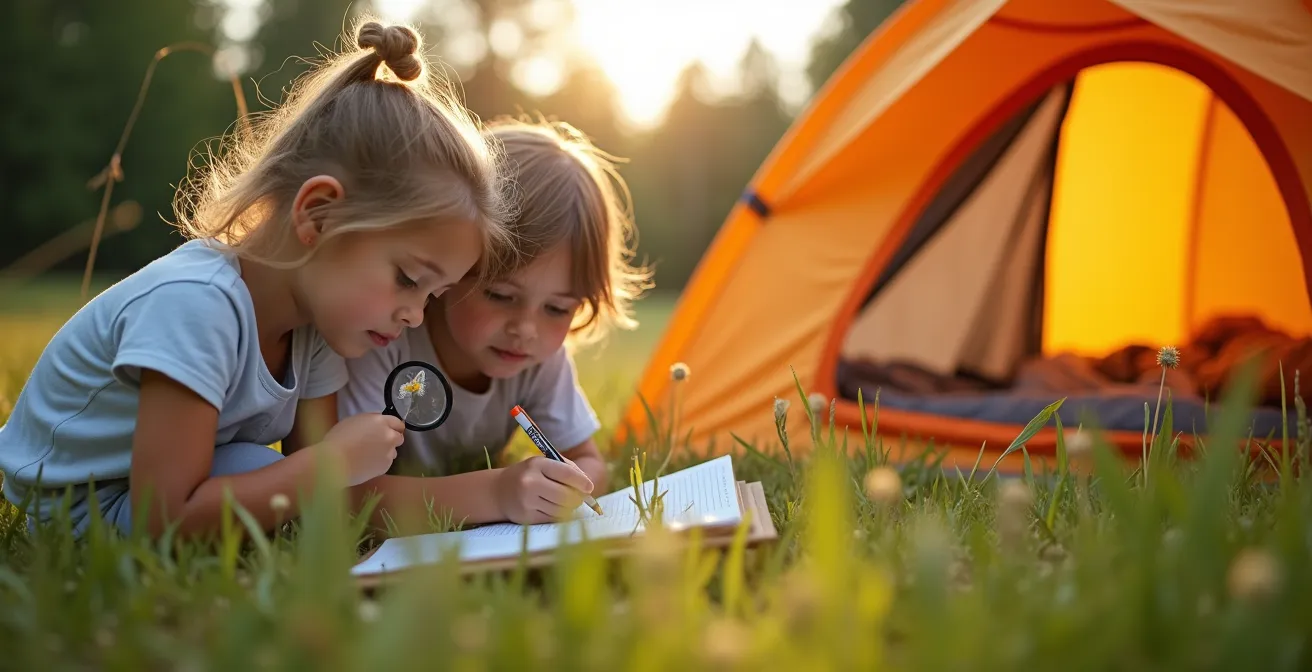
Your campsite is more than just a patch of land; it’s a bustling miniature ecosystem waiting to be explored. This guide transforms the classic camping trip by turning parents and children into ‘Campsite Scientists.’ Instead of generic nature walks, you’ll learn to decode the secret lives of insects, plants, and animals right under your feet. By framing observation as a series of fun detective missions and science experiments, you can teach biology and environmental respect without it ever feeling like a lesson.
The familiar call of “I’m bored!” can quickly interrupt the peace of a family camping trip. We often respond by suggesting a “nature walk,” hoping the scenery will be enough. While well-intentioned, this approach often misses the incredible drama unfolding at a much smaller scale. We see trees, but overlook the complex community of lichens painting their bark. We notice a buzzing insect, but don’t know the fascinating story behind its flight path. The usual advice encourages us to look *at* nature, but rarely teaches us how to *read* it.
But what if the key wasn’t to find a more impressive landscape, but to look at your own campsite with a completely new set of eyes? What if that patch of grass, that buzzing wasp, and those ordinary-looking rocks were clues in a grand natural mystery? This is the core idea of becoming a Campsite Scientist. It’s about shifting perspective from passive sightseeing to active, fun investigation. It’s about realizing your tent is pitched in the middle of a living laboratory, full of amazing stories.
This guide will equip you with a series of “missions” and “experiments” to do just that. We will explore how to turn fear of insects into scientific curiosity, understand the vital role of “messy” nature, become nocturnal detectives, and even contribute to real scientific research. You’ll discover how to teach the profound concept of respect for wildlife not through lectures, but through engaging games that reveal the “job” of every creature. Get ready to transform your next camping trip into an unforgettable bio-discovery adventure.
This article provides a structured path to becoming a family of campsite scientists. Each section is a self-contained “mission” you can embark on, from identifying insects safely to understanding the secret language of the forest at night.
Summary: Your Guide to Becoming a Family of Campsite Scientists
- Hornet or Mammoth Wasp: How to Tell the Difference and Stay Calm?
- Why High Grass in Your Campsite Is a Good Sign, Not Lazy Maintenance
- Hedgehogs and Owls: How to Observe Night Wildlife Without Scaring Them?
- Tiger Mosquitoes: What Really Works to Repel Them in Southern France?
- September Migration: Which Campsites Are on the Flight Path of Storks?
- How to Teach Your Kids Respect for Wildlife Without Being Boring?
- How to Explain the Chaos of Rocks to Your Curious Kids?
- Why Choosing a Campsite in Preserved Nature Reduces Stress Levels?
Hornet or Mammoth Wasp: How to Tell the Difference and Stay Calm?
A loud buzzing near the tent can spark immediate panic. Our first instinct is often to swat or run, teaching kids that these creatures are simply dangerous pests. But for a Campsite Scientist, this is a perfect first mission: turning fear into fascination through careful observation. Understanding the difference between a potentially aggressive hornet and a gentle giant like the mammoth wasp is a powerful lesson in looking closer before reacting. After all, stinging insects are a real concern, with pest education statistics showing they send more than 500,000 people to the emergency room each year in the US alone. Knowing who’s who is step one to staying safe.
The key is to treat them not as threats, but as subjects of study. Hornets, like the European hornet, are social insects that will defend their nest aggressively. They often build paper-like nests in hollow trees or eaves. The mammoth wasp, despite its intimidating size, is a solitary, non-aggressive pollinator. It’s a beneficial insect that hunts beetle grubs in lawns, helping to control pest populations. Teaching your child to spot the differences—the hornet’s smooth, shiny body versus the mammoth wasp’s fuzzy appearance—is a real-life biology lesson that empowers them with knowledge instead of fear.
Your Field ID Guide: Wasp or Hornet?
- Observation Post: Stand still and observe from a safe distance (at least 3-5 metres). Remind your kids that most wasps only sting if they or their nest is threatened.
- Analyse Surface Texture: Is the insect’s body hairy and fuzzy, or smooth and shiny? Mammoth wasps are notably hairy, while hornets appear sleek.
- Track Flight Patterns: Does it fly low over the grass, almost hovering? That’s likely a mammoth wasp hunting. Hornets tend to fly higher and more directly, often around food, trash, or their nest.
- Check Operational Hours: Is it flying at night, attracted to your lantern? The European hornet is unique among its relatives for being active after dark.
- Locate Home Base: If you can spot its home, is it in a high place like a tree hollow or building? That’s a hornet nest. Mammoth wasps are ground-nesters, burrowing underground.
By reframing this common campsite encounter, you replace a moment of panic with a lesson in insect identification, behaviour, and the importance of looking closely. This is the first step in your bio-discovery journey.
Why High Grass in Your Campsite Is a Good Sign, Not Lazy Maintenance
A perfectly manicured lawn might look neat, but in ecological terms, it’s often a desert. When you arrive at a campsite and see areas of long, wild-looking grass, don’t mistake it for neglect. As a Campsite Scientist, you should see it for what it is: a bustling, high-rise apartment complex for countless creatures. This “untidy” patch is a sign of a healthy, functioning micro-ecosystem, and it’s your next destination for a micro-safari.
Each layer of the tall grass provides a different habitat. Down at the soil level, beetles and other decomposers are at work, while small mammals like voles create hidden runways. Move up the stalk, and you’ll find spiders weaving intricate webs, serving as a natural form of pest control. At the very top, in the “penthouse” layer, you’ll see butterflies, bees, and grasshoppers interacting with the seed heads and flowers. This vertical world is a fantastic, living illustration of how different species coexist and depend on each other.

This isn’t just a nice theory; it’s a proven conservation strategy. The biodiversity plan for Green Sheep Camping in Wales, for example, highlights how maintaining species-rich hay meadows alongside camping areas supports a vast array of life, including rare plants and vital invertebrates. By leaving grass to grow, campsite owners create a refuge that is far more vibrant and ecologically valuable than any sterile, close-cropped lawn. Explain to your kids that this isn’t a mess; it’s a wilderness in miniature, and their mission is to document its inhabitants.
So next time you see a patch of tall grass, grab a magnifying glass. Challenge your kids to gently part the stems and count how many different kinds of life they can find. You’ll be amazed at the bustling city you’ve been camping next to all along.
Hedgehogs and Owls: How to Observe Night Wildlife Without Scaring Them?
When the sun goes down, a whole new shift of workers clocks in at the campsite. The daytime birds and butterflies are replaced by the rustles, snuffles, and hoots of nocturnal animals. For your young Campsite Scientists, nighttime offers a thrilling new dimension of discovery. The challenge isn’t just seeing these creatures, but learning how to observe them quietly and respectfully. The goal is to be a ghost: present, but unnoticed.
Your most powerful tool for this mission is not your eyes, but your ears. Before you even start looking, sit quietly for five minutes and just listen. Help your kids identify the different sounds. Is that a low, grunting snuffle? Probably a hedgehog foraging for worms. A classic “hoot-hoot-hoooo”? That’s a tawny owl. This “sound mapping” is a fun, sensory way to build a mental picture of the nightlife around you. When you do use a light, avoid bright white flashlights, which can blind and distress nocturnal animals. Instead, use a flashlight with a red filter or a red-light mode. Wildlife experts explain that using red flashlights makes observers virtually invisible because many nocturnal animals lack the eye receptors to see red light, allowing you to watch their natural behaviour undisturbed.
The next morning, the detective work continues. You can become “Nature Forensics” investigators, searching for the evidence left behind by the night shift. Look for hedgehog droppings (dark, shiny cylinders often full of beetle wings) or the tell-tale “whitewash” marks on tree trunks below an owl’s favourite perch. The most exciting find of all is an owl pellet—a grey, compacted bundle of fur and bone that the owl regurgitates. Carefully dissecting one with tweezers (and gloves!) is like reverse-engineering the owl’s dinner, revealing exactly what it ate. This is a hands-on biology lesson that kids find unforgettable.
| Sound Type | Likely Source | Direction Tips | Time Most Active |
|---|---|---|---|
| Snuffling/grunting | Hedgehog foraging | Low to ground, moving slowly | Dusk to midnight |
| Hoot-hoot-hoooo | Tawny owl calling | High in trees, stationary | All night, peaks at dusk |
| Screeching shriek | Barn owl | Flying overhead | Early evening |
| Rustling leaves | Small mammals | Ground level, quick movements | Throughout night |
This two-part mission teaches not only about specific animals but also the importance of quiet observation, indirect evidence, and the interconnectedness of the food web.
Tiger Mosquitoes: What Really Works to Repel Them in Southern France?
Few things can ruin a camping evening faster than the persistent whine of a mosquito. In some regions, like Southern France, the day-biting tiger mosquito is a particular nuisance. The typical response is to douse everyone in chemical repellents, but the Campsite Scientist has a better, more empowering approach: becoming a “Water Detective.” This mission teaches kids that the most effective way to deal with mosquitoes is to outsmart them by eliminating their breeding grounds.
The key to this mission is understanding the mosquito life cycle. Tiger mosquitoes can breed in an astonishingly small amount of stagnant water—as little as a bottle cap’s worth! This is your critical clue. Your family’s mission is to conduct a systematic sweep of the campsite to find and eliminate all potential mosquito nurseries. Frame it as a detective game. Equip your kids with a “case file” (a notebook) to log every discovery. Look for water collected in tarps, forgotten toys, plant pot saucers, clogged gutters on the campervan, or even inside the holes of tent stakes. A case study on mosquito prevention showed that this simple, systematic removal of standing water can reduce local mosquito populations by up to 80% without any chemicals.
While the tiger mosquito is a well-known issue in specific areas like the Mediterranean, the principle of this Water Detective mission is universal. All mosquitoes need water to breed, so this strategy works anywhere in the world. You can also turn repellent into an experiment. Set up a few cotton balls soaked in different natural oils (citronella, lavender, lemon eucalyptus) and have your kids observe which one mosquitoes avoid the most. They can record their findings like a real entomologist, learning about scientific controls and observation. This turns a passive defence into an active, engaging investigation into what really works.
By transforming pest control into a detective mission, you empower your children with problem-solving skills and a deeper understanding of cause and effect in the natural world.
September Migration: Which Campsites Are on the Flight Path of Storks?
So far, our bio-discovery has focused on the ground and the bushes. Now, it’s time to look up. In late summer and early autumn, the skies above many European campsites become invisible highways for migrating birds. For a Campsite Scientist, this is a chance to connect your small patch of land to a massive, global phenomenon. The annual migration of the white stork is one of nature’s most spectacular events.
The scale of this journey is immense. Conservation monitoring shows that over 500,000 white storks journey from their European breeding grounds to Africa each autumn. Many campsites, particularly in France, Spain, and across Central Europe, lie directly on these ancient flight paths. Witnessing huge flocks, or “kettles,” of storks spiralling upwards on thermal air currents is an unforgettable sight. Explain to your kids that these birds are elite athletes on an epic journey, and your campsite is one of their rest stops or flyover points.
This is the perfect opportunity to introduce the concept of citizen science. Your family’s observations can actually contribute to real scientific research. Before your trip, download an app like eBird or iNaturalist. Teach your kids to identify a white stork: they are large, mostly white birds with black wingtips and long red legs and beaks. When you spot them, your mission is to become a field biologist. Record the date, time, weather, number of birds, and their flight direction. By submitting this data, you are helping scientists track migration routes, monitor population health, and understand the effects of climate change. This transforms your kids from simple spectators into active participants in conservation.
The best times for observation are in the morning (around 8-10 am) when they use rising warm air to gain height, and in the late afternoon as they search for a place to roost for the night. This mission connects your local campsite experience to a global ecological story, showing that even small observations can have a big impact.
It’s a profound lesson in how interconnected our world is, and how science relies on the contributions of curious people everywhere—including right at your campsite.
How to Teach Your Kids Respect for Wildlife Without Being Boring?
The most important rule in nature is “leave no trace,” and the most important lesson is respect. But simply telling a child “be respectful” is an abstract concept. The Campsite Scientist approach makes this lesson tangible, fun, and memorable by revealing the “why” behind the rule. Instead of a lecture, you can play a game: the “Ecosystem Job Fair.”
The premise is simple: every plant, animal, and fungus at the campsite has a crucial job to do. Your mission is to explore the area and “interview” them to find out what their job is. When you find an earthworm, you’ve met the ‘Soil Engineer,’ whose tunnels bring air and water deep into the ground. A spider is not a scary bug, but a highly skilled ‘Pest Control Technician’ protecting the area from being overrun with flies. The mushrooms on a fallen log are the ‘Recycling Managers,’ breaking down dead wood to create new soil. The bee buzzing on a flower is a ‘Pollination Specialist,’ the essential link for helping plants make seeds. This game of personification helps children understand that every living thing has a purpose.
Case Study: The “CSI: Campsite” Investigation
Another powerful method is framing observation as a detective mystery. Scout groups have found that framing nature walks as a “CSI: Campsite” investigation can increase kid’s engagement by a staggering 75%. In these activities, kids aren’t just looking at leaves; they’re solving a ‘crime’. They learn to tell the difference between the irregular chew marks left by a caterpillar and the holes with tell-tale slime trails left by a snail. This turns a simple observation into an exciting puzzle that teaches ecological relationships and sharpens their attention to detail.
By playing these games, respect stops being a command and becomes a logical conclusion. You don’t step on a spider because you understand it’s doing an important job. You don’t pull mushrooms off a log because you know they are the cleanup crew. This approach fosters a deep, intuitive respect born from understanding, not from rules. It’s the difference between being told not to touch something in a museum and understanding the delicate history that makes it so valuable.
This shift in perspective is the ultimate goal of the bio-discovery trip: to cultivate a generation of young scientists who see the value and purpose in every living thing.
How to Explain the Chaos of Rocks to Your Curious Kids?
After exploring the living world, it’s time to turn your attention to the ground beneath your feet. To a child, the jumble of rocks around a campsite might just look like… well, a jumble of rocks. But to a Campsite Scientist, this is a geology lab and a history book rolled into one. The mission here is to reveal that rocks aren’t just lifeless objects; they are the foundation of the entire ecosystem and each one has a story to tell.
The first step is to set up a “Rock Sorting Laboratory.” Give your kids an empty egg carton and challenge them to collect 10-15 different-looking rocks—no two the same. Back at your “lab” (the picnic table), the experiments begin. You can test their properties just like a real geologist. Try a ‘Float vs. Sink’ test in a bucket of water. Conduct a ‘scratch test’ to see which rocks are harder than others. Group them by texture: are they smooth and rounded from being worn down by water, or rough and sharp from a recent break? This hands-on activity transforms a random collection into a classified, ordered scientific sample, teaching concepts of density, hardness, and erosion.
The next level of discovery is to see rocks not just as objects, but as habitats. Flip over a medium-sized rock (carefully!) and see what lies beneath. This cool, damp environment is a vital shelter for worms, slugs, and insects. Look closely at the rock’s surface. Those colourful, crusty patches are lichen, a fascinating symbiotic organism that is a ‘pioneer painter,’ slowly breaking down the rock surface to create the very first bits of soil. Environmental education programs have shown this perspective shift is powerful; one study found a single campsite rock could host multiple lichen and moss species, turning it from a dead stone into a ‘micro-habitat’ in a child’s eyes.
You can explain that every grain of sand on the ground was once part of a big rock, worn down over millions of years. This connects the small pebbles in their hands to the huge mountains on the horizon, teaching a profound lesson about time, change, and the creation of the very soil that makes life possible.
This geological mission teaches kids to see the deep history and foundational importance of the seemingly static world beneath their feet.
Key Takeaways
- Your campsite is a living laboratory; the goal is to shift from passive looking to active, fun investigation.
- Framing observation as a “detective mission” or “science experiment” is the key to engaging kids without being boring.
- True respect for nature grows from understanding the “job” or purpose of every creature and plant, not from memorizing rules.
Why Choosing a Campsite in Preserved Nature Reduces Stress Levels?
After missions involving insects, nocturnal animals, and even rocks, it’s worth asking: what’s the ultimate benefit of all this focused attention on nature? The final mission for our Campsite Scientists is perhaps the most subtle but most impactful: measuring the peace and quiet of the natural world. Choosing a campsite nestled in a preserved, biodiverse environment isn’t just better for wildlife; it’s measurably better for our own minds. This section explores why, and gives you a tool to prove it.
Scientists call the collection of natural sounds—birdsong, wind in the trees, flowing water—biophony. They call the sounds of human activity—traffic, planes, distant machinery—anthropophony. Our brains are hardwired to relax in environments dominated by biophony. These natural soundscapes lower our heart rate, reduce stress hormones, and restore our ability to focus. A campsite with high grass, old trees, and a nearby stream isn’t just a prettier place; it’s a more restorative acoustic environment.
You can turn this concept into a final, simple family activity: the “Family Soundscape Challenge.” Find a comfortable spot, have everyone close their eyes, and set a timer for two minutes. The challenge is to count every distinct sound you hear and classify it. How many natural sounds (birds, insects, wind) did you hear? How many human-made sounds (cars, voices)? You can then calculate your campsite’s “relaxation ratio” by dividing the number of natural sounds by the total number of sounds. A higher ratio indicates a more immersive, stress-reducing natural setting. This simple experiment makes the abstract concept of “peace and quiet” tangible and measurable, proving the value of choosing a campsite rich in nature.
By the end of your bio-discovery trip, your family will not only have a deeper knowledge of the world around you but also a profound, firsthand experience of how a connection with that world can restore your own sense of calm and wonder. Start by trying just one of these missions on your next trip; you’ll be amazed at the world you uncover.