Drinking a Grand Cru from a plastic cup isn’t the sin; the real crime is letting it get ruined by temperature shock and travel trauma before it’s even opened.
- Temperature stability and a post-travel “recovery” period are far more critical to a wine’s integrity than the vessel it’s served in.
- Creative “campsite decanting” techniques and smart transport packing can preserve a fine wine’s complex bouquet and structure, even in the wild.
Recommendation: Focus on mastering the logistics of the bottle’s journey. Protect it from heat and vibration, and the final experience—even in a modern tumbler—will be profoundly rewarding.
The scene is familiar to any camping-adjacent oenophile. There’s the gentle hum of nature, the crackle of a nascent campfire, and the horrifying clink of a precious, carefully-selected bottle of wine against a cast-iron skillet in the packing box. A cold sweat breaks. Is this whole endeavour a fool’s errand? The common wisdom is clear: stick to screw-top rosés and robust boxed reds. They are the sensible, unbreakable, and frankly, uninspiring choice for the great outdoors.
This advice is practical, but it misses the point entirely. The goal isn’t just to have *some* wine; it’s to elevate a moment. It’s about uncorking a story, a specific terroir, a memory, under a canopy of stars. But what if the central conflict of this story isn’t “crystal glass versus plastic cup”? What if the real sacrilege happens long before the wine is poured? The true art of enjoying fine wine while camping lies not in recreating a formal dining room, but in mastering the hostile environment of the journey itself.
The real enemies of a Grand Cru are not your fellow campers’ judgments, but the brutal trinity of temperature shock, travel vibration, and premature oxidation. The plastic cup is merely a red herring. By focusing on protecting the wine’s integrity from the moment it leaves the cellar to the moment it’s poured, you can achieve a sublime tasting experience, regardless of the stemware. It’s about being a pragmatic snob, not a dogmatic one.
This guide will navigate the logistical challenges of bringing your best bottles into the wild. We will explore how to shield your wine from its environment, the art of campsite aeration, and why the final night of your trip is the perfect stage for your liquid masterpiece. Forget the guilt; let’s get practical.
To help you navigate these vinous challenges, this article breaks down the essential strategies for preserving your fine wine on the road. The following summary outlines the key topics we will cover.
Summary: Is It Worth Buying Grand Cru Wine to Drink in a Plastic Cup?
- Temperature Shock: How to Keep a Grand Cru Stable in a Mobile Home?
- Stemware Survival: Should You Bring Your Own Crystal Glasses?
- Breathing Time: How to Aerate a Bold Red Without a Decanter?
- Buying at the Estate: Is It Cheaper Than at Your Local Merchant?
- Special Occasions: Why You Should Save the Grand Cru for the Last Night?
- White or Red: Which Loire Wines Survive a Hot Car Journey Best?
- How to Transport 12 Bottles of Wine in a Campervan Without Breakage?
- Why a Wine Tasting Workshop Is the Best Rainy Day Activity?
Temperature Shock: How to Keep a Grand Cru Stable in a Mobile Home?
The single greatest threat to your fine wine is not a bumpy road, but a fluctuating thermometer. A mobile home or car can become an oven on wheels, inflicting irreversible damage. In fact, shipping studies show wine encounters extreme temperatures ranging from 4-44°C (39-111°F) during transport. Above a certain point, the wine literally begins to cook, flattening its delicate aromas into a stewed, jammy mess and potentially pushing the cork out, causing oxidation. Your mission is to create a bubble of thermal stability.
The ideal ‘comfort zone’ for wine preservation is a steady 10-20°C (50-68°F). While a powered cooler is the gold standard, you can create a “makeshift cellar” even without electricity. The lowest, most central part of your campervan or car is typically the coolest. Wrap your bottles in towels or sleeping bags for insulation. For extreme heat, a surprisingly effective low-tech solution is wrapping a bottle in a wet towel; as the water evaporates, it dramatically cools the glass. This simple trick can be a lifesaver for a prized bottle of white Burgundy on a hot afternoon.
Equally important is allowing the wine to recover from “bottle shock”—the temporary dulling of flavour caused by the vibrations of travel. A rest period of 24 to 72 hours is essential. Find the coolest, darkest, most stable cupboard in your mobile home, lay the bottles down, and let them be. This recovery phase allows the wine’s complex chemical compounds to settle and reintegrate, ensuring it shows its true character when you finally uncork it.
Stemware Survival: Should You Bring Your Own Crystal Glasses?
Let’s address the elephant in the room: the glassware. As a reformed snob, the thought of drinking a meticulously cellared wine from anything other than delicate, paper-thin crystal is initially appalling. The shape of a glass genuinely does influence the bouquet and the way wine hits your palate. However, bringing your Zaltos or Riedels camping is an invitation for heartbreak. The solution lies in the stemware compromise: finding the best possible vessel that won’t shatter into a thousand pieces on a gravel path.
Fortunately, modern materials have come to the rescue. High-quality, BPA-free plastics like Tritan and Polycarbonate offer remarkable clarity and a neutral taste profile, mimicking the experience of glass without the fragility. Stainless steel tumblers are another excellent, virtually indestructible option, with the added benefit of insulation to keep your whites chilled. While some purists detect a slight metallic note, for most, the temperature control advantage outweighs this minor drawback.
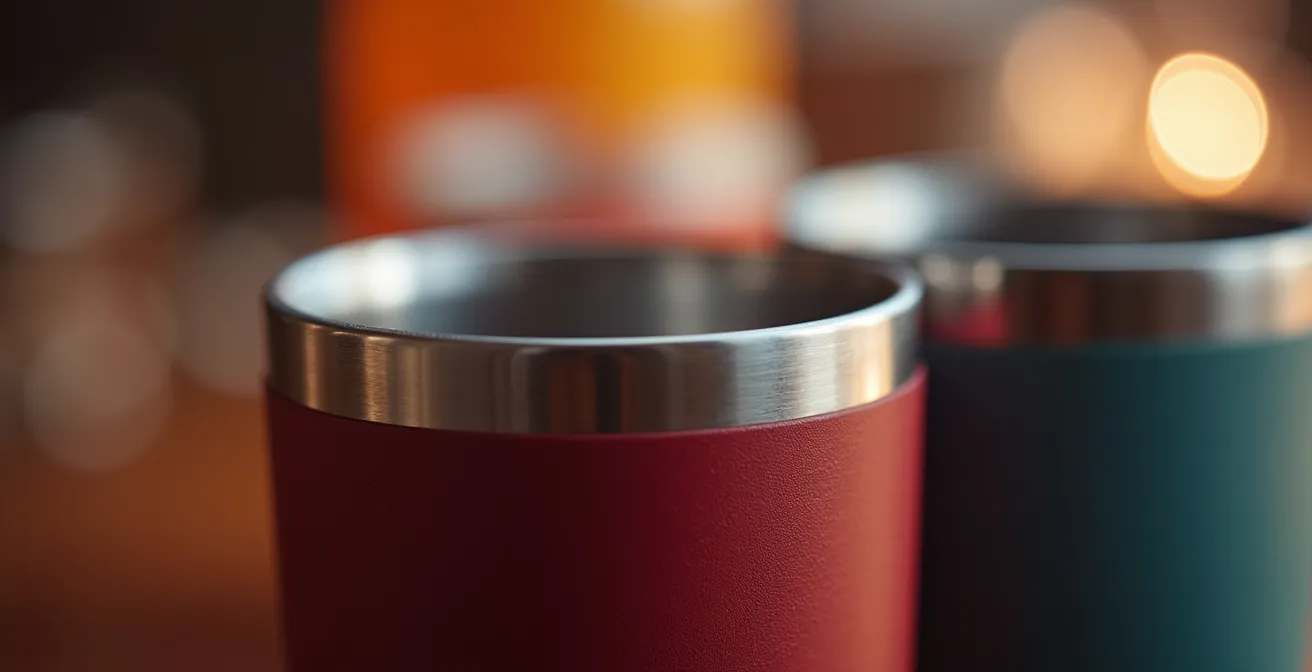
The following table, inspired by numerous product reviews and expert opinions, breaks down the pros and cons of the most common materials for outdoor wine enjoyment. It’s clear that while you sacrifice the delicate feel of crystal, you no longer have to resort to a red plastic party cup that imparts its own undesirable flavour.
| Material | Durability | Taste Impact | Weight | Best For |
|---|---|---|---|---|
| Tritan Plastic | Unbreakable | Neutral | Very Light | Active camping |
| Stainless Steel | Very High | Slight metallic note | Light | Temperature control |
| Polycarbonate | High | Minimal | Light | All-around use |
| Silicone | Flexible/Unbreakable | Neutral | Ultra-light | Backpacking |
Breathing Time: How to Aerate a Bold Red Without a Decanter?
You’ve successfully transported your bottle, let it rest, and chosen your unbreakable stemware. Now, you face the final hurdle for a big, tannic red: aeration. Decanting softens tannins and allows the wine’s bouquet to open up, a crucial step for a young Bordeaux or Barolo. Lugging a fragile glass decanter on a camping trip is, of course, out of the question. This is where you employ the art of campsite decanting.
The most effective and simplest method is the “double-bottle” technique. All you need is another clean, empty bottle (a water bottle will do in a pinch, provided it’s thoroughly rinsed and odour-free). Simply pour the wine into the empty bottle, then pour it back into its original bottle. This vigorous splash-decanting provides a powerful dose of oxygen, equivalent to an hour or more in a traditional decanter. For especially young, aggressive wines, you can repeat the process.
If you prefer a gentler approach or are dealing with an older, more delicate vintage, the “slow-breath” method works well. Just open the bottle a good two to three hours before you plan to drink it. This allows a slower, more controlled interaction with the air. While less dramatic, it’s often sufficient to coax the complexities out of the wine. Portable, in-bottle aerators are also an option, but use them with caution; they can be too aggressive for older wines, potentially stripping them of their subtle secondary and tertiary aromas.
- Double-bottle decant: Pour wine into a clean empty bottle, then back into the original for instant aeration.
- Slow-breath method: Open the bottle 2-3 hours before serving for gentle aeration.
- Repeat transfer: Use the bottle-to-bottle transfer technique twice for very young, tannic wines.
- Portable aerators: Consider for aggressive tannins, but avoid for delicate older vintages.
- Stable storage: Store the opened bottle in a stable, cool location while it breathes.
Buying at the Estate: Is It Cheaper Than at Your Local Merchant?
There’s an undeniable romance to buying wine directly from the estate where it was grown. You meet the winemaker, walk the vineyards, and leave with a case of liquid memories. It often feels like you’re getting a deal by cutting out the middleman. However, the sticker price at the cellar door is only part of the story. For the discerning buyer, the true metric is the “landed cost”—the final price after factoring in the significant expense and risk of getting it home safely.
As the Burgundy Wine Company notes, the best wines are more than just a beverage; they are a piece of history. In a list clarifying the classification, they state:
Grand Cru wines have historical importance. They’re vines that were known well before AOC regulations existed
– Burgundy Wine Company, List of Burgundy Grands Crus classification
Protecting such a wine requires more than just tucking it in your luggage. Professional shipping services are essential for maintaining provenance, but they come at a cost. This is where the local merchant often proves their value. They have absorbed the costs and risks of temperature-controlled shipping, insurance, and storage. While their shelf price may be higher than the estate’s, it might be lower than your final landed cost if you were to ship it yourself.
Case Study: The Hidden Costs of Estate Purchases
Professional wine shipping services highlight a common oversight among collectors. While estate purchases guarantee authenticity, the true “landed cost” must include specialized temperature-controlled transport at 55°F (13°C), comprehensive insurance, and potential damage risks. Many discover that their trusted local merchant’s price, which already includes professional handling and immediate availability, is often more economical than a “cheaper” estate purchase burdened by these necessary logistical costs.
Special Occasions: Why You Should Save the Grand Cru for the Last Night?
You’ve done everything right. The wine has traveled safely, rested peacefully, and is awaiting its grand debut. The temptation is to open it on the first night, to kick off the trip with a bang. I urge you to resist. The finest bottle should be reserved for the final night, transforming it from a simple beverage into the last night ritual.
There are practical reasons for this. By the last night, your palate is more attuned to the environment. You’ve shed the stress of travel and work, and you’re fully immersed in the slower rhythm of camping life. Your senses are heightened, ready to appreciate the nuance and complexity of a great wine. The bottle has also had the maximum possible time to recover from bottle shock, ensuring it will be at its absolute peak performance.
But more importantly, saving the best for last creates a narrative climax for your trip. It becomes the culminating event, a celebration of the journey, the company, and the beauty of your surroundings. It’s the perfect, lingering final note. Opening the Grand Cru on the first night is an overture; opening it on the last is a grand finale. It’s the difference between a pleasant memory and an unforgettable one, a moment of quiet, vinous sublimity as the sun sets on your adventure.
White or Red: Which Loire Wines Survive a Hot Car Journey Best?
Not all wines are created equal when it comes to resilience. If you know your journey will involve temperature challenges, choosing the right type of wine can be your best defense. The structure of a wine—its levels of acid, tannin, and alcohol—acts as a natural preservative. Generally speaking, a wine subjected to temperatures above 75°F (24°C) is at risk of losing its freshness and developing undesirable “cooked” flavours. However, some varietals can take the heat better than others.
Wines from the Loire Valley offer a fascinating case study. For whites, high-acid Chenin Blanc, particularly from appellations like Savennières and Vouvray Sec, shows remarkable fortitude. The high acidity acts as a robust backbone, protecting the wine’s vibrant fruit and mineral notes from becoming flat and flabby. For reds, the region’s signature Cabernet Franc is a surprisingly sturdy traveler. Its naturally high tannins and distinctive pyrazine (bell pepper) notes are less susceptible to heat degradation than the delicate red fruit flavours of, say, a fragile Pinot Noir.
In essence, you’re looking for wines with strong structural components. High acidity in whites and firm tannins in reds are your best friends for a hot car journey. Avoid delicate, low-acid, low-tannin wines, as they are the first to fall victim to heat damage.
Study: The Science of Wine Resilience
Scientific research backs up this field wisdom. An influential study on the effects of transportation demonstrated that travel can cause accelerated bottle aging equivalent to 1-18 months compared to cellar storage. The same research highlighted that wines with a strong phenolic structure, like high-acid Loire Chenin Blanc and thick-skinned Cabernet Franc, showed significantly greater resilience to these temperature fluctuations, as their internal structure acts as a natural preservative.
How to Transport 12 Bottles of Wine in a Campervan Without Breakage?
Once you’ve selected your temperature-resilient wines, the purely physical challenge of transport begins. A campervan is a world of rattling cupboards and sudden stops. Protecting a dozen glass bottles requires a strategic approach that prioritizes stability and shock absorption. The first rule is to position the bottles low to the ground and in the center of the vehicle, where movement and vibration are minimized. Always lay them down parallel to the direction of travel to prevent the wine from sloshing violently against the cork.
You don’t need expensive, custom-built wine cases. Your existing camping gear can be repurposed into an effective buffer system. Thick hiking socks or plush towels make excellent individual bottle wrappers. For separating bottles within a case, rolled-up magazines or, in a stroke of genius, pool noodles cut to size, create perfect, low-cost dividers that absorb shock beautifully. While less of a concern for the “reformed snob,” it’s also worth noting that premium bag-in-box wines have evolved significantly and offer a completely breakage-proof solution for your “everyday” camping quaffer. Before you pack any glass, however, always check local and campsite regulations, as some parks prohibit glass containers.
The goal is to create a snug, cushioned environment where no bottle can clink against another. It’s a game of Tetris, but with much more at stake. Proper packing not only prevents breakage but also reduces the intensity of the vibrations that lead to bottle shock, giving your wine a head start on its recovery.
Your Action Plan: The Campervan Cellar Master Checklist
- Positioning: Place bottles low and central in the vehicle, lying down parallel to the direction of travel.
- Shock Absorption: Wrap each bottle individually in soft materials like hiking socks, towels, or sweaters.
- Dividers: Create snug dividers within your transport box using rolled magazines or custom-cut pool noodles to prevent bottle-on-bottle contact.
- Temperature Control: Aim to keep the transport area between 55-65°F (13-18°C), using insulation or coolers as needed.
- Post-Travel Rest: Upon arrival, allow the wine to rest in a quiet, stable area for at least 24 hours (and up to 2 weeks for professional deliveries) to recover from travel vibrations.
Key Takeaways
- Temperature is the number one enemy of fine wine; keeping bottles stable between 10-20°C (50-68°F) is paramount.
- A post-travel rest period of 24-72 hours is non-negotiable to recover from “bottle shock” and allow the wine to show its true potential.
- Embrace the “stemware compromise” with high-quality polycarbonate or insulated steel tumblers, and master “campsite decanting” with the double-bottle technique.
Why a Wine Tasting Workshop Is the Best Rainy Day Activity?
Inevitably, on any camping trip, the weather will turn. A relentless downpour can wash out hiking plans and dampen spirits. This, however, is the perfect opportunity to turn your campervan or tent into a cozy, impromptu tasting room. A self-guided wine tasting workshop is the ultimate rainy-day activity, transforming a washout into a memorable and educational experience.
The setup is simple. Pick three or four of the bottles you’ve carefully transported. They could be a vertical tasting (different vintages of the same wine), a horizontal tasting (different wines from the same vintage), or a regional tour (wines from different appellations in one area). Pour small tasting portions of each, and take the time to truly engage your senses. Notice the differences in colour, the evolving aromas, and the structure on your palate. It’s an opportunity for mindful appreciation that is often lost in the hustle of a normal dinner.
This activity fosters connection and conversation, turning a passive afternoon into an active, shared discovery. As the team at In Good Taste Wine Company poetically describes the experience:
From swirling, sniffing, and savoring to cozy chats and hearty laughs, our tastings promise to transport you to vineyards near and far
– In Good Taste Wine Company, Virtual Wine Tasting Guide 2024
Trapped by the rain, with nowhere else to be, you have the luxury of time. You can delve into the stories behind the wines, discuss your impressions, and simply enjoy the moment. It’s a perfect antidote to bad weather and a wonderful way to deepen your appreciation for the very wines you worked so hard to bring with you.
Now that you’re equipped with the knowledge to protect your prized bottles from the perils of the road, the only thing left is to choose the perfect Grand Cru for your next adventure and create an unforgettable tasting moment under the stars.