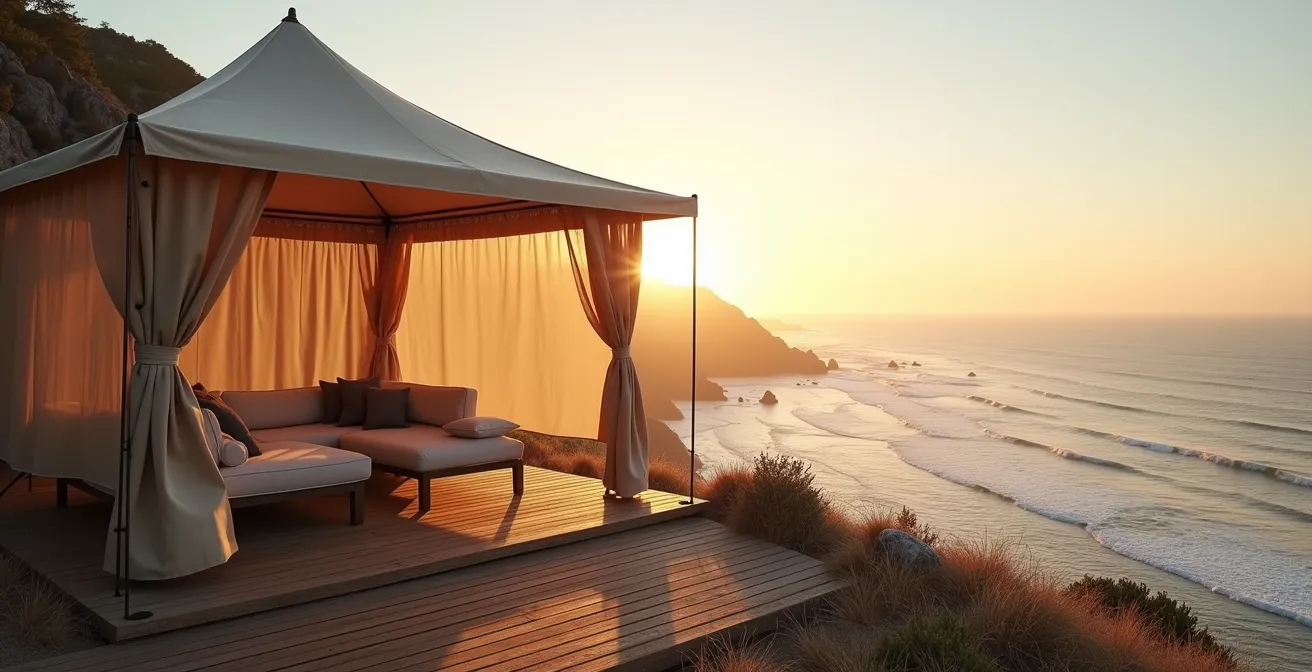
Contrary to the belief that glamping is just a hotel room in a field, its premium price is only justified when it delivers a superior ‘Return on Experience’ that traditional hotels cannot match.
- True luxury lies in engineered comfort (climate control, material science) and guaranteed privacy, not just fancy linens.
- The value is in all-inclusive service logistics and exclusive access to nature, which must outweigh the “authenticity tax” of insects and noise.
Recommendation: Scrutinize a site’s privacy density (acres per unit) and service model before booking; the brochure is not the balance sheet.
The concept of “glamorous camping” presents a paradox for the discerning traveler. On one hand, it promises an immersive connection with nature, an escape from the polished confines of a five-star resort. On the other, it commands a premium price point that invites direct comparison. A recent market analysis reveals that a premium that sees rates can reach USD 650 per night for top-tier resorts, placing a one-week stay firmly in the territory of a luxury hotel suite. For a high-net-worth individual accustomed to impeccable service and flawless infrastructure, the question is not one of simple cost, but of value. Can a tent, however well-appointed, truly deliver a justifiable return on a significant financial investment?
Most discussions devolve into platitudes about “nature” and “unique experiences.” This is an insufficient metric for a critical decision. A proper assessment requires an auditor’s mindset, dissecting the value proposition beyond the marketing gloss. The true justification for a premium glamping price is not in its ability to mimic a hotel, but in its capacity to deliver a superior Return on Experience (ROE). This ROE is measured through specific, tangible deliverables: curated privacy, engineered comfort, and exclusive access—elements that a traditional, high-density hotel, by its very nature, often cannot replicate.
This analysis will serve as an audit of the exclusive glamping model. We will move beyond the brochures to evaluate the critical operational details that separate genuine luxury from a cleverly packaged, overpriced camping trip. We will examine the structural integrity of the accommodations, the logistical reality of remote service, the unspoken “authenticity tax” of the outdoors, and ultimately, determine where the real value lies when comparing a week under canvas to a week in a concrete tower.
This guide provides a structured audit of the glamping value proposition. By breaking down the key components of the experience, from structural design to service delivery, you’ll be equipped to assess whether a premium glamping stay meets the rigorous standards of a true luxury investment.
Summary: A Critical Audit of Glamping’s Luxury Promise
- Canvas vs Hard Shell: Which Glamping Structure Offers Better Temperature Control?
- The Density Trap: How to Spot “Luxury” Campsites That Pack Units Too Close?
- Self-Catering or Room Service: What Does “Exclusive” Really Include?
- How to Secure the Only Sea-View Glamping Suite 9 Months in Advance?
- Insects and Noise: The Reality of Glamping That Brochures Don’t Show
- Why Wooden Eco-Lodges Stay Cooler Than Plastic Mobile Homes in Summer?
- Thread Count in a Tent: Do Luxury Campsites Really Provide Hotel Linens?
- Camping vs Hotel: Which Offers Better Value for a Family of 4 in August?
Canvas vs Hard Shell: Which Glamping Structure Offers Better Temperature Control?
The first line item in a luxury audit is the physical asset itself. In glamping, the structure dictates the fundamental level of comfort. The choice between a classic canvas safari tent and a modern hard-shell pod is not merely aesthetic; it’s a critical decision in engineered comfort. A high-end experience must demonstrate a mastery of its environment, and that begins with superior temperature and humidity control. While canvas evokes a romantic, old-world sense of adventure, its performance is highly variable and dependent on weather. Its primary advantage is breathability, allowing moisture to escape naturally and preventing the stuffiness common in sealed units.

As this macro view of canvas shows, the weave itself is a passive environmental regulator. However, this same porosity makes it a poor insulator against sound and extreme temperature swings. Hard-shell structures, such as geodesic domes or wooden pods, offer a more controlled environment. Their solid construction provides superior insulation against both temperature and noise—a crucial factor when an unexpected rainstorm could otherwise disrupt a night’s sleep. The trade-off is a reliance on active ventilation or HVAC systems to manage humidity and air quality. The following table breaks down the key performance indicators for each structure type.
| Feature | Canvas Structures | Hard Shell Pods |
|---|---|---|
| Breathability | Natural moisture escape | Requires active ventilation |
| Sound Insulation | Low – rain can be disruptive | High – superior dampening |
| Temperature Stability | Variable with weather | More consistent with HVAC |
| Humidity Control | Natural regulation | Can feel stuffy without AC |
The Density Trap: How to Spot “Luxury” Campsites That Pack Units Too Close?
One of the most significant value propositions of glamping over a hotel is privacy. A luxury hotel sells a room; a luxury glamping resort sells space and seclusion. However, many operations fall into the “density trap,” marketing themselves as exclusive while packing units close together to maximize revenue per acre. This fundamentally undermines the promise of an escape. A key audit metric, therefore, is privacy density. A high-end traveler should not be able to hear their neighbor’s conversation or have their view obstructed by another tent. This is a non-negotiable component of the luxury experience.
To assess this, an auditor must look beyond the curated photos on a website and seek out a site map or, even better, the resort’s total acreage versus its number of units. A genuine luxury offering will prioritize space. For example, a prime example is Terramor Outdoor Resort, which spreads 64 luxury canvas tents across 60 acres. This equates to nearly one acre per tent, creating a genuine sense of private immersion in the landscape. This is the benchmark against which other “luxury” sites should be measured. If a resort offers 30 units on five acres, the experience will be more akin to a suburban subdivision than a secluded natural retreat.
Before booking, prospective guests should ask directly about the distance between units. Vague answers like “they are well-spaced” are a red flag. A confident, high-end operator will provide specific measurements, knowing that space is one of their primary assets. Anything less than 50-100 feet of significant distance or natural screening between units begins to erode the premium value of the experience, making it little more than a crowded campground with better bedding.
Self-Catering or Room Service: What Does “Exclusive” Really Include?
The term “exclusive” is often misused in hospitality. In a true luxury context, it relates not just to who is excluded, but to the level of service included. This is where the service logistics of a glamping resort face their greatest test. A 5-star hotel has a centralized kitchen, a large staff, and established infrastructure. A glamping site must deliver a comparable level of service across a sprawling, often rugged, landscape. A key audit question is: does the price reflect a self-catering model with a communal barbecue, or a fully integrated hospitality experience?
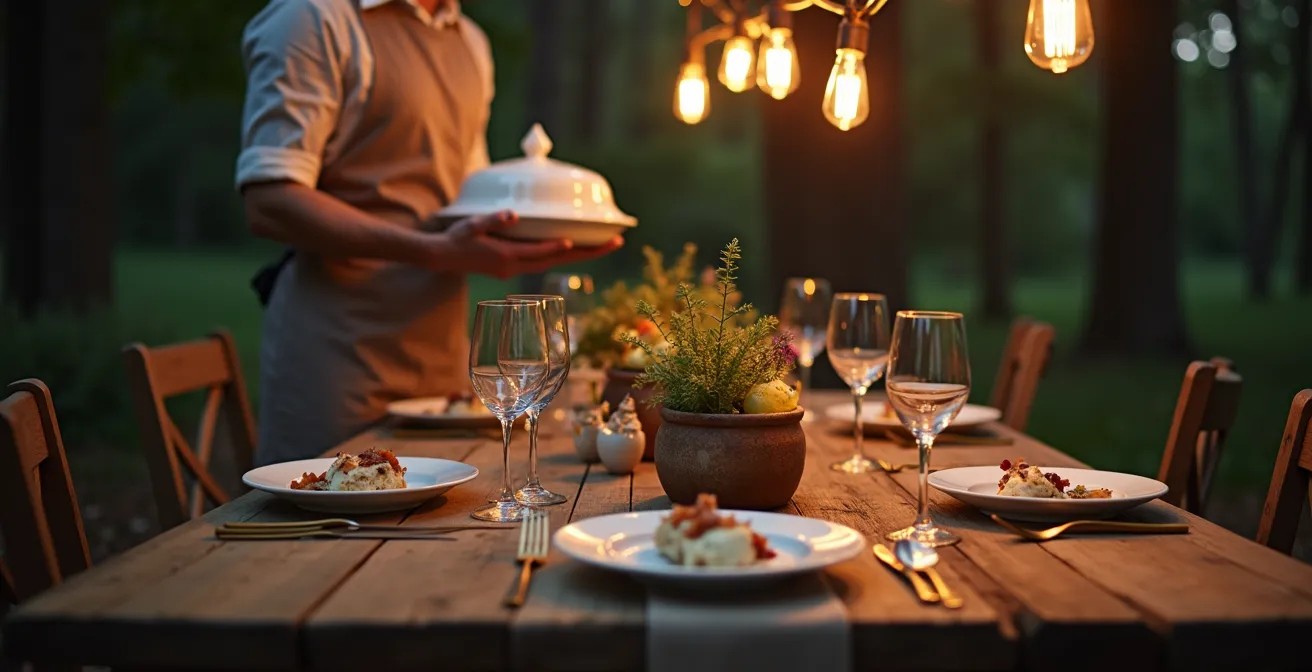
The most exclusive glamping resorts have solved this logistical challenge by creating decentralized, hyper-personalized service models. They justify their premium by offering something a hotel cannot: a private, on-demand service team in a natural setting. A standout example is The Resort at Paws Up in Montana. Within their all-inclusive model, glamping guests enjoy a dedicated camping butler and three gourmet meals daily. This is not just a meal; it is a full-service dining experience delivered to your private patch of wilderness. This level of logistical sophistication is a core component of the value proposition. It transforms the experience from “camping with a nice bed” to a private, catered event in nature, a service level that commands a significant premium.
When evaluating a potential stay, scrutinize the dining options. Is there a single, central restaurant, or are there provisions for in-tent dining? Is service staff shared among all guests, or is a more personalized model offered? The difference between walking to a buffet and having a chef prepare a meal by your private campfire is the very definition of luxury value in this context.
How to Secure the Only Sea-View Glamping Suite 9 Months in Advance?
In luxury travel, the most valuable assets are often the scarcest: the corner suite, the overwater bungalow with a sunset view, or the single sea-view glamping tent. Securing these high-demand units is not a matter of luck but of strategy. While industry reports suggest a 1 to 3-month booking window for peak seasons, this applies to standard inventory. For a one-of-a-kind unit, the game is entirely different, often requiring booking 9-12 months out. The challenge is that these units are rarely available through standard online booking portals; they are managed through a more personal, relationship-based system.
Accessing this top-tier inventory requires bypassing the algorithm and engaging directly with the property. High-end resorts value repeat business and often maintain internal waitlists or offer priority booking windows to loyal guests. Building rapport with the reservations manager can be far more effective than repeatedly checking a website. A simple phone call to inquire about a specific unit for a future date can place you on an internal list, giving you first right of refusal when the booking calendar opens. Mentioning a special occasion, such as an anniversary, can sometimes unlock inventory that is held back for exactly such requests.
For those committed to securing the best, a multi-pronged approach is essential. The following checklist outlines the insider strategies used by seasoned travelers to gain access to the most exclusive accommodations, transforming a hopeful search into a targeted acquisition.
Action Plan: Securing Premium Glamping Inventory
- Target the fringes: Book for the very first or last week of the high season to find better availability on premium units.
- Go direct: Call properties directly to build rapport with staff and inquire about getting on internal waitlists for specific units.
- Leverage special occasions: When calling, mention anniversaries or milestone birthdays, as some properties reserve top units for these events.
- Join the club: Sign up for loyalty programs or newsletters that offer pre-sale booking windows to their members before the general public.
- Play the long game: If the desired unit is unavailable, book a less-desirable one to gain return-guest status and priority access for future years.
Insects and Noise: The Reality of Glamping That Brochures Don’t Show
A comprehensive audit must account for liabilities as well as assets. In glamping, the greatest liability is the unfiltered reality of nature—what can be termed the “authenticity tax.” Brochures showcase serene sunsets and peaceful wildlife, but they omit the mosquitos, the 3 a.m. chorus of unfamiliar animal sounds, and the sound of rain drumming on a canvas roof. A true luxury provider does not pretend these elements don’t exist; they actively engineer solutions to mitigate them, thereby justifying their premium price. The difference between a $200-a-night stay and a $650-a-night stay is often found in how effectively this tax is managed.
Noise is a primary concern. The key is distinguishing between desirable natural ambiance and intrusive, man-made noise. A sophisticated resort uses staggered layouts, natural sound barriers like tree lines, and strict quiet-hour enforcement to insulate guests from the sounds of their neighbors or operational noise from generators. For sensitive sleepers, the choice of a hard-shell structure over canvas can be a critical mitigating factor against weather-related noise. Most seasoned glamping operators observe what can be called a “week-long acclimatization curve,” where guests’ initial sensitivity to unfamiliar sounds typically evolves into comfortable acceptance by the third or fourth day. The role of the luxury provider is to ensure those sounds are from nature, not from poor planning.
Similarly, insect management must go beyond a can of bug spray. Premium sites invest in screened porches, professional and eco-friendly pest control for the immediate vicinity of the tent, and site selection that avoids marshy, insect-prone areas. This table helps differentiate between an acceptable part of the experience and a failure of the operator to provide a luxury environment.
| Sound Type | Natural Ambiance | Potentially Intrusive | Mitigation Strategy |
|---|---|---|---|
| Wildlife | Birds, crickets | Loud nocturnal animals | Site selection away from active zones |
| Weather | Gentle rain, breeze | Heavy rain on canvas | Hard shell structures for sensitive sleepers |
| Human Activity | Distant campfire chatter | Neighboring music/parties | Staggered layouts, quiet hours enforcement |
Why Wooden Eco-Lodges Stay Cooler Than Plastic Mobile Homes in Summer?
Beyond the common canvas tent, the high end of the glamping market features rigid structures, where material science becomes a defining factor of luxury. The choice between a wooden eco-lodge and a standard plastic-clad mobile home is a stark example. While both may offer similar amenities on paper, their performance in providing a comfortable living environment, particularly in summer, is vastly different. The superiority of wood lies in its natural properties, which contribute directly to a passive and more pleasant form of engineered comfort.
The core principle at play is thermal mass. Wood is a dense material that absorbs and releases heat slowly. This creates a natural temperature buffer: the lodge stays cooler during the peak heat of the day and then gently radiates that stored warmth back during the cool of the night. Plastic, by contrast, has low thermal mass; it heats up and cools down rapidly, creating an uncomfortable, oven-like interior during the day. Furthermore, wood is a hygroscopic material, meaning it naturally absorbs and releases moisture from the air, helping to regulate indoor humidity. This makes a warm day feel far more comfortable than in a sealed plastic unit, where humidity can build up and create a stuffy, clammy atmosphere.
Top-tier eco-lodges amplify these natural advantages with smart passive cooling designs. These are not afterthoughts but are integrated into the architecture itself to minimize reliance on energy-intensive air conditioning. Key features include:
- Large roof overhangs that provide shade to walls and windows from direct sun.
- Strategic placement of operable windows to enable natural cross-ventilation.
- Light-colored or reflective roofing materials to reduce solar heat gain.
- Elevated floor designs that promote cooling air circulation underneath the structure.
This holistic approach demonstrates a commitment to sustainable luxury, where comfort is achieved through intelligent design rather than brute-force mechanics.
Thread Count in a Tent: Do Luxury Campsites Really Provide Hotel Linens?
For a guest accustomed to the standards of a Four Seasons or a Ritz-Carlton, the quality of the bedding is a primary touchstone of luxury. It is a tangible, easily-audited metric. The promise of “luxury linens” in a glamping context can be ambiguous, but for a resort to justify a premium price, the standard must be equivalent to that of a high-end hotel. This is not a trivial detail; research shows that comfortable bedding ranks as the #2 most desired amenity, second only to Wi-Fi. It is a core expectation, not an optional extra.
So, what does “hotel-standard” mean in practice? It means more than just a high thread count. It encompasses a complete sleep system: a supportive, high-quality mattress (often king-size), premium pillows with varying firmness options, a luxurious duvet, and professionally laundered, high-quality sheets. Top-tier glamping sites understand this and invest accordingly. They operate with professional laundering services, ensuring the same level of hygiene and crispness one would expect from a hotel housekeeper. The best operators treat the bed as the sanctuary of the unit, the one place where the rustic environment gives way completely to uncompromised comfort.
Leading glamping resorts explicitly market their bedding to meet this expectation, as it’s a key differentiator from mid-range competitors. For instance, top-rated sites like Backland in Arizona provide detailed descriptions of their sleep offering, where each tent includes a king-size bed, luxury linens, and automatic climate control. This level of detail is a sign of a confident operator. When auditing a potential resort, if the website is vague about the specifics of the bed or linens, it’s a significant red flag. True luxury is transparent about its quality touchpoints.
Key takeaways
- The structure’s material (canvas vs. wood vs. hard shell) is the first indicator of true comfort engineering.
- Evaluate “privacy density” by dividing the resort’s acreage by the number of units; anything less than a half-acre per unit is a red flag.
- True luxury glamping service is decentralized and personalized (e.g., a dedicated butler), justifying a premium over a hotel’s centralized model.
Camping vs Hotel: Which Offers Better Value for a Family of 4 in August?
The final audit question brings us to a direct, quantitative comparison: for a family of four during peak season, which option delivers better value? On the surface, a hotel might seem more straightforward. However, a detailed cost and value analysis often reveals a more nuanced picture. The financial equation for a family requires factoring in the need for multiple rooms or a suite in a hotel, which can dramatically escalate costs compared to a single, spacious family-sized glamping tent that sleeps 4-6 people. This is a growing consideration as market data reveals that 43% of glamping demand comes from the 18-32 age group, which includes many young families.
Beyond the nightly rate, an auditor must consider ancillary costs. A hotel stay often involves three restaurant meals per day and paid excursions to keep a family entertained. A glamping stay, by contrast, often includes free, nature-based activities (hiking, stargazing, swimming) and the option for some self-catering, which can significantly reduce daily expenditures. While the initial sticker price of a premium glamping unit may be high, the total cost of the vacation can often be lower than a comparable hotel stay, especially when measured on a per-person basis.
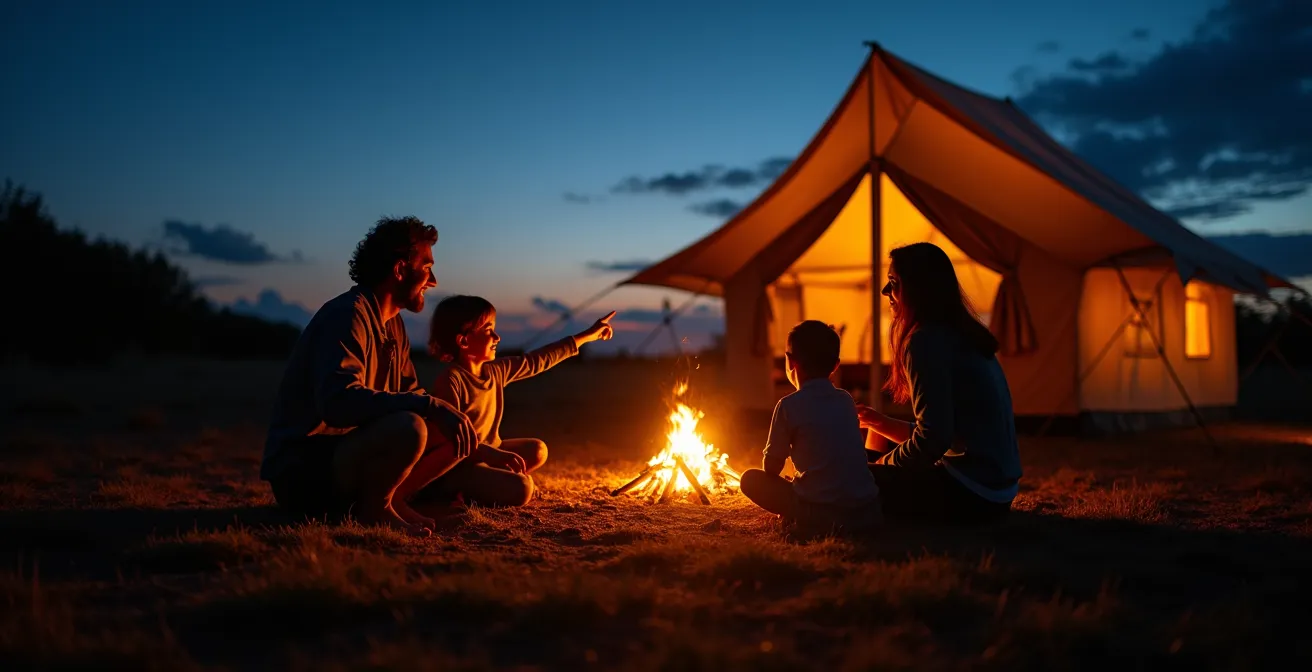
The table below provides a general cost breakdown, but the ultimate decision rests on the intangible Return on Experience. A hotel offers convenience and predictability. Glamping offers space, freedom, and a shared family adventure. The value of children experiencing nature firsthand, away from screens, and the memories created around a campfire are assets that do not appear on a balance sheet but are often the most valuable part of the investment.
| Factor | Glamping (Family Tent/Pod) | Hotel (2 Connecting Rooms) |
|---|---|---|
| Average Nightly Rate | $200-300 (sleeps 4-6) | $300-500 (2 rooms needed) |
| Space per Family | Safari tent + outdoor deck | 2 cramped rooms |
| Food Costs | Some self-catering possible | 3 restaurant meals daily |
| Activities | Free nature-based options | Paid hotel excursions |
| Per-Person Cost | $50-75/night | $75-125/night |
Ultimately, the justification of glamping’s premium price is a personal calculation. It requires the prospective guest to act as their own auditor. Before your next booking, calculate the ‘per-person, per-day’ cost and weigh it against the intangible Return on Experience that exclusive access, privacy, and a unique connection to the natural world provides.