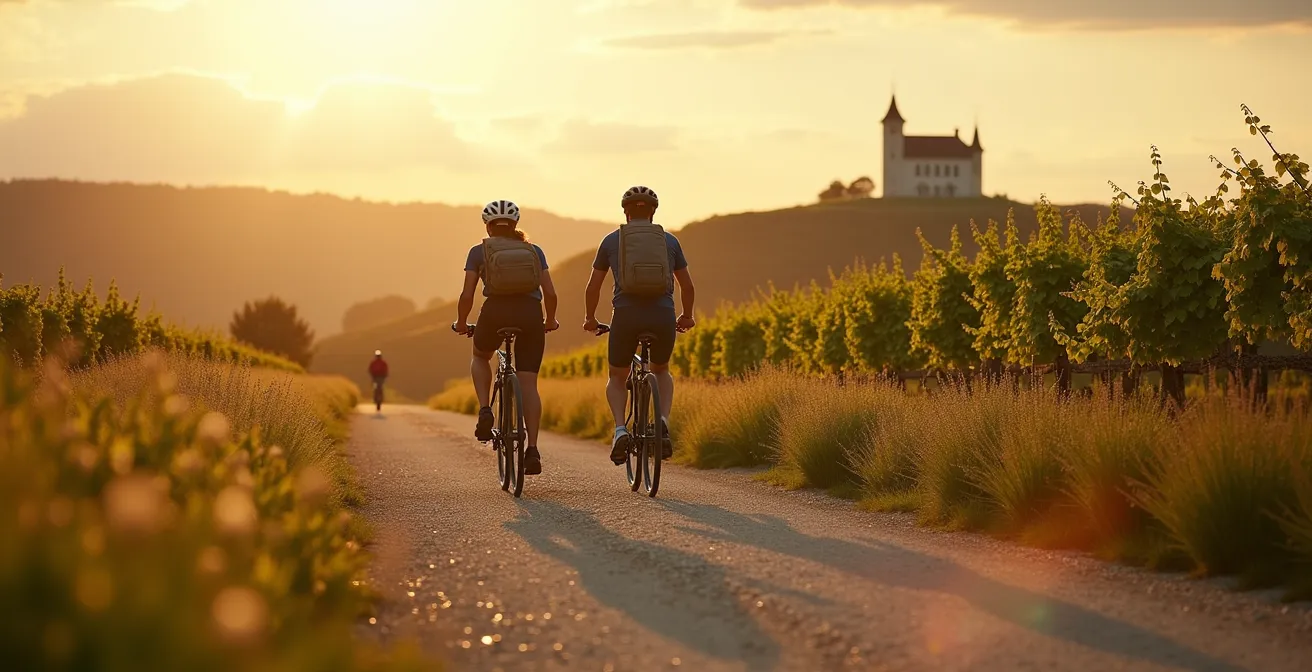
The dream of cycling through the Loire Valley’s vineyards and châteaux often clashes with the reality of logistics, safety, and limited time.
- Prioritizing experiences is crucial; you can’t visit a major château and multiple wineries in one day.
- Responsible wine enjoyment requires smart planning, like tasting near your evening’s campsite and using alternative transport for purchased bottles.
Recommendation: Success lies not in trying to do everything, but in mastering the art of the strategic trade-off to maximize enjoyment and minimize stress.
The image is iconic: you, your partner, and two bicycles gliding past a fairy-tale château, a bottle of crisp Sauvignon Blanc tucked into a pannier for a picnic by the river. The Loire Valley promises this idyllic blend of active travel, cultural immersion, and gastronomic delight. Yet, for many active couples, the reality can be a frustrating puzzle. How do you balance the desire for a serious wine tasting with the responsibility of cycling safely? How do you choose between the grandeur of Château de Chambord and the charm of a small, family-run winery when your time is short? The standard advice to “follow the signs” and “book in advance” often fails to address these fundamental frictions.
Many guides list attractions but neglect the crucial logistics that define a cycling tour. They’ll tell you what to see, but not how to manage the “payload” of six fragile wine bottles on a bumpy path, or how to handle a tasting at 11 a.m. with 40km still left to ride. The result is often a trip of missed opportunities or unnecessary risks. But what if the key to a perfect Loire cycling tour wasn’t about seeing more, but about choosing smarter? What if the secret was a mindset of strategic compromise?
This guide moves beyond the typical itinerary. It’s built on a principle of “responsible indulgence” and logistical awareness. We’ll explore the practical trade-offs required to truly enjoy the synthesis of cycling, culture, and wine. We will tackle everything from securing your valuable e-bike at a busy campsite to understanding which wines can actually survive the journey. By focusing on smart compromises, you can craft an experience that is both deeply rewarding and perfectly safe, ensuring your Loire Valley memories are of breathtaking views and exquisite flavours, not logistical headaches.
To help you plan this balanced adventure, this article breaks down the essential strategic decisions you’ll face. From security and wine transport to prioritizing your precious time, each section offers practical solutions for a seamless journey.
Contents: Loire by Bike: A Strategic Guide for Couples
- Bike Theft: How to Secure Your E-Bike in a Busy Campsite?
- White or Red: Which Loire Wines Survive a Hot Car Journey Best?
- Château de Chambord or Local Winery: Which to Prioritize on a Short Trip?
- Grape Juice and Coloring Books: Which Vineyards Actually Welcome Kids?
- Visiting in September: Can You Participate in the Grape Harvest?
- Alsace or Burgundy: Which Wine Route Has the Best Cycle-Friendly Campsites?
- Lascaux IV: How to secure Tickets During Peak Season Without Waiting for Hours?
- How to Combine a Family Camping Trip with Serious Wine Tasting in Bordeaux?
Bike Theft: How to Secure Your E-Bike in a Busy Campsite?
Your e-bike is your key to the Loire Valley, a significant investment that makes long distances and gentle slopes effortless. Unfortunately, its value also makes it a prime target. In France, a bustling campsite can be a hotspot for opportunistic thieves, with research from the European Cyclists’ Federation showing that 23% of stolen bicycles are e-bikes. Simply locking your bike to a rack is no longer enough; a layered security approach is essential for peace of mind.
The core principle is to make your bike as difficult and time-consuming to steal as possible. This involves using multiple, different types of locks and securing various components. An opportunist looking for a quick score will likely move on to an easier target. For instance, a high-quality U-lock for the frame combined with a cable lock to secure the wheels to a fixed object creates two separate challenges for a thief. For ultimate protection, modern technology offers a powerful safety net. One case study from a Lake Garda campsite highlighted how a GPS tracker hidden on an e-bike led Hungarian police to intercept a van containing 20 stolen bikes destined for Romania. This demonstrates that even if a theft occurs, recovery is possible with the right tracking technology.
The most vulnerable time is overnight. Beyond locking the bike, you should always remove the most valuable and essential components. Take the battery and the display unit into your tent or camper. This not only secures them but also renders the bike far less attractive to thieves targeting e-bikes specifically. A bike without its power source is just a heavy, less valuable bicycle. Consider this your final, non-negotiable step before turning in for the night. Combining physical locks, electronic tracking, and component removal creates a formidable defense.
Your E-Bike Campsite Security Checklist
- Double Down on Locks: Use a minimum of two high-quality locks. A robust U-lock should secure the frame to an immovable object (tree, solid bike rack), while a secondary cable lock should loop through both wheels.
- Secure Components: Use component-specific locks for high-value parts like wheels and your saddle. At night, always remove the battery and display unit and bring them inside your tent or vehicle.
- Install a GPS Tracker: Fit a covert GPS tracker like BikeTrax. In the event of theft, this provides real-time location data for police, dramatically increasing the chance of recovery.
- Consider an Alarm: A motion-sensitive alarm can be a powerful deterrent. Choose one with adjustable sensitivity to avoid false alarms from wind or accidental bumps, keeping your campsite neighbors happy.
- Choose Your Spot Wisely: Lock your bike in a well-lit, high-traffic area if possible. Avoid isolated corners of the campsite. If your pitch is hidden, lock the bike to your vehicle.
White or Red: Which Loire Wines Survive a Hot Car Journey Best?
While the title mentions a car, the cyclist’s challenge is even greater. After a delightful tasting, how do you transport that prized bottle of Sancerre or Chinon back to your campsite without it spoiling from heat and vibration? This is the core of “payload management” for the wine-loving cyclist. Heat is the number one enemy of wine, rapidly degrading its delicate aromas and flavours. A bottle left in a sun-baked pannier for a few hours can be ruined before you even get a chance to open it.
The first line of defense is insulation and cooling. A simple insulated wine sleeve, pre-chilled or even dipped in the cool waters of the Loire river itself, can protect a bottle for a short journey. This small piece of gear is one of the best investments you can make. The second strategy involves choosing the right format. While a traditional glass bottle is classic, it’s heavy and fragile. Modern alternatives are far better suited for cycle touring. Canned wine and plastic bottles are lightweight and durable, perfect for a day trip or a picnic. For longer stays, a 3L Bag-in-Box (BIB) from a local producer offers excellent value and durability, ensuring you have quality wine on tap at your campsite for several days.
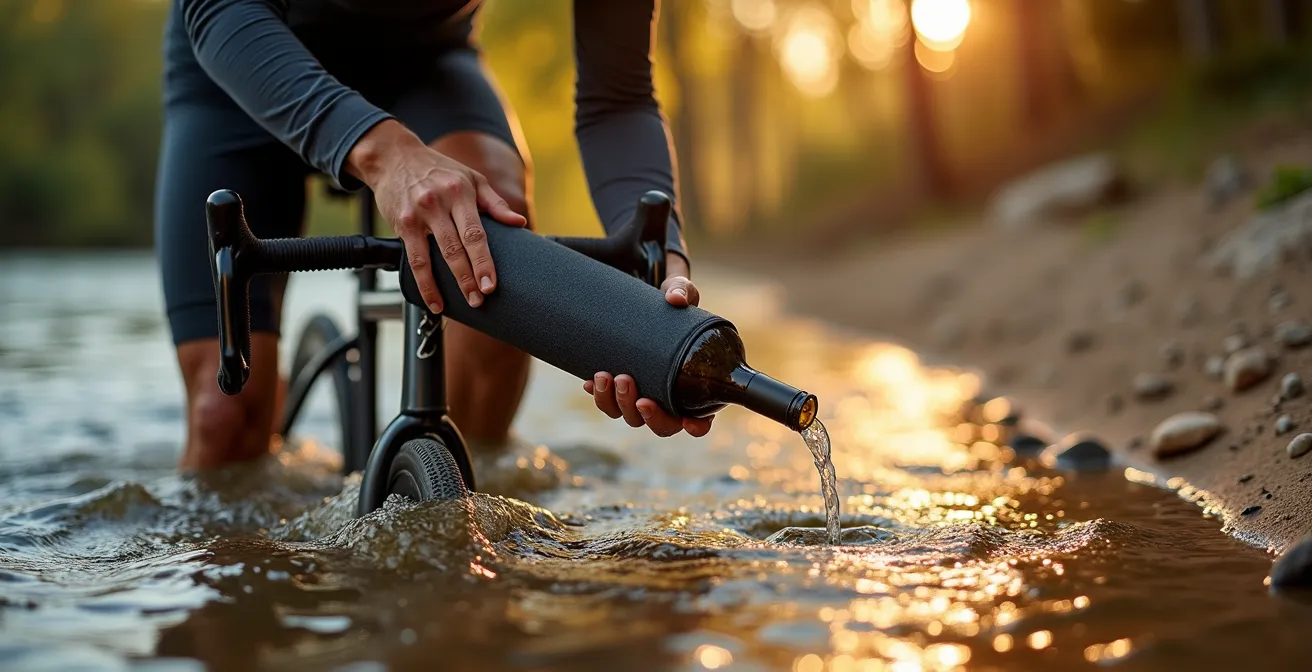
Ultimately, the most effective strategy is a logistical one. As one Loire Valley cycling expert wisely noted:
The best wine for a cyclist is the one you buy minutes from your campsite.
– Loire Valley Cycling Expert, Cycling Thread – Loire Valley Guide
This “hyper-local sourcing” approach eliminates almost all risks. Plan your tastings for the end of the day at vineyards close to your accommodation. This minimizes transport time and exposure to heat, ensuring the wine you buy is in perfect condition for your evening meal. It transforms wine buying from a logistical problem into the perfect final stop of your day’s ride. The following table breaks down the pros and cons of different formats for your journey.
| Wine Format | Weight | Durability | Best For |
|---|---|---|---|
| Bag-in-Box (BIB) | 3L = 3kg | Excellent | Multi-day tours |
| Aluminum Cans | 250ml = 265g | Excellent | Day trips |
| Plastic Bottles | 750ml = 850g | Good | Short distances |
| Traditional Glass | 750ml = 1.3kg | Poor | End-of-day purchase only |
Château de Chambord or Local Winery: Which to Prioritize on a Short Trip?
This is the classic Loire Valley dilemma and the perfect example of a necessary “logistical compromise.” On one hand, you have the monumental, world-famous châteaux like Chambord. On the other, the intimate, authentic experience of a small, family-run winery. With limited time, you likely can’t do both justice in a single day. The choice you make will define the character of your trip, so understanding the trade-offs is essential.
The primary factor is time. According to touring schedules, a proper visit to a massive estate like Chambord requires a minimum of four hours, and that doesn’t include the cycling time to get there and back. In contrast, a typical winery visit and tasting lasts around 90 minutes. In the time it takes to see one grand château, you could potentially visit two different wineries and explore the surrounding village. During peak season, this time difference is magnified by long queues and crowds at major châteaux, whereas local wineries typically offer a more personal and immediate welcome.
However, it’s not always an either/or choice. The Loire is full of creative solutions that blend history and wine. Many troglodyte cave wineries are historic sites in their own right, offering a fascinating glimpse into centuries of history carved from the tuffeau stone. Another fantastic option for those seeking both culture and wine is to look for wineries that are part of a larger historic complex. For example, the Plouzeau winery in Chinon is directly connected to the town’s medieval fortress by a well shaft cut through the rock. They offer cellar tours that combine the region’s history with a tasting, providing a high “experience density” that satisfies both interests. These hybrid locations, often part of the cyclist-friendly Accueil Vélo network, represent the ultimate strategic compromise.
Grape Juice and Coloring Books: Which Vineyards Actually Welcome Kids?
While your trip may be for two, understanding what makes a vineyard “family-friendly” provides a powerful insight into which establishments are truly focused on hospitality and a welcoming experience for all visitors. The presence of activities for children is often a proxy for a winery that goes the extra mile in customer service, offering more than just a standard tasting. These are the places that think creatively about the visitor experience.
A prime example of this philosophy is the ‘From the vine wine’ tour detailed by Loire Wine Tours for visitors with children. While adults taste five different Vouvray wines, children are engaged with their own tasting of local fruit juices served in dark glasses to make it a special occasion. They participate in scavenger hunts in the vineyard and sensory games identifying wine aromas from small flasks. This isn’t just about keeping kids occupied; it’s about creating a parallel, engaging experience that enriches the visit for the entire group. A winery that puts this much thought into welcoming children is likely to offer a superior, more engaging experience for adults as well, often including food pairings or more detailed educational components.
This welcoming attitude is echoed in personal experiences. One family shared their delight with a visit to a local domain:
We had a lovely experience at Domaine Paget in Azay le Rideau, where we enjoyed a proper tasting while the kids got their own grape juice and games to play. What a treat!
– Family traveller, Bridges and Balloons
For a couple, this translates into seeking out wineries that advertise “ateliers sensoriels” (sensory workshops) or “dégustations gourmandes” (gourmet tastings with food). These offerings signal a vineyard that is invested in providing a rich, multi-faceted experience beyond simply pouring wine. They are more likely to be passionate about sharing their craft and creating a memorable stop on your cycling journey, making your visit feel less like a transaction and more like a genuine cultural exchange.
Visiting in September: Can You Participate in the Grape Harvest?
Cycling the Loire in September is a sensory feast. The air is crisp, the vineyards are golden, and the unique, sweet smell of fermenting grapes wafts from cellars. It’s the time of the *vendanges* (grape harvest), and many visitors dream of participating. However, the reality is that joining a professional harvest crew is difficult. It’s physically demanding work that relies on experienced, efficient teams. Most wineries simply don’t have the capacity to integrate tourists into their core operations.
However, that doesn’t mean you can’t experience the harvest season. Many towns host a “Fête des Vendanges”, or harvest festival, which offers a fantastic festive atmosphere with parades, music, and public grape-pressing events. These are perfect for soaking up the culture as a spectator. A few wineries also offer limited “vendanges touristiques,” which are specific, pre-booked events designed for visitors. These opportunities are rare and fill up months in advance, so planning is critical if this is a priority for your trip.
Perhaps the best strategy for a September visit is to embrace the broader meaning of “harvest.” The Loire Valley is a rich agricultural region, and grapes are not the only crop. This is where a strategic pivot can lead to a uniquely memorable experience. As the local tourism board points out, September offers other fascinating harvest activities that are often more accessible to visitors.
September is harvest time for other local products. Unique detours include the saffron harvest in the Gâtinais or apple harvest for cidre production.
– Loire Valley Tourism Board, Alternative Harvest Experiences Guide
Instead of a crowded grape harvest, you could find yourself in a field of purple crocus flowers, learning to harvest delicate saffron threads, or picking apples at a local cidery. These experiences are often more hands-on, less crowded, and offer an equally authentic taste of the region’s agricultural heritage. They represent a smart compromise that can turn a potential disappointment into a highlight of your trip.
Alsace or Burgundy: Which Wine Route Has the Best Cycle-Friendly Campsites?
While Alsace and Burgundy boast world-renowned wine routes, a cyclist’s priorities are unique. It’s not just about the quality of the wine, but the quality of the journey. When factors like terrain, campsite availability, and family accessibility are considered, the Loire Valley emerges as the superior choice for the type of balanced, accessible trip most cycling couples seek. The other regions, while beautiful, present significant logistical challenges.
The most critical factor is the terrain. The Loire à Vélo route is famed for being predominantly flat, making it accessible to cyclists of all fitness levels, even with panniers loaded with camping gear and a few bottles of wine. In contrast, Alsace features rolling hills, and Burgundy is known for its challenging climbs, which can turn a pleasant ride into a grueling workout. This difference in topography is a major consideration for a multi-day tour where energy conservation is key.
Furthermore, the infrastructure supporting cyclists is unparalleled in the Loire. According to official data from France Vélo Tourisme, there are over 700 ‘Accueil Vélo’ accredited establishments (accommodations, rental shops, and tourist sites) within 5km of the route. This “Accueil Vélo” label guarantees cyclist-friendly services, such as secure bike storage and repair kits. This density of certified campsites and hotels provides incredible flexibility, allowing you to end your day’s ride whenever you choose, rather than being forced to push on to the next distant accommodation. The following table provides a clear comparison:
| Region | Terrain | Campsite Density | Average Pitch Price | Family Accessibility |
|---|---|---|---|---|
| Loire Valley | Predominantly flat | High (Accueil Vélo) | €15-25/night | Excellent |
| Alsace | Rolling hills | Moderate | €18-30/night | Good |
| Burgundy | Challenging hills | Low-Moderate | €20-35/night | Moderate |
While a seasoned athlete might relish the hills of Burgundy, for a couple seeking a relaxing and flexible holiday that balances cycling with sightseeing and wine tasting, the Loire’s combination of flat terrain and dense, high-quality infrastructure makes it the clear winner.
Lascaux IV: How to secure Tickets During Peak Season Without Waiting for Hours?
The challenge of securing tickets for a world-famous attraction like Lascaux IV in the Dordogne—with its notorious queues and required advance bookings—is a perfect illustration of what you can *avoid* by choosing the Loire Valley. While the Loire has its own share of popular sites, its cultural landscape is far more diverse and accessible, allowing for a more spontaneous and less stressful travel experience. Instead of battling crowds for a single, high-stakes ticket, the Loire offers a wealth of world-class alternatives that you can often explore on a whim.
The key is to shift your mindset from “ticking off the big name” to “discovering hidden gems.” For every crowded blockbuster château, there are dozens of smaller, equally fascinating sites that require no advance booking. Troglodyte caves, historic gardens, and smaller family-owned châteaux offer deep cultural immersion without the logistical nightmare of peak season crowds. A perfect example of this strategic pivot is the Museum of Prehistory of Grand-Pressigny. Located in Southern Touraine and accessible via the ‘Indre à Vélo’ cycle path, this museum offers world-class exhibits on prehistoric life. It provides an enriching experience comparable to Lascaux but without the associated stress and crowds.
Even for the Loire’s most popular châteaux, a smart booking strategy can make all the difference. You don’t have to wait for hours if you plan ahead. For sites like Château de Chenonceau, booking online two to three weeks in advance is wise during peak season. For special events like the nighttime shows at the Villandry Gardens, a one-month lead time is recommended. Arriving early (before 10 a.m.) is another simple but effective way to beat the crowds. The Loire Valley Pass can also offer skip-the-line benefits at several key locations. By applying these tactics, you can enjoy the A-list sites without the A-list hassle.
Key Takeaways
- Prioritize or Compromise: You can’t see a major château and enjoy a leisurely winery tour on the same day. Choose one main event per day to maximize enjoyment.
- Plan Your Indulgence: The best way to enjoy wine tasting is to schedule it near your evening’s campsite to avoid cycling after drinking and to protect your purchases from heat.
- Leverage the Infrastructure: The Loire’s flat terrain and dense network of “Accueil Vélo” campsites make it uniquely suited for a flexible, low-stress cycling holiday compared to other French wine regions.
How to Combine a Family Camping Trip with Serious Wine Tasting in Bordeaux?
The question of combining family camping with serious wine tasting in a region like Bordeaux highlights, by contrast, precisely why the Loire Valley is such an exceptional destination for this type of travel. While Bordeaux is a titan of the wine world, its culture is largely adult-focused and appointment-only. For the cycling couple or family seeking flexibility and a variety of activities, the Loire offers a far more accommodating and diverse experience.
The fundamental difference lies in accessibility. Bordeaux’s prestigious estates typically require reservations made weeks or even months in advance. The culture is one of formal, guided tours, which can feel intimidating and are not conducive to a spontaneous cycling trip. The Loire, on the other hand, thrives on a culture of “dégustation-vente” (tasting and sales), where countless wineries welcome walk-in visitors. This open-door policy is perfect for cyclists, who can spontaneously decide to stop at a sign that catches their eye.
Moreover, the Loire ecosystem is built for more than just wine. Beyond the vineyards, you’ll find over 40 major châteaux, the world-famous Zoo de Beauval, and a network of magnificent gardens. This variety of non-wine activities ensures there’s always something to do, which is crucial for keeping a trip with mixed interests engaging. For wine lovers who appreciate Bordeaux’s famous grapes, the Loire offers compelling and delicious alternatives. As the experts at Loire Valley Wine Tours note, “If you love Bordeaux’s Cabernet Sauvignon, you must explore the Loire’s Cabernet Franc in Chinon and Saumur-Champigny.” This offers a chance to expand your palate while enjoying a more accessible travel style.
| Aspect | Loire Valley | Bordeaux |
|---|---|---|
| Non-wine Activities | 40+ châteaux, Zoo Beauval, gardens, cycling paths | Limited – mainly wine-focused |
| Winery Accessibility | Open ‘dégustation-vente’ culture, walk-ins welcome | Appointment-only estates |
| Family Services | ‘Ateliers pour enfants’ workshops common | Adult-focused experiences |
| Cycling Infrastructure | 900km dedicated Loire à Vélo paths | Limited safe family routes |
| Accommodation Range | Extensive campsite network | Fewer budget options |
Now that you understand the strategic principles, the next step is to start sketching out your own journey. Begin by identifying your “must-see” priorities and planning your route around those key anchor points, embracing the art of the smart compromise.