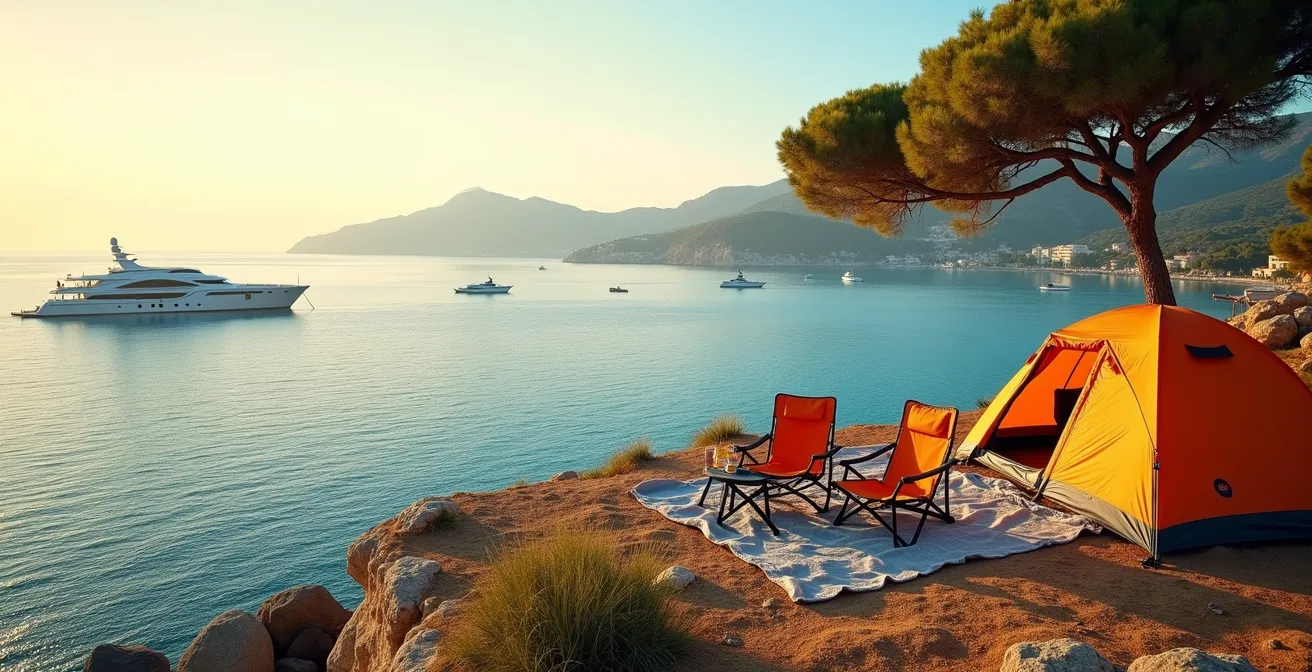
Yes, you can access the Riviera’s billionaire lifestyle while camping—the secret isn’t spending more, but hacking access to exclusive experiences.
- Trade crowded public beaches for secret coves by leveraging coastal paths and the “golden hour” after 6 PM.
- Swap notorious traffic jams for scenic ferry rides or e-bike routes to explore Monaco like a local insider.
- Exchange overpriced restaurants for sophisticated “progressive dining” tours through authentic neighborhoods like Nice’s Le Port.
Recommendation: Embrace the “Access Hacker” mindset. Use strategic timing, local knowledge, and the right gear to unlock the true luxury of the French Riviera for the price of a campsite pitch.
The dream of the French Riviera conjures images of superyachts glistening in the Mediterranean, champagne flutes clinking in exclusive beach clubs, and drives along coastal roads in a classic convertible. For most, this fantasy is quickly shattered by the reality of eye-watering prices, suffocating crowds, and the feeling that the real glamour is happening behind a velvet rope. The typical advice for budget travelers often involves compromising: stick to crowded public beaches, eat only from supermarkets, and view iconic locations from a distance.
But what if the entire premise is wrong? What if the essence of the “billionaire lifestyle” isn’t about extravagant spending, but about privileged access, unique experiences, and a sense of effortless freedom? The true luxury of the Côte d’Azur isn’t found on a 50€ sunbed but in discovering a deserted cove with crystal-clear water. It’s not about the Michelin-starred meal but about assembling a perfect picnic of market-fresh tapenade, cheese, and rosé to enjoy at sunset. This is the art of access hacking.
This guide re-frames the Riviera experience. Forget saving pennies; we’re focused on “experience arbitrage”—finding and unlocking high-value moments that cost little to nothing. We will explore how to leverage timing, geography, and local knowledge to bypass the crowds, discover hidden gems, and curate a trip that feels genuinely luxurious and exclusive, all from the smart, affordable base of a campsite. It’s time to stop looking in from the outside and start living the Riviera dream, on your own terms.
This article provides a strategic roadmap to achieve that. From navigating the coastline to dining like an insider, each section offers concrete hacks to elevate your camping trip into a truly glamorous adventure.
Summary: Your Guide to Hacking the Riviera’s Luxury Lifestyle
- Public vs Private Beaches: Where to Swim Without Paying 50 € for a Sunbed?
- Train or Car: How to Visit Monaco from Your Campsite Without Traffic Jams?
- Sand or Pebbles: Which Riviera Beaches Offer the Clearest Water for Snorkeling?
- How to Eat Like a Local in Nice for Under 20 €?
- Cannes Festival Period: The Worst Time to Camp if You Hate Crowds
- How to Find Secluded Spots on the Riviera During High Season Without Stress?
- Red Flag vs Orange Flag: What Do They Really Mean for Kayakers?
- How to Combine a Family Camping Trip with Serious Wine Tasting in Bordeaux?
Public vs Private Beaches: Where to Swim Without Paying 50 € for a Sunbed?
The quintessential Riviera image is a striped parasol on a private beach, but this luxury comes at a steep price. The savvy traveler knows that the Mediterranean Sea is free for everyone, and the key is knowing where—and when—to access it. The “access hacker” approach isn’t about settling for the most crowded public sand strip. It’s about finding locations that offer the same ambiance and pristine water as the exclusive clubs, without the bill. The areas adjacent to these clubs often share the exact same beautiful coastline.
The most powerful tool in your arsenal is the Golden Hour Strategy. While tourists flock to the beaches between 11 AM and 4 PM, insiders arrive after 6 PM. The day-trippers have departed, parking spaces magically appear, and the harsh sun gives way to a soft, golden light. This is the perfect time for a romantic picnic on a now-deserted beach. All along the Mediterranean, past the famous resort towns and the ‘Billionaire’s Peninsula’ of Saint-Jean-Cap-Ferrat, rocky promontories offer a more intimate and authentic experience than the managed sands of private clubs.
To truly escape, explore the coastal footpaths known as the Sentier du Littoral. The stretch at Cap d’Ail, for example, winds past Belle Époque villas and grants access to hidden rocky coves (‘calanques’) perfect for a private swim. By packing your own portable shade, high-quality snorkeling gear, and a curated picnic from a local market, you elevate a free activity into a bespoke luxury experience that no beach club can replicate.
Ultimately, the most luxurious beach experience is not one you pay for, but one you discover. It’s the feeling of having a slice of the Mediterranean all to yourself as the sun sets.
Train or Car: How to Visit Monaco from Your Campsite Without Traffic Jams?
Driving into Monaco during high season can feel less like a glamorous Grand Prix experience and more like a multi-hour parking lot simulator. The train is a reliable alternative, but the real “billionaire” feeling comes from arriving with style and ease, bypassing the queues altogether. This requires thinking beyond conventional transport and adopting a multi-modal access strategy. One of the most stylish hacks is to take the coastal ferry from Nice, arriving directly into Port Hercules, granting you the same grand entrance as the yacht owners.
For more active and flexible exploration, consider renting e-bikes in a neighboring town like Cap d’Ail or Beausoleil. This allows you to effortlessly glide past all traffic and explore Monaco’s steep hills, discovering viewpoints inaccessible by car. An even savvier trick is the Beausoleil Elevator Hack. Park for free in the French town of Beausoleil, which sits directly above Monaco, and use the network of free public elevators (‘ascenseurs publics’) to descend directly into the heart of the principality, feeling like a local in the know.
This perspective from the hillsides offers a stunning and crowd-free vantage point, especially at sunrise.
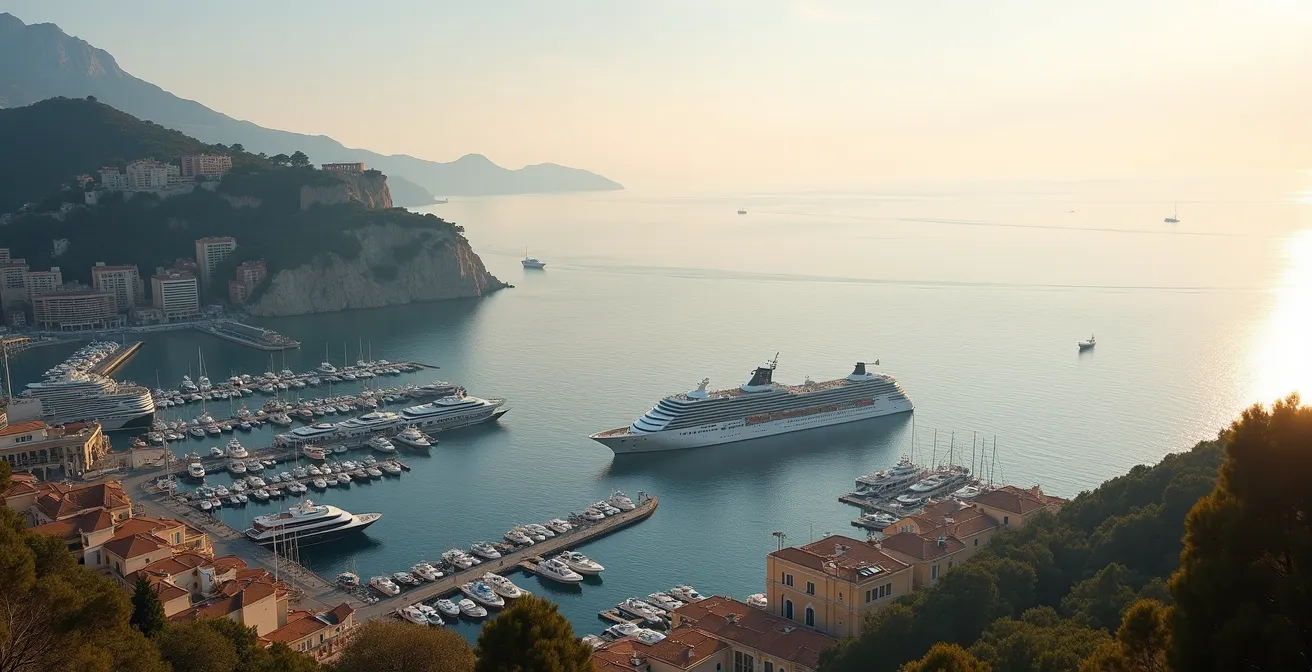
While you can still drive some of the famous streets that serve as the Formula 1 circuit, it’s best attempted during off-peak hours for a smoother ride. For a truly unforgettable, high-end experience, consider the 10-minute ‘Héli Air Monaco’ tour. While not free, its cost can be surprisingly reasonable on a weekday, offering a multi-million-dollar perspective of the principality that puts you in a very exclusive club.
By combining these methods, you transform the logistical headache of visiting Monaco into a seamless and memorable part of your luxury adventure.
Sand or Pebbles: Which Riviera Beaches Offer the Clearest Water for Snorkeling?
For the snorkeling enthusiast, water clarity is the ultimate luxury. On the French Riviera, the choice between sand and pebble beaches is a crucial one. While sandy beaches like Pampelonne are famous, their fine particles are easily stirred up by waves and swimmers, reducing visibility. The secret to consistently crystalline water lies with pebble beaches and rocky coves. Pebbles don’t create clouds of sediment, meaning visibility is naturally superior, often exceeding 10-15 meters.
The following table, based on an analysis of Riviera coastal conditions, breaks down the options for snorkelers seeking the best visibility.
| Beach Type | Water Clarity | Best Examples | Snorkeling Quality |
|---|---|---|---|
| Pebble Beaches | Excellent (8-15m visibility) | Cap d’Ail, Plage Mala | Superior – no sand stirring |
| Rocky Coves | Outstanding (10-20m visibility) | Saint-Jean-Cap-Ferrat pointe | Best – protected from currents |
| Sandy Beaches | Good (5-10m visibility) | Plage de Pampelonne | Variable – depends on conditions |
| Mixed Sand/Rock | Very Good (7-12m visibility) | Théoule-sur-Mer | Good – offers variety |
Beyond natural geology, the Riviera offers a unique cultural snorkeling experience that rivals any private art gallery. A prime example is the underwater museum near Île Sainte-Marguerite. Here, you can snorkel or scuba dive among submerged sculptures by artist Jason deCaires Taylor.
The Underwater Museum: A Billionaire-Style Art Experience
This free underwater eco-museum offers a cultural experience unlike any other. Six monumental sculptures are submerged at depths of 3-5 meters, making them perfectly accessible to snorkelers. The installation combines art appreciation with marine exploration, creating a memorable ‘billionaire-style’ moment that is completely free for campers equipped with a simple mask and snorkel. It’s an adventure that feels exclusive, thought-provoking, and deeply connected to the sea.
By targeting pebble beaches and unique sites like this, you can guarantee a world-class snorkeling adventure that most tourists on sandy beaches will never experience.
How to Eat Like a Local in Nice for Under 20 €?
Dining on the Côte d’Azur can drain your budget faster than a leaky inflatable. But eating well here isn’t about securing a reservation at a palace hotel; it’s about knowing the local rhythms and culinary codes. The most potent strategy for gourmet dining on a budget is targeting the weekday lunch menu, or ‘formule du midi’. Between 12 and 2 PM, even high-rated restaurants offer a two or three-course meal, often centered around a stellar ‘plat du jour’ (dish of the day), for a fraction of their evening prices.
For an even more authentic taste, head to the Marché de la Libération, a market favored by locals over the more tourist-centric Cours Saleya. Here you can buy regional specialties like ‘socca’ (a delicious chickpea pancake) from the best vendors. Assembling your own feast from the market is a classic move, but the ultimate “access hack” is the ‘apéro-dînatoire’ or progressive dinner.

Case Study: The 16€ Progressive Dinner in Le Port, Nice
This approach transforms bar-hopping into a sophisticated, multi-course dining experience. You start at one spot for an aperitif and a small bite, then move to another for the next course. For example: begin at a classic bar for a glass of local rosé with olives (5€), move to a specialist vendor like Chez Freddy for a slice of ‘pissaladière’ (a caramelized onion tart) (4€), and finish at a cozy spot like La Petite Table for a small board of local cheese and charcuterie (7€). This progressive journey through Nice’s vibrant Le Port district provides variety, an authentic atmosphere, and gourmet quality, all while staying comfortably under the 20€ budget. It’s an experience rich in discovery, not cost.
By adopting these local habits, you eat better, have more fun, and experience the authentic flavors of Nice for less than the price of a single tourist-trap pizza.
Cannes Festival Period: The Worst Time to Camp if You Hate Crowds
For anyone averse to crowds, the Cannes Film Festival in May transforms the Riviera into a logistical nightmare. The influx of thousands of film industry professionals and enthusiasts creates gridlock traffic, packed restaurants, and campsites booked months in advance. On the surface, it seems like the absolute worst time for a peaceful camping trip. However, for the luxury travel hacker, it presents a unique opportunity to soak in an unparalleled atmosphere of glamour for free, if you know how to navigate it.
The secret is to treat the festival not as an event to attend, but as a spectacle to observe. You can access the high-wattage glamour without a badge or a ticket. The key is strategic positioning and timing. While the French Riviera is known for its glamorous resorts, the festival period offers free, front-row seats to the world of high fashion and celebrity culture.
Access Hack: Free Festival Experiences for Campers
Instead of fighting the crowds, campers can enjoy exclusive-feeling events for free. Each night, the ‘Cinéma de la Plage’ offers public screenings of classic films right on the beach—just bring a blanket. You can watch the red-carpet arrivals from strategic public viewpoints near the Palais des Festivals (arrive very early). Perhaps most impressively, the festival triggers a gathering of the world’s most spectacular superyachts in Port Canto. A simple stroll along the quay becomes a free ‘boat show’ of unparalleled scale, a quintessential billionaire-style activity without any cost. The trick is to dress smartly to blend in with the chic atmosphere, turning your people-watching into a sophisticated pastime.
By shifting your mindset from “participant” to “privileged observer,” you can turn the most crowded time of the year into a highlight of your trip, absorbing the electric atmosphere on your own terms.
How to Find Secluded Spots on the Riviera During High Season Without Stress?
During July and August, the Côte d’Azur’s coastline can feel like one continuous, crowded beach. The secret to finding tranquility isn’t to search for an undiscovered beach but to employ the Vertical Escape Method. This means moving away from the packed horizontal line of the coast, either upwards into the hills or outwards onto the water. The Riviera’s true magic is often found just a few kilometers inland or offshore.
The ‘villages perchés’ (perched villages) like Eze, Saint-Paul-de-Vence, or Gourdon offer a breathtaking escape. These medieval hilltop towns provide multi-million-dollar views and a serene atmosphere, but only if you time your visit correctly. Arrive before 10 AM or after 5 PM to avoid the tour bus crowds. Similarly, the ‘Corniche’ roads—especially the Moyenne and Grande Corniches between Nice and Menton—offer panoramic vistas of the entire coastline that are just as spectacular as any villa’s terrace, but completely free to enjoy.
Another vertical escape is to the sea. Taking the first ferry of the day to the Îles de Lérins (off Cannes) or Porquerolles allows you to hike to the far side of the island and claim a private cove before anyone else arrives. A high-quality campsite with its own large pool or river access can also become a strategic midday retreat, allowing you to relax in a private setting while the coastal areas are at their most chaotic (12-4 PM).
Action Plan: Your Vertical Escape Checklist
- Target ‘villages perchés’ like Eze or Saint-Paul-de-Vence, visiting only before 10 AM or after 5 PM to dodge crowds.
- Take the very first ferry of the day to islands like Îles de Lérins and immediately hike to the farthest coves for seclusion.
- Use your campsite as a strategic midday retreat (12-4 PM) when coastal hotspots are overwhelmingly crowded.
- Explore the Moyenne or Grande Corniche roads by car or bike for spectacular, crowd-free coastal views.
- Book a campsite with premium amenities like a large pool or direct river access to create an exclusive daytime oasis.
This data-driven table illustrates how effective timing can be.
| Location | Avoid (Peak Hours) | Best Times | Crowd Level |
|---|---|---|---|
| Eze Village | 10 AM – 5 PM | Before 9 AM, After 6 PM | 80% less crowded |
| Monaco | 11 AM – 4 PM | Early morning, Evening | 60% less traffic |
| Nice Beaches | 12 PM – 4 PM | After 6 PM (golden hour) | 70% fewer people |
| Îles de Lérins | After 11 AM | First ferry (8:30 AM) | Private cove access |
This isn’t about avoiding the Riviera’s beauty; it’s about experiencing it from a smarter, more exclusive vantage point, free from the stress of the crowds.
Red Flag vs Orange Flag: What Do They Really Mean for Kayakers?
For the land-based tourist, a red or orange flag on the beach means danger and disappointment. For the savvy kayaker, it can be an opportunity. Understanding maritime flags is a crucial “access hack” that empowers you to safely explore the coastline when it’s off-limits to others, creating a truly exclusive experience. It transforms a simple kayak into a ‘Yacht-Proxy’—a personal exploration vehicle for discovering hidden sea caves and coves inaccessible to swimmers and large vessels.
A red flag (‘drapeau rouge’) indicates a complete ban on swimming and water activities due to dangerous conditions like strong currents or high surf. This is a non-negotiable stop sign for everyone. An orange flag (‘drapeau orange’), however, signifies that swimming is dangerous and not recommended but not strictly forbidden. It serves as a warning, and most swimmers will stay out of the water.
The Kayaker’s Orange Flag Advantage
Experienced kayakers who can read the weather patterns (like the ‘houle’ or swell direction) can use orange flag days to their advantage. While the main beaches are empty, they can launch from a sheltered cove and paddle into spectacular, less-crowded areas. This is the moment to safely paddle past the anchored superyachts and explore the dramatic coastline near Plage Mala or the calanques of Théoule-sur-Mer. It’s an exercise in skill and judgment that rewards you with unparalleled solitude and a perspective on the Riviera that few ever get to see.
Of course, safety is paramount. This strategy is only for confident paddlers who have checked the forecast for wind (avoiding the Mistral when it exceeds 40 km/h) and stay within the 300-meter coastal band. Planning routes with potential “paddle-up” beach cafés for a refreshment stop adds another layer of luxury to the adventure. The best time for the smoothest water is almost always in the early morning, before 10 AM, when the sea is calm and boat traffic is minimal.
By understanding and respecting the sea, a simple kayak becomes your key to unlocking the most private and pristine parts of the Côte d’Azur coastline.
Key Takeaways
- The “billionaire lifestyle” is accessed through smart hacks, not high spending. Focus on curating exclusive experiences.
- Leverage timing (the “Golden Hour” and off-peak visits) and geography (the “Vertical Escape”) to avoid crowds and find seclusion.
- Use affordable gear like kayaks or e-bikes as “Yacht-Proxies” to gain freedom and access to hidden coves and viewpoints.
How to Combine a Family Camping Trip with Serious Wine Tasting in Bordeaux?
When one thinks of “serious wine tasting” in France, the mind immediately jumps to the grand châteaux of Bordeaux. For a family camping on the French Riviera, a pilgrimage to Bordeaux is a major, multi-day detour. However, the savvy travel hacker knows that you don’t need to cross the country to find world-class tasting experiences. The Côte d’Azur and its hinterland offer their own unique and sophisticated tasting opportunities—from globally acclaimed rosé wines to artisanal olive oils and perfumes—that are far more accessible and family-friendly.
The Var hinterland, just behind the glamour of Saint-Tropez, is the heart of Provence rosé production. Here, family-run vineyards like Château de Berne or Château Sainte Roseline offer educational tours and structured tastings of high-end wines that rival any beach club offering. Many of these domaines welcome families and even have picnic areas or restaurants, allowing adults to engage in a serious tasting while children play in a beautiful, safe environment. This provides a luxury experience that feels both authentic and inclusive.
But the tasting experiences on the Riviera extend far beyond wine. You can apply the same “access hacker” mindset to other local treasures:
- Perfume in Grasse: The world’s perfume capital offers free tours at historic ‘parfumeries’ like Fragonard and Molinard, where you can learn the art of scent creation.
- Olive Oil in the Hills: Above Nice and Menton, you can visit artisanal olive mills for professional tastings that reveal the complex flavors of regional olive oils.
- Lemons in Menton: Explore the famous ‘citronneraies’ (lemon groves) of Menton and finish with a tasting of locally produced limoncello.
Booking these visits in the afternoon often helps you avoid morning tour groups, leading to a more personal and private experience. It’s about discovering the rich ‘terroir’ of the South of France in all its forms.
Instead of chasing the Bordeaux label, embrace the accessible luxury right at your doorstep. This is the essence of smart travel: finding the extraordinary in the unexpected and creating rich memories without the logistical stress.