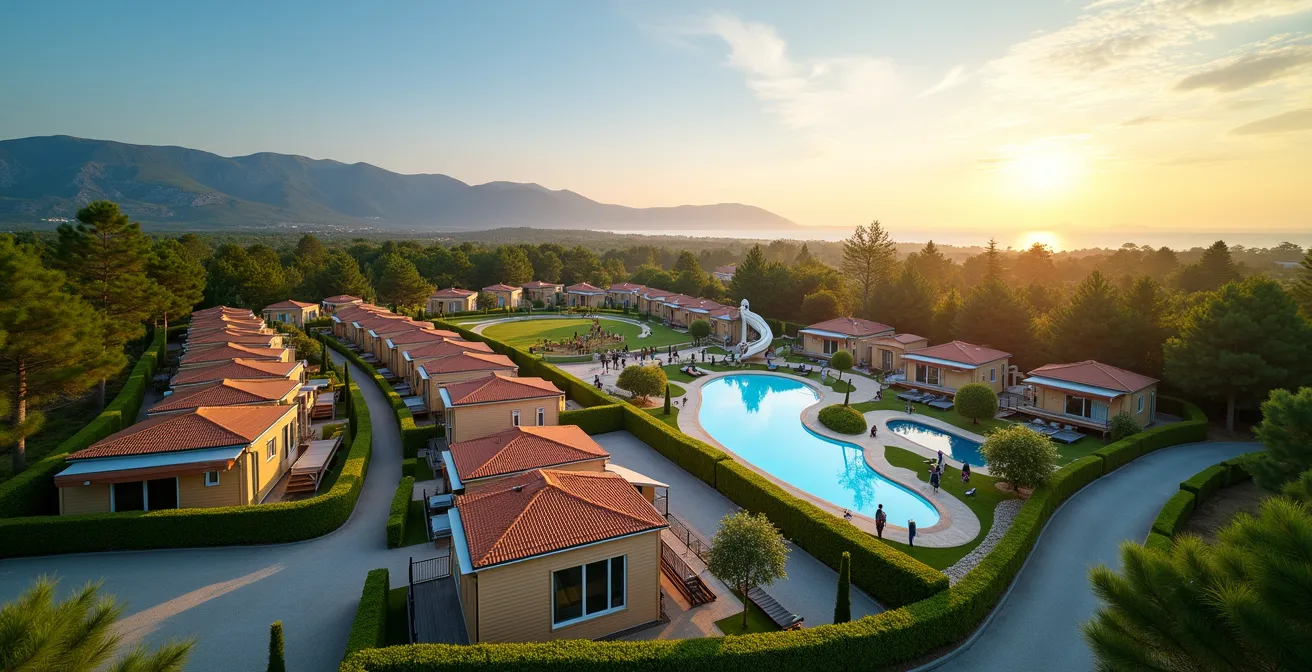
A 5-star rating on a French campsite doesn’t guarantee a luxury experience; it guarantees compliance with an administrative grid focused on infrastructure.
- Stars prioritize quantifiable metrics like pitch size and the number of languages spoken, not experiential quality like atmosphere or kids’ club excellence.
- True value is often found in lower-starred sites that invest in superior maintenance and prime locations instead of “point-chasing” for a higher rating.
Recommendation: Use the official star rating as a starting point, then use an auditor’s checklist to investigate what truly matters for your holiday.
For international travelers planning a trip to France, the campsite star rating system seems like a straightforward seal of quality. The logic feels simple: more stars must mean a better, more luxurious experience. A 5-star site should, by definition, be superior to a 3-star one. However, this assumption is the single biggest mistake a visitor can make, often leading to disappointment and a significant gap between expectation and reality. The system, overseen by Atout France, is not a consumer-facing guide to luxury; it is an administrative blueprint that rewards quantifiable infrastructure over intangible holiday quality.
Most guides will simply list the criteria for each star level. They might tell you that a 4-star requires a heated pool or that a 5-star needs staff who speak three languages. While factually correct, this information is useless without context. It doesn’t tell you if the pool is clean, if the staff are helpful, or if the kids’ club is anything more than a small room with a few crayons. The fundamental flaw in relying solely on stars is mistaking a checklist for a guarantee of quality. This guide takes a different approach. We will provide you with a hospitality auditor’s toolkit to look beyond the plaque on the wall.
Instead of just listing the rules, we will deconstruct them. You will learn to spot the difference between a campsite that has earned its stars through genuine quality and one that has simply ticked the right boxes. We will analyze why a 4-star in France is worlds apart from one in Italy, how to verify if a rating is even valid, and why the most sought-after campsites aren’t always the ones with the most stars. By the end, you won’t just see a number; you’ll see the full picture, enabling you to find the perfect campsite that delivers real value for your family.
This detailed analysis will walk you through the critical points of contention and investigation. By exploring these topics, you will gain the insight needed to make an informed decision that goes far beyond the official star rating.
Summary: Decoding the French Campsite Star System
- French 4-Star vs Italian 4-Star: Why the Standards Are Completely Different?
- Does a 5-Star Rating Mean Better Kids’ Clubs or Just Bigger Pitches?
- How to Spot a Campsite Trading on an Expired Star Rating?
- Is the Price Jump from 3 to 4 Stars Justified by Amenities?
- Do 5-Star Campsites Sell Out Faster Than 3-Star Ones?
- Public vs Private Beaches: Where to Swim Without Paying 50 € for a Sunbed?
- Does “Accessible” Really Mean Wheelchair Friendly in French Campsites?
- Camping vs Hotel: Which Offers Better Value for a Family of 4 in August?
French 4-Star vs Italian 4-Star: Why the Standards Are Completely Different?
The first step in decoding campsite ratings is to understand that a “star” is not a universal unit of quality. The meaning of a 4-star rating changes dramatically across European borders, a fact that stems from deep cultural and administrative differences. France operates under a centralized national system managed by Atout France. This creates a uniform standard across the country, but one that is heavily focused on infrastructure and spatial requirements. It’s a system born from a camping culture that values the ’emplacement nu’ (bare pitch) and the autonomy of the camper.
In stark contrast, Italy has no single national standard. Instead, it operates with 20 different regional systems. This means a 4-star campsite in Tuscany is judged by different criteria than one in Venice. Generally, the Italian ‘villagio turistico’ model prioritizes hospitality, resort-style services, and the quality of animation programs over raw space. This philosophical divergence has a direct impact on the guest experience. A French 4-star guarantees a minimum pitch size of 80m² and paved alleys, reflecting a focus on order and space. An Italian 4-star might have smaller pitches but offer a far superior restaurant, a more dynamic kids’ club, and a stronger service culture.
The following table illustrates just how different the approach is, based on a comparison between the French national standard and a typical regional Italian one.
| Criteria | French 4-Star (Atout France) | Italian 4-Star (Regional) |
|---|---|---|
| Governance | Centralized national system | 20 different regional systems |
| Pitch Size | Minimum 80m² guaranteed | Varies by region (44m² in Venice) |
| Focus | Infrastructure & spatial standards | Hospitality & service quality |
| Languages at Reception | 2 foreign languages required | Service-oriented, varies |
| Review Cycle | Every 5 years | Every 5 years |
| Documentation | Single national standard | 80+ pages of regional criteria |
Cultural Impact on Camping Standards
The French camping culture values ‘l’emplacement nu’ (bare pitch) autonomy with strict space requirements, while the Italian ‘villagio turistico’ model prioritizes resort-style amenities. This philosophical difference explains why a French 4-star guarantees 80m² minimum pitch size with paved alleys, while an Italian 4-star may have smaller pitches but superior animation programs and restaurant services.
This highlights a crucial takeaway for any traveler: you cannot compare a French 4-star to an Italian one and expect a similar experience. The French system audits for tangible assets, while many Italian systems place a higher value on the intangible quality of the services provided.
Does a 5-Star Rating Mean Better Kids’ Clubs or Just Bigger Pitches?
This question cuts to the heart of the value-perception gap in the French star system. A 5-star rating absolutely guarantees certain high-end infrastructural elements. Of the 275 5-star campsites in France (2024), all must have features like a swimming pool complex, a reception desk staffed by people who speak at least three languages (including English), and spacious pitches of at least 80m². These are concrete, auditable criteria. However, the system has significant blind spots when it comes to a family’s primary concerns, such as the quality of childcare and entertainment.
The Atout France grid awards points for the existence of a kids’ club, but it does not and cannot measure its quality. It doesn’t audit the staff-to-child ratio, the training of the animators, the variety of activities, or the safety of the playground. A 5-star site could theoretically meet the criteria with a single, uninspired staff member in a small room, while a passionate 3-star site might run an outstanding, multilingual program that parents rave about. The stars reward the presence of an amenity, not its excellence. This is where an auditor’s mindset is critical.
Instead of trusting the star, you must become an investigator. The quality of a kids’ club is revealed not in a brochure, but in the details. Look for specific programs like a ‘Club Ados’ (teen club), which indicates a more robust and segmented entertainment offering. Scour recent guest reviews and social media for candid photos and mentions of the ‘animation’ team by name. A great team leaves a lasting impression that a star rating can never capture.

As this image shows, true quality in a kids’ club is about engagement and professional supervision, factors that are invisible to the star rating system. Your investigation should focus on finding evidence of this level of care, rather than simply confirming the existence of a club.
Ultimately, a 5-star rating guarantees a large pitch and multilingual service, but it offers no guarantee that your children will have a better time. That requires a deeper level of pre-booking research that goes far beyond the official classification.
How to Spot a Campsite Trading on an Expired Star Rating?
One of the most significant risks for an uninformed traveler is booking a campsite based on a star rating that is no longer valid. The official Atout France classification is a rigorous process, but it is not permanent. This is a critical piece of information for any consumer, as it directly impacts the reliability of the marketing claims. As an official accredited inspector confirms, the process is time-limited and requires verification on site.
The classification is valid for 5 years. After verification and examination in situ of the conformity of criteria, the certificate is transmitted via www.classement.atout-france.fr
– ICH (Inspection Classement Hôtel), Official Atout France Accredited Inspector
This five-year validity period means a campsite awarded 5 stars in 2019 might not meet the same criteria today, yet it could still be trading on its past glory. A well-maintained campsite will proudly display its current, dated classification plaque at the reception. Its absence, or the use of vague language, should be a major red flag. An honest, currently-rated 4-star is always a better choice than a campsite ambiguously claiming “5-star quality services” without a valid certificate to back it up.
Becoming an auditor of a campsite’s rating is straightforward if you know what to look for. Your investigation should start with the campsite’s own marketing materials and end with the official government registry. Be alert for these warning signs:
- Vague Language: The website uses phrases like “5-star quality services” or “luxury campsite” instead of the official term “5-star campsite” (‘camping 5 étoiles’).
- Missing Plaque: The official, dated blue plaque is conspicuously absent from photos of the reception area.
- Outdated Logos: Marketing materials (brochures, PDFs) show old designs of the star rating logo.
- Rating Discrepancies: Large booking platforms (which often have data feeds) list a different star rating than the campsite’s own website.
- No Validity Dates: The site makes no mention of its classification renewal date. A proud campsite will often state “Classified 5-star until 2027”.
- Official Registry Check: The ultimate test is to search for the campsite on the official Atout France registry. If it’s not listed, the rating is not official.
Performing this simple due diligence protects you from misleading marketing and ensures that the price you pay corresponds to a currently certified level of infrastructure and service. Never take a star rating at face value without a quick verification.
Is the Price Jump from 3 to 4 Stars Justified by Amenities?
On the surface, the price difference between star categories can seem erratic. While one would expect a clear step up in cost, the reality is more nuanced. The pricing data from European Consumer Centre shows significant overlap, with a 3-star site costing €32-40 per night for four people, while a 4-star can range anywhere from €20-50. This overlap suggests that star rating is not the sole, or even primary, driver of price. Factors like location, recent renovations, and supply-demand dynamics in a specific week can have a much greater impact.
The core reason for this discrepancy lies in how campsites achieve a higher star rating. The Atout France grid is a points-based system. To move from 3 to 4 stars, a campsite must accumulate a certain number of points from a list of optional criteria. This can lead to a strategy known as “point-chasing”, where owners install low-cost, low-usage amenities purely to meet the threshold for the next star level. This explains why the price jump might not feel justified by the tangible benefits you receive as a guest.
The “Point-Chasing” Amenities Strategy
Campsites can achieve 4-star status by adding low-usage amenities that score points in the Atout France grid – like a single token-operated sauna or a minimal-hours spa facility that is rarely open. A savvy 3-star campsite owner might choose to forgo the 4th star and instead invest the same budget in things that truly matter to guests but don’t score points, such as superior maintenance staff, more frequent cleaning of sanitary blocks, or securing a prime beachfront location that doesn’t count toward star criteria.
This is where an auditor’s perspective is invaluable. When comparing a high-end 3-star to a basic 4-star, you must ask where the investment has gone. The 3-star might have an impeccably maintained pool and spotless bathrooms because the owner prioritizes operational excellence. The 4-star might have those things plus a rarely used jacuzzi that was just enough to push it over the points threshold. The price difference you pay is for that jacuzzi, whether you use it or not. The perceived value, therefore, may be much higher at the meticulously run 3-star site.
Before paying a premium for a 4 or 5-star site, investigate what specific amenities that extra star provides. If they are amenities you will actually use and value (like a heated indoor pool for a May holiday), the price may be justified. If not, you may find better value at a top-tier 3-star site.
Do 5-Star Campsites Sell Out Faster Than 3-Star Ones?
The common assumption is that the highest-rated campsites are the most in-demand and therefore the first to sell out. While there is truth to this, the reality of booking patterns is far more complex and driven by factors of scarcity and loyalty that operate independently of the star system. The first factor is pure numbers. The current campsite distribution data reveals a pyramid structure. In 2024, France has 2,522 3-star campsites but only 1,327 4-star and a mere 275 5-star sites. This inherent scarcity of 5-star properties naturally concentrates demand, especially from international markets conditioned to seek out the highest rating.
However, this is only part of the story. Booking speed is also heavily influenced by national booking cultures and the limited capacity of unique, lower-starred sites. Certain demographics, particularly Dutch and German families, are known for planning far in advance and booking large, 5-star resort campsites up to a year ahead to secure their preferred pitch. This creates an early perception of scarcity for top-tier sites.
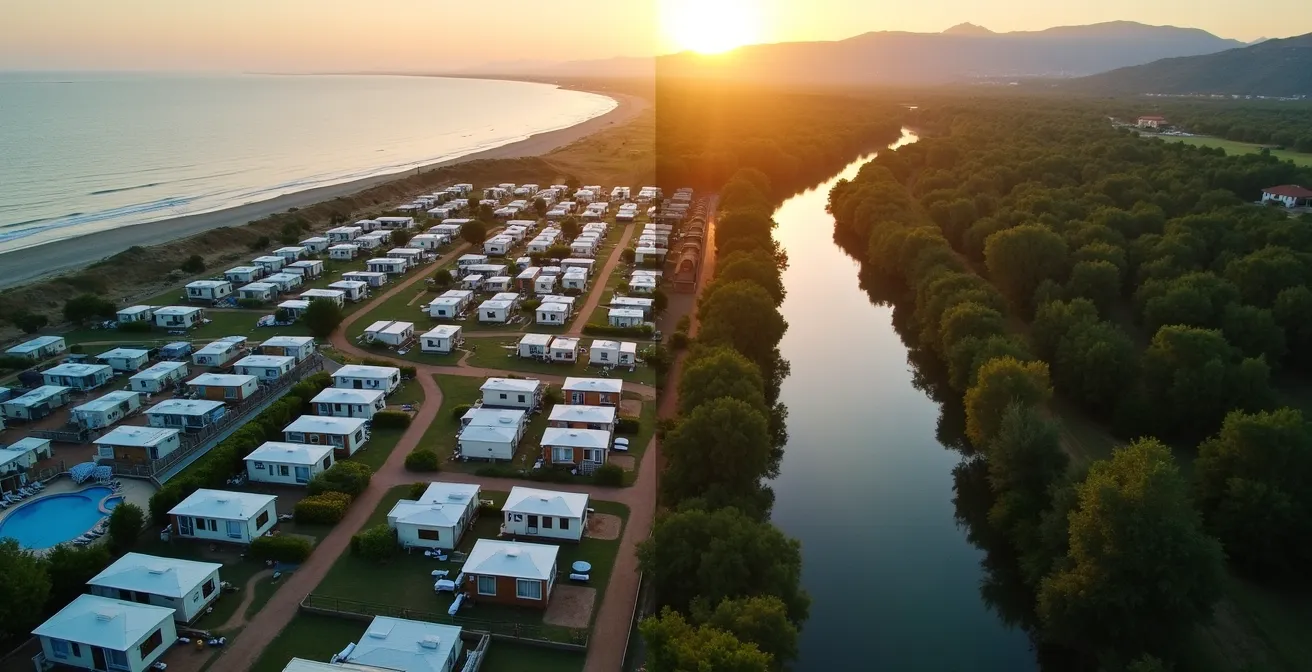
This contrast in scale is key. A sprawling 5-star resort may have 500 pitches, while a beloved 3-star site on an idyllic river may only have 80. This smaller site can sell out just as quickly, or even faster, due to its limited inventory and a fiercely loyal base of repeat visitors who book their same spot year after year, often before it even becomes available to the general public.
Booking Patterns by Nationality and Campsite Type
Dutch and German families who prioritize large 5-star resort campsites often book up to a year ahead, creating early scarcity. Meanwhile, small cult-favorite 3-star sites on idyllic rivers with only 80 pitches can sell out even faster due to limited capacity and loyal repeat visitors. The most sought-after accommodations (premium sea-view mobile homes, lodges with hot tubs) within any star rating sell out first to repeat bookers, regardless of the campsite’s overall rating.
Therefore, if you have your heart set on a specific type of accommodation—be it a giant resort or a small, charming site—early booking is always advisable. The most desirable spots are taken not because of their star rating, but because they offer a unique value that a loyal clientele recognizes and reserves well in advance.
Public vs Private Beaches: Where to Swim Without Paying 50 € for a Sunbed?
For many, a key part of the French camping experience is the beach. However, arriving at the coast to find it lined with expensive private beach clubs (‘plages privées’) charging €50 for a pair of sunbeds can be a shock. A common misconception is that these clubs own the beach, but French law is firmly on the side of the public. Understanding your rights and a few simple investigative techniques can ensure you always have free access to the sea.
The foundational principle is the ‘Loi Littoral’, a law that guarantees public access to the coastline. This is a powerful legal tool for every beachgoer in France. As the European Consumer Centre confirms, private concessions cannot block access to the water itself.
The ‘Loi Littoral’ and ‘servitude de passage’ guarantee that the first few meters of sand from the water’s edge are always public domain in France, even in front of the fanciest beach club.
– European Consumer Centre France, Legal Rights for Beach Access in France
This means you are always legally entitled to walk along the shoreline and lay your towel on the strip of sand closest to the water, even directly in front of an exclusive club. Private concessions can only rent out the space behind this public strip. The key is knowing how to find the larger public beach areas (‘plages publiques’) where you can set up for free without being crowded. Your smartphone is your best tool for this.
Here is a smart beach-goer’s guide to finding free access:
- Use Satellite View: Before you go, open Google Maps and switch to Satellite View. Private concessions are easy to spot: they look like neat, colored rectangles of perfectly aligned umbrellas and sunbeds. Public areas are the larger, irregular patches of tan or beige sand with randomly scattered towels and people.
- Look for ‘Accès à la mer’ Signs: These signs indicate official public pathways to the beach, often running between private properties or hotels.
- Target Specific Beaches: On the Côte d’Azur, for example, avoid the main, famous beaches like the Croisette in Cannes (which is dominated by concessions) and head to the western end, like Plages du Midi, which has vast public sections.
- Explore Protected Areas: Natural parks and protected coastlines, like the Calanques near Marseille or the L’Estérel massif near Saint-Raphaël, are home to stunning public coves (‘calanques’) that are entirely free.
- Check Local Maps: Local tourist office maps often explicitly mark ‘plage publique’, guiding you to the right spots.
By combining legal knowledge with modern mapping tools, you can confidently navigate any French coastal town and find the perfect spot to enjoy the sun and sea for free.
Does “Accessible” Really Mean Wheelchair Friendly in French Campsites?
For travelers with mobility needs, the term “accessible” can be dangerously ambiguous. A campsite might claim to be accessible because it has a ramp to the reception, while the path to the accommodation is gravel and the pool has no level access. In France, there is only one reliable way to ensure a campsite has been thoroughly audited for genuine accessibility: the official ‘Tourisme & Handicap’ label. This state-certified label is not an optional extra; it is the gold standard.
Unlike a simple star rating, the state-certified accessibility standard confirms that an establishment has been independently audited and meets stringent criteria for at least one of four disability types (motor, visual, hearing, mental). A campsite displaying the ‘Tourisme & Handicap’ logo for motor disabilities guarantees features like roll-in showers, sufficient turning space in rooms, and level access to main facilities. Relying on a campsite’s self-proclaimed “accessibility” without this label is a significant risk.
Even with the label, it is crucial to become your own auditor before booking. The needs of every individual are unique, and a generic label cannot cover all specifics. The best approach is to contact the campsite directly with a detailed checklist of questions. This not only gets you the precise information you need but also gauges the staff’s awareness and helpfulness regarding accessibility issues. Vague or dismissive answers are a major red flag. Your pre-booking investigation is the most important step in ensuring a safe and comfortable holiday.
Your Pre-Booking Accessibility Audit Checklist
- Pathways: Is the path from reception to the accessible mobile home and main facilities paved and level, or is it gravel, grass, or sloped?
- Accommodation Specifics: Can you provide photos and exact dimensions of the roll-in shower and the space around the toilet and bed?
- Pool Access: What is the exact gradient (percentage) of the pool access ramp, and is a pool-specific wheelchair available?
- Facility Access: Are there designated accessible toilets available near the pool, restaurant, and bar areas?
- Site Layout: What is the approximate distance from the accessible accommodation to the main facilities like the shop, restaurant, and beach/village?
By prioritizing campsites with the official ‘Tourisme & Handicap’ label and then following up with this targeted audit, you can book with confidence, knowing the site is equipped to meet your specific needs.
Key Takeaways
- The French star system is an administrative audit of infrastructure, not a review of experiential quality.
- Investigate beyond the stars by checking for expired ratings, analyzing guest reviews for specifics, and using satellite maps.
- True value is often found in lower-starred sites that prioritize maintenance and location over “point-chasing” for a higher rating.
Camping vs Hotel: Which Offers Better Value for a Family of 4 in August?
When planning a family holiday in high-season August, the question of accommodation type is central to the budget. While a hotel might seem like the default for comfort, a modern, high-quality campsite often presents a far superior value proposition, especially for a family. The comparison goes beyond the nightly rate; it involves a total cost analysis that includes meals, entertainment, and ancillary expenses. When all factors are considered, the financial savings of camping are substantial.
A hotel’s nightly rate is just the beginning of the expenses. A family of four is largely dependent on restaurants for every meal, and the cost of external activities and daily parking adds up quickly. In contrast, a campsite’s fee is largely all-inclusive. Entertainment, from pools and sports courts to kids’ clubs, is typically included. A mobile home with a full kitchen empowers the family to self-cater most meals, drastically reducing food costs. Parking is almost always free and adjacent to the accommodation. The table below breaks down a typical weekly budget during August.
| Cost Category | 4-Star Campsite (Weekly) | 3-Star Hotel (Weekly) |
|---|---|---|
| Accommodation | €280-350 (€40-50/night) | €840-1050 (€120-150/night) |
| Meals | €350 (mostly self-catered) | €980 (2-3 restaurant meals/day) |
| Entertainment | €0 (included on-site) | €280 (external activities) |
| Parking | €0 (included) | €70-140 |
| Total Weekly | €630-700 | €2,170-2,450 |
Beyond the raw numbers, modern premium campsites are blurring the lines between camping and hotel comfort. The rise of the “hybrid” campsite lodge offers a compelling alternative that combines the best of both worlds.
The Premium Campsite Hybrid Value Proposition
Modern 5-star campsite lodges offer hotel-level comfort, including air conditioning, en-suite bathrooms, dishwashers, and high-speed WiFi. They combine this with the unique benefits of camping: a private terrace for outdoor dining, BBQ facilities, the freedom for children to roam safely, and access to all on-site entertainment programs, pools, and sports facilities. A premium lodge for four people might cost €1,000-€1,400 per week in August—still significantly less than a comparable family hotel suite while providing three times the living space and full kitchen facilities.
Armed with this auditor’s perspective, you’re now ready to look beyond the plaque on the wall. By critically assessing the true value proposition of any French campsite, you can find the perfect match that delivers an outstanding holiday for your family’s specific needs and budget.