
A gated resort’s true value is not its wall, but its integrated “Security Ecosystem” designed specifically to contain a wandering child.
- Physical barriers are just the first layer; procedural safeguards like guest policies and staff training are equally vital for true security.
- Technology such as RFID wristbands and license plate recognition provides active, not just passive, containment measures for an anxious parent’s peace of mind.
Recommendation: When choosing a resort, you must audit its entire security system—from staff visibility to railing gaps—not just the presence of a front gate.
It’s a moment that lasts only a second but feels like an eternity: you look away, and when you look back, your curious, fast-moving toddler is gone. For parents of a “runner,” that flash of panic is a familiar, gut-wrenching dread. Planning a vacation, which should be a relaxing escape, becomes an exercise in risk assessment. How can you possibly unwind when every open door, crowded beach, or unfenced pool feels like a potential disaster? The standard advice—”just watch them more closely”—feels dismissive to anyone who understands the lightning speed and determination of a wandering toddler.
Many families turn to the idea of a gated resort as the obvious solution. The promise of a controlled environment seems like the only way to exhale. But here is the critical distinction that most parents miss: a gate is not a strategy. True safety is not a single feature but a comprehensive, multi-layered system. The most secure resorts don’t just build walls; they cultivate a complete security ecosystem where physical barriers, technological tools, strict procedures, and highly trained staff work in concert to create a bubble of safety. It’s an environment designed not just to keep unwelcome visitors out, but to keep your precious explorer safely in.
This guide moves beyond the simple “is it gated?” question. We will deconstruct the layers of a resort’s security ecosystem, giving you the expert framework to assess whether a property offers a genuine sanctuary or just the illusion of one. From wristband technology to the surprising security of a thorny hedge, you will learn to see a resort through the eyes of a security professional, ensuring your next family vacation is truly restful.
Summary: Why a Gated Resort Is Essential for Families with wandering Toddlers?
- The Wristband System: Why Wearing It Is Annoying but Necessary?
- Can My Friends Visit? Understanding the Strict Guest Policy
- Hedges vs Fences: How Green Barriers Can Be Just as Secure?
- License Plate Recognition: How It Stops Car Theft?
- The Midnight Curfew: What Happens if You Arrive After the Gates Lock?
- Uniforms and Badges: How to Recognize Staff from Intruders?
- The Railing Gap Danger: How to Baby-Proof a Rental Deck in 10 Minutes?
- Why Your 7-Year-Old Cannot Join the Full Day Canyoning Trip?
The Wristband System: Why Wearing It Is Annoying but Necessary?
That colorful plastic band snapped onto your wrist at check-in can feel like a nuisance, but for a parent of a runner, it is one of the most vital components of the resort’s security ecosystem. Its purpose goes far beyond all-inclusive access. Think of it as a tool for active containment. In the chaotic environment of a large resort, a child can disappear in seconds. In fact, statistics from Florida theme parks reveal that about 11 children are reported missing daily, a sobering reminder of how quickly separation can occur even in “magical” places. A simple, color-coded wristband immediately identifies your child as a registered guest, distinguishing them from any non-guest or child who may have wandered onto the property.
More advanced resorts utilize RFID technology within these bands, transforming them into a powerful safety device. This isn’t just about convenience; it’s a procedural safeguard. These systems can be programmed to trigger an alert if a child’s wristband is scanned at an exit point without a corresponding parent’s band. Some systems allow staff to scan a lost child’s band and immediately pull up essential, non-personal information, such as their designated muster station or the parent’s contact number, drastically reducing the time it takes to reunite a family. The momentary annoyance of wearing a wristband is an insignificant price to pay for a technological safety net that operates silently in the background, giving you an extra layer of protection.
Can My Friends Visit? Understanding the Strict Guest Policy
A resort’s guest policy is not about being antisocial; it is the primary procedural safeguard that gives the physical gate its meaning. An open-door visitor policy effectively renders a fence useless. A truly secure resort for families operates on a “closed-loop” principle: every single person inside the perimeter is accounted for. This is why front gate security will meticulously check arriving vehicles against a daily list of registered guests and staff. No one gets in unless they are on that list. This zero-tolerance approach is the bedrock of the entire security ecosystem.
When friends or family who are not staying at the resort want to visit, they will almost certainly be denied entry or required to purchase a day pass and go through a formal registration process. This involves showing ID, being issued a temporary wristband, and having their details logged. While it may seem inconvenient, this process ensures that the resort maintains a complete and accurate manifest of every individual on the property at all times. This strict control is what separates a truly secure, gated property from one that simply has a decorative fence. It guarantees that the person swimming next to your child in the pool is a registered guest who has been vetted through the same security protocol as you.
This table clearly illustrates the fundamental differences in access control, which is the core of a resort’s security promise.
| Security Feature | Gated Resorts | Open Resorts |
|---|---|---|
| Entry Control | 24/7 monitored gates | Open access |
| Guest Registration | Pre-registration required | Walk-in allowed |
| Visitor Tracking | ID verification & temporary passes | No tracking system |
| Perimeter Security | Complete enclosure | Partial or none |
Hedges vs Fences: How Green Barriers Can Be Just as Secure?
When you assess a resort’s perimeter, don’t just look for towering metal fences. A well-designed security ecosystem employs a layered defense, and sometimes the most effective barriers are the ones that blend into the landscape. A dense, mature hedge is not merely decorative; it can be a formidable “hostile plant barrier.” From a toddler’s perspective, a thick wall of green is just as impassable as chain-link, but without the institutional feel. The key is the type of plant and its density.

Top-tier resorts often use species like Pyracantha (Firethorn) or Barberry, which are packed with sharp thorns and grow into a tangled, impenetrable mass. A small child cannot push through this, and the sharp deterrent is often more effective at preventing an attempt than a smooth fence. This “green fence” serves multiple purposes: it provides a robust physical barrier, acts as a visual deterrent that blocks the view of anything tempting on the other side, and maintains the resort’s aesthetic appeal. It proves that thoughtful landscape architecture can be a powerful and integrated part of the property’s overall safety strategy, creating a secure boundary that feels natural and serene rather than restrictive.
License Plate Recognition: How It Stops Car Theft?
While the focus is often on keeping your toddler in, a comprehensive security ecosystem also excels at controlling who—and what—comes in and out. The vehicle entrance is a primary point of vulnerability, and modern resorts are increasingly moving beyond a simple security guard with a clipboard. License Plate Recognition (LPR) systems represent a crucial technological layer of defense. When you check in, your vehicle’s license plate is registered in the resort’s security system. From that point on, your entry and exit are automated and seamless.
But the true value of LPR is in who it keeps out. The system automatically flags any vehicle that is not on the pre-approved list of current guests, staff, or registered vendors. If an unauthorized car attempts to enter, security is instantly alerted. This system is a powerful deterrent against car theft, but its role in child safety is just as important. It ensures that no unknown vehicles can simply drive onto the property, significantly reducing the risk of abduction or other criminal activity. It creates a verifiable audit trail of every vehicle that has accessed the resort. This automated, unblinking surveillance of the perimeter’s main access point provides a level of control that human-only monitoring can’t match, tightening the security bubble around your family.
The Midnight Curfew: What Happens if You Arrive After the Gates Lock?
Arriving at your resort late at night after a long flight only to find the main gates locked can seem like a major hassle. However, this midnight curfew is another deliberate and critical procedural safeguard. Limiting access during the overnight hours is a strategic decision that allows the resort to maintain maximum control with minimal staff. Instead of monitoring multiple entry points, security can focus its resources on patrolling the grounds and responding to internal needs. It dramatically simplifies the task of ensuring the perimeter remains secure when visibility is low and most guests are asleep.
So, what happens if your flight is delayed? Reputable resorts have a strict protocol for late arrivals. Your booking information will have included an after-hours or emergency security number. You will contact this number and be directed to a specific checkpoint. There, a security officer will require your photo ID and reservation confirmation to verify you against the guest manifest. Once confirmed, they will grant you access, and some resorts may even provide a security escort to your accommodation to ensure you arrive safely. This controlled process ensures that even in the middle of the night, the resort’s “closed-loop” integrity is never compromised. The inconvenience is a direct trade-off for a guarantee that no one can wander onto the property unverified while your family sleeps.
Uniforms and Badges: How to Recognize Staff from Intruders?
In a security ecosystem, the staff are not just employees; they are the human firewall. They are the most active, observant, and interactive layer of your family’s protection. But their effectiveness is entirely dependent on one simple factor: your child’s ability to instantly recognize them as “safe” adults. This is why strict uniform policies and highly visible ID badges are non-negotiable elements of a secure resort. A crisp, consistent uniform makes staff members stand out in a crowd, providing an immediate visual cue for a lost child to approach for help.

Beyond simple visibility, the presence of a well-trained, uniformed staff creates a powerful deterrent. Intruders or those with ill intent are less likely to act when they see a professional and alert security presence. As a parent, you should take a moment upon arrival to point out the staff uniforms to your child. Teach them that if they ever get lost, they should look for someone wearing that specific shirt. The best family resorts invest heavily in this human element. For instance, the renowned staff training at Beaches Resorts focuses on creating genuinely caring experts in childcare, ensuring that the human firewall is not only visible but also approachable and effective. They become a trusted presence your child can rely on, transforming every staff member into a potential guardian.
The Railing Gap Danger: How to Baby-Proof a Rental Deck in 10 Minutes?
You’ve chosen a gated resort, but the security ecosystem extends all the way to the micro-level of your own room, especially the balcony. A beautiful ocean view can quickly become a parent’s worst nightmare. The most common danger is the gap in the railings. A curious toddler can slip through a surprisingly small space, or use furniture to climb over. As a child safety specialist, I insist that the first thing you do upon entering your room is a 10-minute safety audit of the balcony or deck. Do not assume it’s safe.
You must actively check for hazards. Move all chairs, tables, and planters far away from the railing to eliminate climbing opportunities. Check the locking mechanism on the balcony door; is it functional and out of your child’s reach? Some properties take this seriously; for example, a travel review notes that The Ritz-Carlton Orlando provides a six-pack of outlet covers as part of their standard family amenities, showing a commitment to in-room safety. However, you cannot rely on the hotel to do everything. You must be the final line of defense within your private space. Use this practical checklist to secure your rental deck immediately upon arrival.
Your 10-Minute Balcony Safety Checklist
- Perform the Can Test: Try to fit a standard soda can through the railing gaps. If it fits, the gap is dangerously wide for a toddler, and you must block it or prevent access to the balcony entirely.
- Clear the Climb Zone: Move all furniture—chairs, tables, loungers—at least four feet away from the railings to prevent any attempts at climbing.
- Test the Locks: Check every balcony door lock to ensure it is functional and secure. If your toddler can reach it, bring a temporary door stop or wedge to add another layer of security.
- Soften Sharp Corners: Identify any sharp corners on tables or railings at your child’s head height and apply temporary adhesive foam protectors you can bring from home.
- Secure the Gaps: For any immediate gaps you can’t otherwise block, a roll of heavy-duty painter’s tape can serve as a temporary, non-damaging solution to create a visual and physical barrier.
Key Takeaways
- A resort’s security is a multi-layered “ecosystem,” not just a single gate. Evaluate all its components.
- Procedural safeguards, like strict guest policies and staff training, are just as important as physical barriers.
- You are the final layer of security. Always perform your own safety audit of your room and balcony.
Why Your 7-Year-Old Cannot Join the Full Day Canyoning Trip?
It can be frustrating when your adventurous 7-year-old is denied a spot on an exciting excursion like a canyoning trip, especially when they seem perfectly capable. However, these age restrictions are not arbitrary rules; they are a non-negotiable part of the resort’s duty of care and a sign of a responsible security ecosystem. Activities like canyoning, zip-lining, or even certain water sports require not only physical strength and coordination but also a specific level of emotional maturity and the ability to follow complex, multi-step instructions in a high-stress environment. A 7-year-old simply does not have the same cognitive development or risk perception as a 12-year-old.
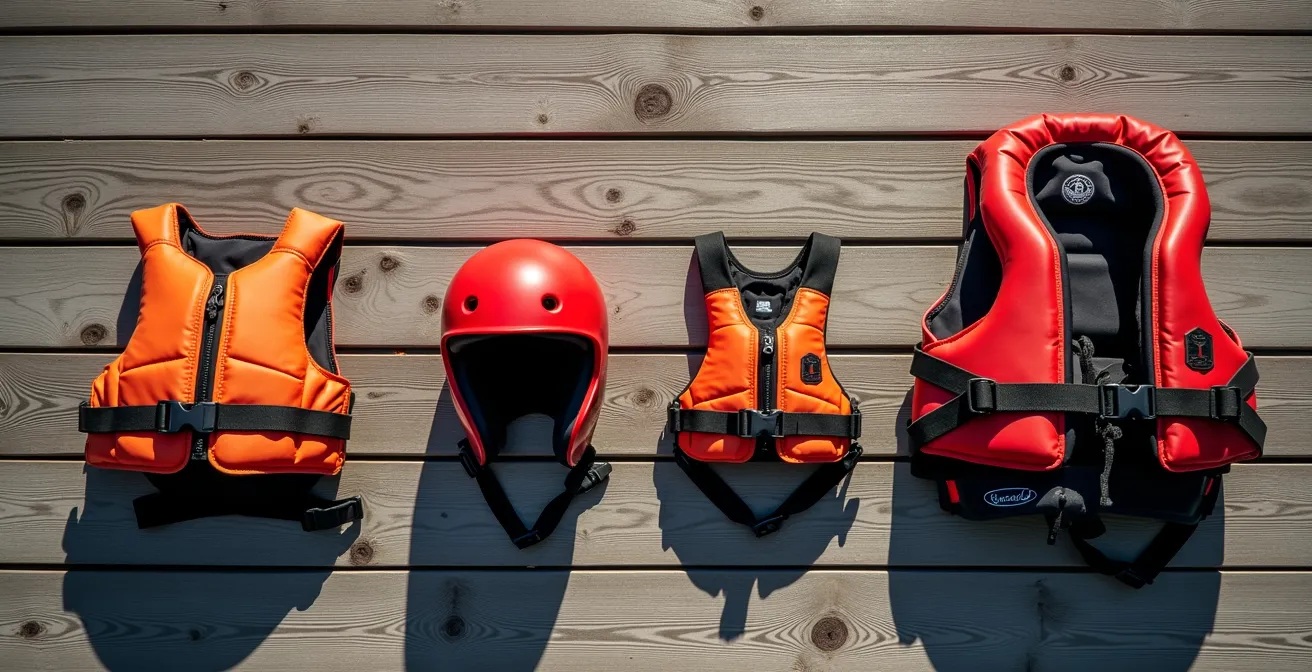
Furthermore, safety equipment itself is a major factor. Harnesses, helmets, and life jackets are designed and certified for specific weight and size ranges. Using ill-fitting equipment is incredibly dangerous and can lead to catastrophic failure. An operator that ignores its own safety guidelines and allows an underage child to participate is not “flexible”—it is negligent. Premier family resorts like Club Med build their reputation on this principle, employing qualified early childhood professionals who maintain strict staff-to-child ratios and design activities specifically tailored to the developmental stage of each age group. Accepting a firm “no” on age-restricted activities should be seen as a positive sign that you have chosen a resort that prioritizes your child’s life over a potential sale.
Ultimately, choosing a gated resort is an act of outsourcing a portion of your vigilance to a system you can trust. By learning to deconstruct and audit this security ecosystem—from its policies and people to its physical and technological barriers—you empower yourself to make an informed decision. This ensures you can finally take that deep, relaxing breath you deserve, confident that you have created the safest possible environment for your family’s precious vacation.