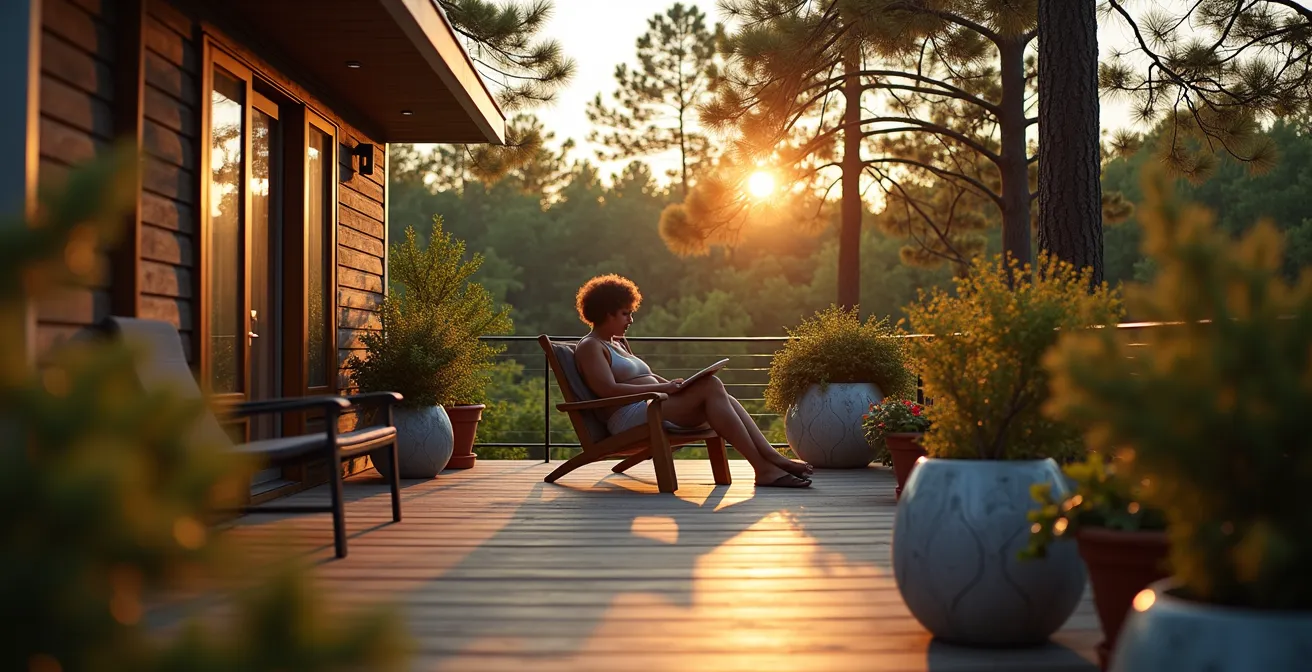
For an introvert, a large private deck isn’t an upgrade; it’s the essential element that transforms a campsite from a source of social anxiety into a true sanctuary for psychological decompression.
- It functions as a “transitional space,” creating a crucial buffer between your private refuge and the public campground.
- Intentional design allows you to craft a controlled “sensory bubble,” managing sight and sound for genuine rest.
- It provides the perfect “prospect-refuge” setting, allowing you to enjoy nature’s views from a position of safety and security.
Recommendation: Prioritize campsites offering this feature and consciously design your deck as a personal wellness tool, not just an outdoor floor.
For those of us who identify as introverts, the call of the wild is a powerful one. We crave the quiet expanse of nature, the rustle of leaves, and the freedom from the constant hum of social demands. Yet, the reality of modern camping can often be a jarring contradiction. The very escape we seek can place us in close proximity to neighbors, shared facilities, and the unavoidable social chatter of a bustling campground. It presents a paradox: we’re surrounded by nature, yet we struggle to find the personal space needed to truly connect with it.
The common advice often misses the point. We’re told to “find a secluded spot” or “just put up a privacy screen.” While these tips have merit, they treat privacy as a simple logistical problem to be solved. They fail to address the deeper psychological need for a space that feels not just separate, but safe, controlled, and restorative. This is where the true, often-underestimated value of a large, private deck comes into play. It’s more than just an amenity; it’s a piece of spatial design that can fundamentally change the camping experience for an introvert.
But what if we stopped seeing the deck as just an outdoor floor and started treating it as a ‘transitional space’? A purposefully designed sanctuary that mediates between the secure cocoon of your mobile home and the unpredictable beauty of the outdoors. This isn’t about building walls against the world, but about creating a controlled environment where we can let our guard down, enabling true psychological decompression. It’s the architectural key to unlocking the restorative power of nature, without the social cost.
This guide explores how to leverage this critical feature. We will deconstruct the ways a private deck serves an introvert’s needs, from creating a private yoga space to managing sensory inputs like noise. We’ll examine practical considerations like orientation and safety, all through the lens of maximizing personal well-being and creating your perfect outdoor haven.
Summary: Why a Private Deck Is an Introvert’s Most Essential Camping Tool
- How to Use Your Deck for Yoga Without Being Watched by Neighbors?
- South or West Facing: Which Deck Orientation Maximizes Your “Apéro” Time?
- The Railing Gap Danger: How to Baby-Proof a Rental Deck in 10 Minutes?
- Why a Semi-Covered Deck Is Essential for Camping in the Loire Valley?
- Ants and Wasps: How to Keep Your Outdoor Dining Area Pest-Free Naturally?
- Cicadas Noise: How to embrace the Sound of the South Without Losing Sleep?
- Pairing Local Cheeses with Your Vineyard Purchases: A Camper’s Guide
- Can You Really Fix Back Pain While Sleeping in a Campsite Mobile Home?
How to Use Your Deck for Yoga Without Being Watched by Neighbors?
For many introverts, activities like yoga or meditation are not exercise; they are essential practices for centering and recharging. The thought of being observed during these vulnerable moments can completely negate their benefits. Your deck is the perfect stage for this, but only if you can create a genuine sensory bubble. This is about more than just visual privacy; it’s about curating a space where your senses feel safe and unthreatened, allowing your mind to truly let go.

The key lies in applying the principles of Prospect-Refuge theory, a concept in environmental psychology. It states that humans feel most comfortable in spaces where they have a clear view (prospect) from a protected position (refuge). By positioning your yoga mat with your back to the solid wall of your mobile home (your refuge) and facing an open, natural view, you create a powerful sense of psychological safety. As one analysis of introverts in nature notes, this ability to find a personal refuge is key to recharging. As an expert from Introvert Dear explains, “I’ve done a few multi-week canoeing and camping trips with bigger groups, and found that every time I was feeling too ‘peopled out’ on these trips, I could just go sit by myself to recharge.” This principle of a secure ‘refuge’ is what transforms your deck yoga from a public performance into a private ritual.
To build this sanctuary, think in layers. Use portable privacy screens or even lightweight sarongs hung from adjustable poles to block direct sightlines. Introduce a sound barrier, either with high-quality headphones playing nature sounds or a small white noise machine. This intentional design reduces cortisol levels, quiets the hyper-vigilance that drains introverts, and allows you to fully immerse yourself in your practice.
South or West Facing: Which Deck Orientation Maximizes Your “Apéro” Time?
The orientation of your deck is not a trivial detail; it is a fundamental design choice that dictates the light, warmth, and, most importantly, the social exposure of your sanctuary. As a spatial designer focused on well-being, I can’t stress this enough: choosing the right orientation is the first step in aligning your outdoor space with your internal rhythm. For the classic “apéro” hour, the golden light of late afternoon is idyllic, but a west-facing deck often means more foot traffic as people return from their day’s activities. It’s a trade-off between ambiance and solitude.
Understanding the flow of a campground is key. Most activity congregates around central paths and amenities. An east-facing deck offers the ultimate quiet time in the morning, perfect for a peaceful coffee, while a north-facing deck provides consistent, cool shade and is often positioned away from the main hustle and bustle, making it a true introvert’s haven. The following table breaks down the pros and cons, helping you make a choice that prioritizes your peace of mind.
| Orientation | Best Time | Privacy Level | Introvert Benefits |
|---|---|---|---|
| West-Facing | 4-8 PM Golden Hour | Medium (more activity) | Vibrant sunset views but higher foot traffic |
| East-Facing | 6-10 AM | High (quiet mornings) | Peaceful sunrise coffee, minimal camper activity |
| North-Facing | All day shade | Highest | Consistent cool shade, faces away from main paths |
| South-Facing | 12-3 PM | Low (maximum exposure) | Full sun but most visible to others |
This decision is not just about sun exposure; it’s about curating your social interactions. By strategically choosing a deck that faces away from high-traffic zones, you are actively designing your environment to reduce unwanted social friction and maximize your opportunities for psychological decompression. It is a proactive step toward ensuring your camping trip is genuinely restorative. As shown by a comparative analysis of campground layouts, aligning your site with your privacy needs is paramount.
The Railing Gap Danger: How to Baby-Proof a Rental Deck in 10 Minutes?
An introvert’s ability to relax is directly tied to their sense of security. You cannot achieve a state of peaceful decompression if a part of your brain is constantly on high alert, monitoring a potential hazard. For campers with small children or pets, the gaps in a rental deck’s railings represent a significant source of this low-grade, constant anxiety. Addressing this issue swiftly and effectively is not just about safety; it’s about reclaiming your mental peace.
The good news is that you don’t need permanent modifications. A simple, no-damage kit can make any rental deck secure in minutes. The goal is to create a reliable barrier without drilling a single hole. Using materials like garden netting secured with heavy-duty, reusable zip ties provides a flexible and surprisingly strong solution. For larger gaps or openings near the mobile home, a foam pool noodle can be wedged in as an instant, soft filler. These small interventions are incredibly effective at silencing that nagging voice of worry in the back of your mind.
Interestingly, the same tools used for privacy can double as safety barriers. Well-placed privacy screens or even a sturdy tarp, which you might already have for creating a secluded sitting area, can be secured to railings to serve both purposes. This multi-functionality is a core principle of smart, efficient design. By solving the safety issue, you simultaneously enhance your sense of enclosure and privacy, reinforcing the deck’s role as a secure refuge. Only when your environment is truly safe can you fully relax and be present.
Why a Semi-Covered Deck Is Essential for Camping in the Loire Valley?
Weather is the one variable no camper can control, and in a region like the Loire Valley, known for its mix of brilliant sunshine and sudden showers, an entirely open deck can feel limiting. A semi-covered deck, however, transforms from a simple platform into a versatile, all-weather transitional space. It’s an ‘outdoor room’ that offers the best of both worlds: the open-air feeling of being in nature and a reliable shelter from the elements. This feature dramatically expands the usability of your most valuable private space.
The psychological impact of a roofed section is profound. It provides a tangible sense of shelter that powerfully enhances the ‘refuge’ aspect of the Prospect-Refuge theory. This feeling of being protected while still observing the outside world is deeply calming. As experts in the field have noted, this specific design element is ideal for focused, quiet activities.
A roofed section creates a stronger sense of ‘refuge’ making it the perfect spot for deep focus activities like reading, writing, or intimate conversation.
– Environmental Psychology Research, Prospect-Refuge Theory in Outdoor Design
This isn’t just a feeling; it has a measurable impact on behavior. When you have a guaranteed dry spot, you’re more likely to leave books, a journal, or a laptop outside, integrating your indoor comforts with your outdoor life. The data supports this, as industry research reveals that semi-covered decks increase outdoor living time by up to 50% in regions with variable weather. For an introvert, this extra time isn’t just a bonus; it’s more time spent in their personal sanctuary, decompressing and recharging, regardless of what the sky is doing.
Ants and Wasps: How to Keep Your Outdoor Dining Area Pest-Free Naturally?
Your serene deck sanctuary can be quickly compromised by the persistent intrusion of ants and wasps. For an introvert sensitive to their environment, these small invaders are more than a nuisance; they are a breach of the carefully constructed peace, forcing you into a state of agitated vigilance. Reclaiming control over your dining area is essential for a relaxing meal. The key is not to declare all-out war, but to use a subtle, natural, and strategic defense system.
Forget harsh chemicals. Your defense is about creating a perimeter that is unappealing to pests. Start by creating a scent barrier. Portable diffusers with peppermint oil placed at the corners of the deck work wonders against ants. For wasps, a centerpiece of fresh herbs like mint, basil, and lavender is not only beautiful but also a natural deterrent. Before sitting down to eat, spraying the table legs with a simple solution of clove oil and water can prevent ants from making their way up to your plate.
One of the most effective strategies is misdirection. About fifteen minutes before you plan to eat, set a “decoy” plate with something sweet (like a small piece of fruit or a drop of jam) about 20 feet away from your deck. This tactic lures wasps to a more appealing target, leaving your dining area in peace. This, combined with a disciplined 5-minute post-meal cleanup ritual where all food is stored in sealed containers, creates an environment that is simply not worth the effort for pests. This intentional design of your space ensures your meals remain a restorative experience, not a battle.
Cicadas Noise: How to embrace the Sound of the South Without Losing Sleep?
The sound of cicadas is the quintessential soundtrack of a southern summer—a vibrant, pulsating energy that is the very essence of the region. However, for a noise-sensitive introvert, this constant, high-frequency hum can quickly shift from atmospheric to oppressive, disrupting naps and preventing sleep. The conventional response is to try and block it out, but a more effective and mindful approach is to change your relationship with the sound itself.
Instead of fighting the noise, you can learn to re-frame it. A technique called ‘active listening meditation’ involves dedicating just five minutes each evening to simply sitting on your deck and focusing entirely on the cicada chorus. Notice its rhythms, its layers, its rise and fall. By consciously engaging with the sound instead of resisting it, you can transform it from an irritant into a form of natural white noise. For more direct intervention during sleep or naps, technology can help. Interestingly, acoustic research demonstrates that pink and brown noise masks high-frequency cicada sounds 40% more effectively than traditional white noise. Many free apps offer these specific sound frequencies.
Finally, you can work *with* the cicadas’ natural schedule. They are most active during the hottest part of the day, typically from 2 PM to 5 PM. Plan your active excursions or indoor time for this window. Schedule your quiet deck activities, like reading or morning coffee, for the early morning (6-10 AM) and late evening (after 8 PM) when they are dormant. This strategic scheduling allows you to embrace the sound as part of the authentic local experience, without letting it dominate your moments of psychological decompression.
Pairing Local Cheeses with Your Vineyard Purchases: A Camper’s Guide
The private deck truly fulfills its purpose as a sanctuary when it becomes the stage for moments of simple, sophisticated pleasure. It’s the perfect setting to unwind and savor the unique flavors of your travel destination. After a visit to a local vineyard, returning to your private enclave to pair your new wine with regional cheeses is an experience that elevates camping from rustic to refined. It’s a quiet celebration of place, enjoyed on your own terms.
You don’t need a full kitchen to create this moment. The beauty of it lies in its simplicity, which is why a minimalist, high-quality kit is all you need. The goal is to have the right tools that are both functional and a pleasure to use, enhancing the ritual. This isn’t just about eating and drinking; it’s about mindfully engaging your senses in your controlled, peaceful environment—the ultimate expression of introverted-friendly leisure.
Having a dedicated kit means you’re always ready for this impromptu moment of luxury. It’s about being prepared to create a peak experience without fuss or extensive preparation. It transforms your deck from a mere space into a destination for enjoyment.
Your Essential Wine & Cheese Kit Checklist
- A Quality Folding Knife: Check for a classic Opinel No. 8 or similar; it’s elegant, sharp, and perfect for both cheese and fruit.
- A Portable Cutting Surface: Inventory your gear for a foldable bamboo cutting board. It provides a clean, stable surface and packs away easily.
- Proper Glassware: Ensure you have a set of unbreakable but elegant Govino wine glasses. They feel better than plastic cups and enhance the wine’s aroma.
- Sustainable Food Storage: Locate your beeswax wraps. They are the ideal way to preserve leftover cheese without plastic, molding perfectly to any shape.
- Insulated Transport: Verify you have an insulated wine carrier. This not only protects your purchase but often doubles as a small cooler for your cheese.
Key Takeaways
- View your deck not as a feature, but as a “transitional space” you can design for psychological well-being.
- Use privacy screens, sound, and positioning to create a “sensory bubble” based on Prospect-Refuge theory.
- Proactively manage your environment—from pests and noise to safety—to eliminate low-grade anxiety and enable true relaxation.
Can You Really Fix Back Pain While Sleeping in a Campsite Mobile Home?
The single greatest threat to a restorative camping trip is poor sleep. For many, the notoriously firm or unsupportive mattresses in rental mobile homes can lead to nagging back pain, completely undermining any relaxation gained during the day. However, you are not powerless against a bad mattress. With a few key strategies, you can take control of your sleep environment and ensure you wake up refreshed, not sore.
The most impactful change you can make is to modify the mattress itself. While you can’t replace it, you can dramatically improve it. Campers consistently report that investing in a portable 3-inch memory foam topper transforms the sleeping experience. In fact, many users have found a significant impact, with one solo camping guide noting that 78% experienced significant pain reduction within just three nights. Paired with a dedicated lumbar support pillow to maintain the natural curve of your spine, this combination can neutralize even the most challenging rental mattress.
Your deck also plays a crucial role in your spinal health. Use it as a space for a 10-minute pre-sleep spinal decompression routine. Gentle movements like Cat-Cow stretches, spinal twists, and Child’s pose help to lengthen the spine and release the tension accumulated during the day. Performing these stretches in the calm, open air of your private deck is a powerful ritual that prepares both body and mind for a night of deep, restorative rest.

This proactive approach to sleep and spinal care ensures that your body can fully repair itself overnight. It’s the final piece of the puzzle, guaranteeing that your quest for psychological decompression is supported by deep physical restoration. After all, a rested mind is only possible in a rested body.
Ultimately, the private deck is far more than just a pleasant feature. It is the critical architectural element that allows an introvert to truly thrive in a campground setting. By understanding it as a wellness tool and intentionally designing it for privacy, security, and pleasure, you transform a simple camping trip into a deeply restorative retreat.