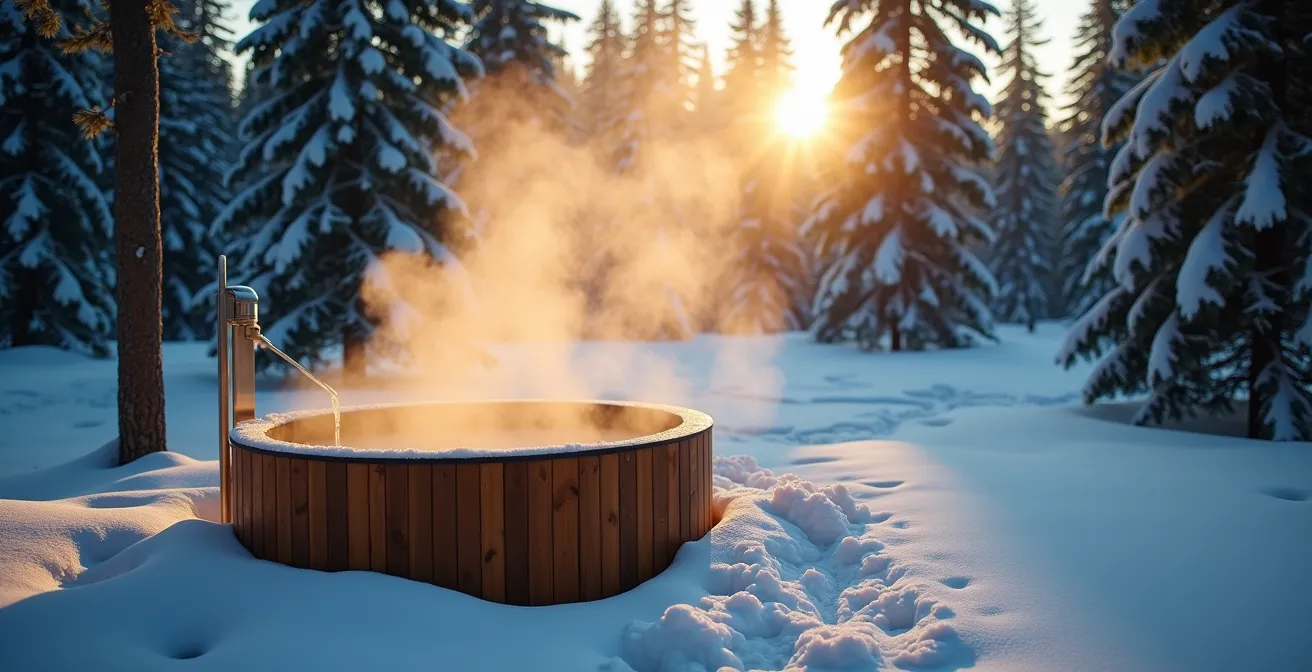
The ultimate luxury of a private Nordic bath isn’t just the warmth; it’s the profound physiological reset and sensory immersion that a standard jetted tub simply cannot provide.
- It transforms a simple soak into a silent, wood-fired primal ritual that engages all the senses, from the crackle of fire to the scent of cedar.
- It actively aids deep muscle recovery and resets your sleep cycle through natural temperature shifts, offering benefits far beyond mere relaxation.
Recommendation: For a truly restorative escape, prioritize accommodations offering a private, wood-fired Nordic bath over a conventional Jacuzzi.
Imagine the scene: the crisp, cool air of an autumn evening, the scent of pine and damp earth hanging in the twilight, and the stars beginning to prick the deep blue sky. For couples seeking a romantic escape during the quiet shoulder seasons, the allure of warmth is powerful. The common answer is often a “hot tub,” a feature synonymous with luxury camping. But this generic term lumps together two vastly different experiences: the churning, chlorinated world of a communal Jacuzzi and the serene, elemental embrace of a private Nordic bath.
While any hot water feels good on a cold day, we’ve been led to believe that more jets and more bubbles equal more luxury. This thinking overlooks the fundamental purpose of a wellness retreat: to quiet the noise, not add to it. What if the ultimate amenity wasn’t about mechanical force, but about a return to a more primal, sensory ritual? What if the true benefit lies not just in getting warm, but in a holistic experience that resets your body and mind in a way a buzzing tub never could?
This is the core of the private Nordic bath experience. It’s an invitation to engage in a thermal dialogue with nature—the intense, enveloping heat of wood-fired water against the invigorating chill of the air. It’s an acoustic sanctuary, where the only sounds are the crackling fire and your own heartbeat. This guide moves beyond the superficial to explore the profound physiological and sensory reasons why a private Nordic bath isn’t just another amenity; it is the definitive element of a restorative winter or autumn camping trip.
In this article, we’ll explore the critical differences in hygiene, the ritual of heating the water, the science behind muscle recovery, and how this ancient practice can profoundly reset your body’s natural rhythms. Prepare to see the humble “hot tub” in a completely new light.
Summary: The Definitive Guide to the Nordic Bath Experience
- Water Change Frequency: How to Ensure Your Private Hot Tub Is Sanitary?
- Wood-Fired Tubs: How Long Does It Really Take to Heat the Water?
- Jacuzzi Curfews: Why You Can’t Use Your Private Tub After 10 PM?
- Nordic Bath vs Jacuzzi: Which Is Better for Muscle Recovery After Hiking?
- Why You Should Book a Nordic Bath Accommodation for an October Trip?
- Hot Water Hygiene: How to Tell if a Jacuzzi Is Clean Before Getting In?
- Circadian Rhythms: How Natural Light Resets Your Biological Clock?
- Why Wooden Eco-Lodges Stay Cooler Than Plastic Mobile Homes in Summer?
Water Change Frequency: How to Ensure Your Private Hot Tub Is Sanitary?
One of the most immediate, though often unspoken, concerns with any shared water facility is hygiene. A private Nordic bath inherently resolves this by offering you complete control and transparency. Unlike large, high-traffic commercial Jacuzzis, a private tub is used only by you and is often drained and refilled with fresh water for each new guest. This simple fact eliminates the cumulative bather load and chemical buildup that are constant challenges in shared spas.
For public facilities, sanitation is a complex and continuous battle. To be considered safe, operators must maintain a minimum chlorine level of 3 ppm or a bromine level of 4 ppm, with testing required at least twice a day. These chemicals are necessary to combat the germs introduced by a high volume of users, but they can also cause skin irritation and the familiar, harsh “pool smell.” A private bath, filled with fresh mountain water for your exclusive use, bypasses this entire chemical-heavy system.
The experience is not just more pleasant but fundamentally cleaner. The water is yours alone, offering peace of mind that a shared tub cannot. You are not soaking in the remnants of countless strangers’ lotions, oils, and bacteria. This shift from a chemically managed public utility to a personal, fresh-water sanctuary is the first and most crucial step in elevating the experience from a simple hot tub dip to a true wellness ritual. It is the foundation of trust upon which genuine relaxation is built.
Wood-Fired Tubs: How Long Does It Really Take to Heat the Water?
The heart of the Nordic bath is its wood-fired stove, an element that transforms the act of heating water from a passive wait into an engaging, primal ritual. Unlike the instant-on, sterile hum of an electric Jacuzzi, preparing a wood-fired tub is a deliberate process. This isn’t a drawback; it’s a core part of the experience. It reconnects you with the elemental power of fire and builds a sense of anticipation and accomplishment.
So, how long does this ritual take? The answer depends on tub size, the starting water temperature, and the ambient air temperature, but industry data shows that wood-fired hot tubs typically heat in 1.5 to 4 hours. This investment of time is repaid with a superior quality of heat—a deep, radiant warmth that feels fundamentally different from the forced, blown heat of a jetted tub. You become the master of your own comfort, stoking the flames to achieve the perfect temperature.
This process is not just about patience; it’s about efficiency and a connection to the elements, as the following example demonstrates.
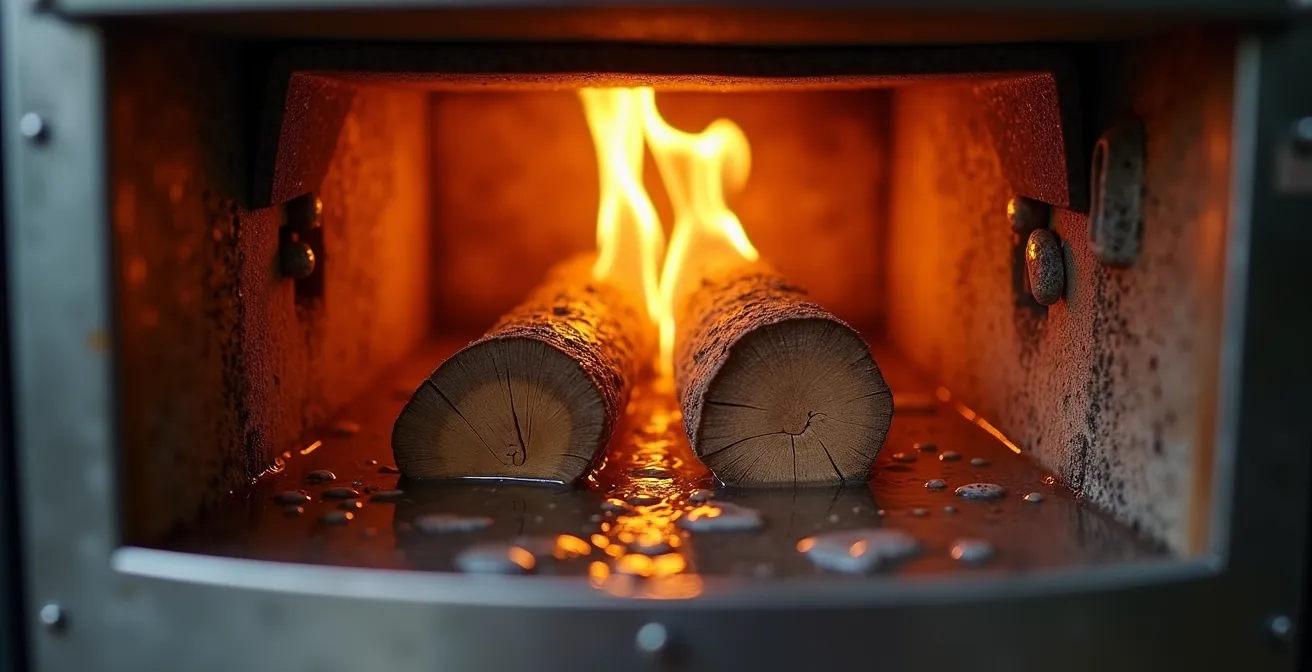
The radiant energy from the firebox creates an enveloping, silent heat that permeates the water thoroughly. This is the essence of the primal ritual—tending a fire to create your own sanctuary of warmth amidst the cool wilderness.
Case Study: The Efficiency of Wood-Fired Heating
A report from manufacturer Backcountry Recreation highlights the impressive performance of their 6′ x 4′ wood-fired tub. Holding 600 gallons of water, it can be heated from a chilly 40°F (4°C) to a blissful 105°F (40°C) in just 3.5 to 4 hours. This is noted as being four times faster than a conventional electric spa heater. Their recommended method involves starting with a roaring fire to reach 95°F, then reducing the fire to smaller logs to gently maintain the ideal soaking temperature of 102-106°F. This demonstrates how a hands-on approach provides both speed and precise control.
Jacuzzi Curfews: Why You Can’t Use Your Private Tub After 10 PM?
Many campsites and rental properties enforce a strict 10 PM curfew on the use of outdoor Jacuzzis, a rule that can feel restrictive, especially on a romantic getaway. This isn’t an arbitrary rule to spoil your fun; it’s a practical necessity born from the inherent nature of a jetted tub. The noise from the powerful pumps and churning jets, which may seem like a pleasant hum during the day, becomes a significant source of noise pollution at night.
In the stillness of a natural environment, sound travels surprisingly far, especially in the cold, dense air of an autumn or winter evening. This mechanical drone disrupts the peace for neighboring campers and, more importantly, disturbs local wildlife. Nocturnal animals rely on the quiet of the night for hunting and navigating their territory. The persistent hum of a Jacuzzi can create an “acoustic dead zone,” forcing them to abandon their natural habitats.
This is where the wood-fired Nordic bath reveals one of its most profound advantages: it operates in complete silence. There are no pumps, no jets, no electricity. The only sounds are the gentle crackling of the fire and the soft lapping of water. This creates a true acoustic sanctuary, allowing for an authentic sensory immersion in nature, day or night. You can soak under a midnight sky, listening to the hoot of an owl or the rustle of leaves, without causing any disturbance. This freedom from curfews isn’t just a convenience; it’s a testament to a design that respects its environment, allowing for a deeper, more harmonious connection with the wilderness around you.
Nordic Bath vs Jacuzzi: Which Is Better for Muscle Recovery After Hiking?
After a long day of hiking through crisp autumn forests, your muscles are tired and sore. The promise of a hot soak is what kept you going on that last mile. But not all hot soaks are created equal when it comes to effective muscle recovery. While a jetted Jacuzzi offers a form of hydro-massage, a silent Nordic bath provides a more systemic and arguably more beneficial form of physiological reset.
A Jacuzzi’s jets provide targeted myofascial release, which can feel good on specific sore spots like calves or lower back. However, the experience is active and can be noisy, which may not fully lower your body’s stress response (cortisol levels). The recovery is primarily mechanical.
A Nordic bath, in contrast, focuses on deep, static immersion in perfectly still, radiantly heated water. This promotes a systemic reduction in inflammation throughout the body. The silence and natural setting further enhance cortisol reduction, shifting your nervous system from “fight or flight” to “rest and digest.” Furthermore, the open-air design of a Nordic bath makes it ideal for contrast therapy—alternating between the hot water and the cold air. This process of vasodilation and vasoconstriction is a powerful tool for flushing lactic acid and reducing muscle soreness. This “thermal dialogue” with the elements is a cornerstone of Nordic wellness that a sheltered, enclosed Jacuzzi cannot replicate.
The following table, based on an analysis of Nordic bathing principles, breaks down the key differences for post-hike recovery:
| Feature | Nordic Bath | Jacuzzi |
|---|---|---|
| Heat Type | Static immersion (38-40°C) | Hydro-massage jets (36-40°C) |
| Recovery Benefit | Systemic inflammation reduction | Targeted myofascial release |
| Contrast Therapy | Easy transition to cold air/snow | Limited by location and jets |
| Cortisol Reduction | Enhanced by silent natural setting | May be limited by mechanical noise |
| Mineral Benefits | Often uses natural mineral water | Requires chemical treatment |
| Depth/Buoyancy | Typically deeper (full immersion) | Standard depth with seats |
Why You Should Book a Nordic Bath Accommodation for an October Trip?
October is a magical time for a romantic getaway. The summer crowds have vanished, the air is crisp, and the landscape is ablaze with the fiery colours of autumn. It is in this specific context that the private Nordic bath transforms from a simple amenity into the centrepiece of an unforgettable sensory experience. It’s about more than just staying warm; it’s about fully immersing yourselves in the unique beauty of the season.
The experience is a symphony for the senses: the visual feast of golden hour light filtering through red and yellow leaves, the earthy scent of damp earth and woodsmoke, the sound of the crackling fire, and the profound feeling of the enveloping heat of the water against the cool caress of the autumn air. This is the “sensory immersion” that a sterile, indoor, or plastic-shelled Jacuzzi can never offer. It’s an experience deeply woven into the fabric of its natural surroundings.
This is not just a theoretical benefit; it is an experience that resonates deeply with those who have tried it. As one guest shared about their shoulder-season escape:
The Finnish kota with its Nordic bath was absolute magic in October. The combination of crisp autumn air, the scent of damp earth, and soaking in mountain water heated by wood fire created an unforgettable experience. We could enjoy it morning, afternoon, at aperitif time, and even for a midnight bath under the stars.
– Guest, Camping Iscle de Prelles
To make the most of this unique opportunity, a little planning can elevate the experience from wonderful to truly sublime.
Your Checklist for the Perfect October Nordic Bath
- Plan for the “Golden Hour”: Aim to be in the tub between 4-6 PM, when the low autumn sun creates breathtaking visuals through the foliage.
- Bring a Thermos: Have a flask of warm herbal tea or mulled wine on hand to sip while you soak, enhancing the internal and external warmth.
- Layer for Transition: Keep fluffy robes or warm wool blankets nearby to make the transition from the hot water to the cool October air a cozy and comfortable part of the ritual.
- Check the Sky: October nights often bring clear, dark skies. Check the forecast for a cloudless night to combine your soak with some of the year’s best stargazing.
- Gather Dry Hardwood: Prepare your firewood in advance. October dampness can make starting a fire challenging, so ensure you have a stock of dry, seasoned hardwood ready.
Hot Water Hygiene: How to Tell if a Jacuzzi Is Clean Before Getting In?
While a private Nordic bath offers inherent cleanliness, you may still encounter a standard Jacuzzi at a larger campsite or hotel. Knowing how to quickly assess its hygiene can protect your health and peace of mind. Your senses are your best first line of defense. Before you even think about getting in, take a moment to look, feel, and smell.
First, look at the water clarity. You should be able to see the drain or floor of the tub clearly. Cloudy or murky water is a major red flag, indicating poor filtration or an overgrowth of bacteria. Second, check the waterline. A “scum line” of foam or oily residue suggests that the tub has not been cleaned recently and is accumulating body oils and other contaminants. Third, touch the sides of the tub below the waterline. They should feel smooth and clean, not slimy or sticky. A slippery film is likely biofilm, a colony of bacteria that is resistant to chlorine.
Finally, trust your nose, but be aware of a common misconception. According to a report on hot tub illness prevention from the CDC, a strong chemical smell is not a sign of cleanliness. In fact, it often indicates the opposite: that the disinfectant (chlorine) has combined with sweat, urine, and bacteria to form chloramines, which are irritating and less effective at killing germs. A truly clean and well-balanced tub has very little odour. Given that industry standards recommend changing hot tub water every 3-4 months for average residential use, a high-traffic commercial tub faces a constant battle for hygiene that these simple sensory checks can help you evaluate.
Circadian Rhythms: How Natural Light Resets Your Biological Clock?
The benefits of a Nordic bath extend far beyond clean water and muscle relaxation; they tap into the very core of our biology, specifically our circadian rhythms. Your “biological clock” is a master regulator of sleep, energy, and mood, and it is primarily calibrated by exposure to light and temperature changes. The modern indoor lifestyle, with its constant artificial light and stable temperatures, can dysregulate this delicate system. The outdoor Nordic bath experience serves as a powerful, natural reset button.
The key is the dynamic temperature shift. Soaking in hot water for an hour or so before bed raises your core body temperature. When you get out into the cool night air, your temperature begins to drop rapidly. This sharp decrease mimics the natural temperature drop that your body associates with sundown, sending a powerful signal to your brain to produce melatonin, the hormone that governs sleep. This makes falling asleep easier and improves the quality of that sleep.
Furthermore, the environment itself plays a crucial role. By soaking outdoors under the dim light of the moon and stars, you avoid exposure to the blue light from screens and indoor lighting. Blue light is a notorious suppressor of melatonin production. The low-light, natural environment of an evening soak in a Nordic bath protects your body’s natural sleep signals, aligning your internal clock with the rhythm of the day and night. This isn’t just relaxation; it’s a deep, physiological reset that leaves you feeling genuinely restored and synchronized with the natural world.
Key takeaways
- A private Nordic bath offers superior hygiene and a chemical-free experience compared to a shared Jacuzzi.
- The wood-fired heating process is a rewarding ritual, not a chore, connecting you to the elements of fire and water.
- Silent operation allows for 24/7 use without disturbing nature or neighbors, creating a true “acoustic sanctuary.”
Why Wooden Eco-Lodges Stay Cooler Than Plastic Mobile Homes in Summer?
The choice of a wooden Nordic bath is often paired with accommodation in a wooden eco-lodge or cabin, and this is no coincidence. The same principles that make wood the ideal material for a hot tub also make it superior for creating a comfortable living space in any season. The key lies in wood’s natural thermal properties. Wood has a high thermal mass, meaning it can absorb and store heat energy.
In summer, this means the thick wooden walls of a lodge absorb the sun’s heat during the day, keeping the interior cool. At night, they slowly release that heat, preventing the cabin from becoming too cold. A plastic or thin-metal mobile home, by contrast, has low thermal mass; it heats up instantly in the sun and cools down just as fast at night, creating an uncomfortable environment.
These same properties are what make wood, particularly FSC-certified cedar and spruce, the perfect insulator for a Nordic bath. As highlighted by manufacturers, the wooden staves of the tub are excellent at retaining the radiant heat from the wood stove, making the entire structure highly energy-efficient. It keeps the water hot for longer, even in the freezing cold. This natural ability to manage temperature creates a more stable, comfortable, and sustainable environment, whether it’s for your lodging or your soak. It’s a holistic system where the material choice reflects a deeper commitment to quality, comfort, and harmony with nature.
By choosing an accommodation that pairs a wooden lodge with a private, wood-fired Nordic bath, you are opting for a complete wellness system—one that offers sensory delight, physiological benefits, and is built in harmony with the natural world. It is, in every sense, the ultimate winter camping amenity.
Frequently Asked Questions about Private Nordic Baths
Why are wood-fired tubs often exempt from strict curfews?
Wood-fired Nordic baths operate silently without pumps or jets, producing only the gentle crackling of wood, making them less disruptive to nocturnal wildlife and neighboring campers.
How does cold air affect sound travel at night?
Cold, dense air near the ground creates a temperature inversion that can cause sound waves to bend back toward the earth, allowing mechanical pump noise to travel much further than during warm daytime conditions.
What wildlife is most affected by nighttime hot tub use?
Nocturnal mammals like deer, foxes, and owls rely on quiet environments for hunting and feeding. Artificial light and mechanical noise can disrupt their natural patterns and force them to avoid valuable habitat areas.
How does a pre-bedtime Nordic bath improve sleep?
The rapid temperature drop when exiting the hot bath mimics your body’s natural evening cooling, triggering the release of melatonin and signaling it’s time for sleep.
What’s the ideal timing for an evening soak?
Soak 60-90 minutes before your intended bedtime to allow your core body temperature to drop naturally, aligning with your circadian rhythm.
How does stargazing from the tub protect melatonin production?
The low-light environment of outdoor Nordic bathing avoids the blue light exposure that suppresses melatonin, unlike indoor spa facilities with bright lighting.