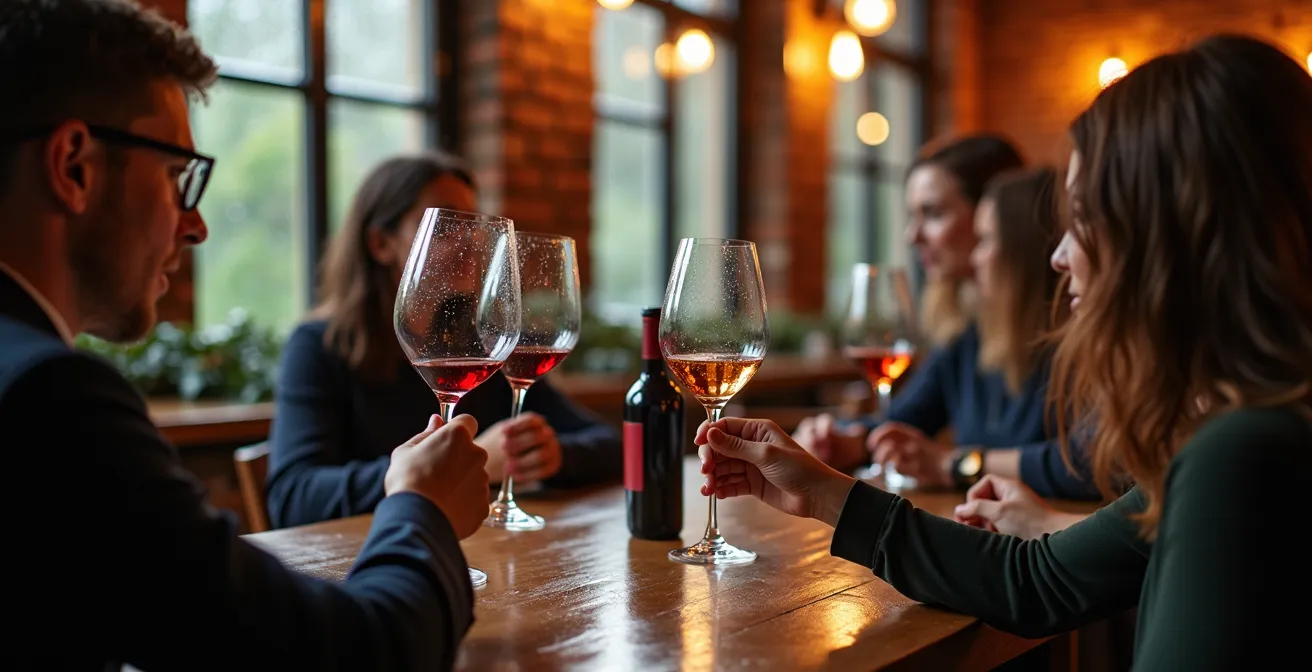
In summary:
- A rainy day offers a perfect opportunity to master wine tasting as a structured, educational skill.
- Learning professional protocols, like when to spit and how to manage alcohol intake, empowers you to taste responsibly and safely.
- You can transform a simple tasting into an engaging workshop for the whole family, including children.
- Knowing how to identify authentic wineries and navigate tasting etiquette removes the pressure to buy, enhancing the experience.
A sudden downpour can feel like a disaster when you’re camping. Tents get damp, hiking trails turn to mud, and the planned outdoor adventure is washed away. The typical response is to find the nearest town and kill time in a café or a generic tourist shop. Many might consider a winery visit, but often approach it as just a way to drink indoors, missing the real opportunity it presents. This approach often leads to awkward encounters, pressure to buy expensive wines, and a general sense that you’re not getting the most out of the experience.
But what if that rainy day wasn’t a setback, but a strategic advantage? The truth is, a wine tasting can be far more than a simple distraction. It can be a structured, educational, and deeply rewarding workshop. The key isn’t just to *find* a tasting, but to understand the mechanics and etiquette behind it. When you approach it as a skill to be learned—much like mastering a new knot or navigating with a compass—you transform a passive activity into an empowering one. This guide reframes the rainy day wine tasting, moving beyond casual sipping to provide a complete framework for becoming a confident, knowledgeable taster.
We’ll explore the professional protocols that separate amateurs from connoisseurs, address the critical safety aspect of tasting and driving, and even show you how to include the entire family. You’ll learn to distinguish genuine winemakers from tourist traps, handle the delicate situation of tasting without buying, and optimize your experience down to the biological best time of day. By the end, that rainy day will be the reason you gained a new, sophisticated skill.
This article provides a complete roadmap to mastering the art of the wine tasting workshop. Below, the table of contents outlines each skill and strategy we will cover to turn you from a casual visitor into a confident participant.
Summary: Why a Wine Tasting Workshop Is the Best Rainy Day Activity?
- Spit or Swallow: What Is the Polite Protocol at a French Tasting?
- The Breathalyzer Test: How many Samples Put You Over the French Limit?
- Grape Juice for Kids: How to Include Children in the Tasting Ritual?
- Free Tasting vs Obligation to Buy: How to Leave Without Spending 100 €?
- Why 11 AM Is the Biological Peak for Wine Tasting?
- The “Free Tasting” Scam: How to Spot Genuine Winemakers vs Tourist Shops?
- Château de Chambord or Local Winery: Which to Prioritize on a Short Trip?
- Saint-Vincent Tournante: Which Festivals Are Worth the Crowds?
Spit or Swallow: What Is the Polite Protocol at a French Tasting?
The first hurdle for many at a serious tasting is the spittoon. It feels counterintuitive, even rude, to spit out good wine. However, in a professional or educational context, spitting is not just accepted; it’s expected. The goal of a tasting workshop is sensory evaluation, not intoxication. Spitting allows you to analyze dozens of wines while keeping your palate sharp and your judgment clear. Your palate becomes fatigued and less discerning with each sip you swallow due to rising alcohol levels. Professionals who taste hundreds of wines a day rely on this technique to do their job effectively.
The science backs this up. The goal is to coat your mouth to engage all your taste buds, but to minimize actual alcohol absorption. While some alcohol is absorbed through the mucous membranes in the mouth, it’s a tiny fraction compared to swallowing. In fact, research shows an average BAC of 0.0026% when spitting compared to 0.05% when swallowing the same amount of wine. This is the fundamental principle of palate calibration: you are preserving your primary tool—your sense of taste—for the entire duration of the workshop.
Mastering the technique removes any awkwardness and signals that you are there to learn. It’s a matter of confidence and control, turning a potentially embarrassing moment into a display of competence. The key is to be discreet and decisive.
Your Action Plan: The Professional Spitting Technique
- Take a moderate sip (about 5-10ml) and swirl it around your mouth for 5-10 seconds to ensure it coats all surfaces.
- Form a small ‘O’ shape with your lips, keeping your teeth slightly apart to create a channel.
- Lean slightly over the spittoon and use controlled pressure from your diaphragm and cheeks to create a steady, quiet stream.
- Aim for the center of the spittoon with a confident, single motion to avoid splashing.
- Rinse with water between different wines to cleanse the palate and further reduce residual alcohol absorption.
The Breathalyzer Test: How many Samples Put You Over the French Limit?
Understanding the protocol of spitting leads directly to the most critical practical question, especially for campers who need to drive: how much is too much? A typical tasting pour is small, usually around 15ml (or half an ounce), but they add up quickly. Swallowing even a few of these samples can easily put you over the legal driving limit, which in France is 0.5 grams per liter of blood (equivalent to a 0.05% BAC). For novice drivers, the limit is even lower at 0.2 g/L.
The difference between spitting and swallowing is dramatic and cannot be overstated. A study called the “Bac(chus) Wine Tasting Experiment” provided clear data. Participants who spat out ten 15ml samples over an hour had Blood Alcohol Concentrations (BAC) ranging from just 0.01% to 0.06%. In contrast, those who swallowed the same amount had BACs ranging from 0.3% to a staggering 0.63%, well over the legal limit in most countries. This demonstrates that with proper technique, you can taste extensively and remain safe to drive.
This isn’t about being overly cautious; it’s about being a resourceful and responsible planner. The risk is real, and relying on “feeling fine” is a dangerous gamble. Factors like body weight, food intake, and wine strength all affect alcohol absorption, making it highly unpredictable. The only reliable strategy is to control the intake itself through a disciplined tasting protocol.

The table below clearly illustrates the stark difference in outcomes based on your chosen method. It serves as a powerful reminder that the decision to spit or swallow is not just about etiquette, but about safety and legality.
| Method | Number of Wines (15ml each) | Time Period | Average BAC | Legal Driving Status |
|---|---|---|---|---|
| Spitting | 10 | 1 hour | 0.0026% | Safe in all countries |
| Swallowing | 10 | 1 hour | 0.3-0.63% | Over limit in most countries |
| Professional tasting (spitting) | 30 | 2 hours | ~0.008% | Generally safe |
Grape Juice for Kids: How to Include Children in the Tasting Ritual?
A rainy day activity shouldn’t mean splitting up the family. While wine tasting is an adult pastime, its core principles can be adapted into a fascinating and educational experience for children. The key is to shift the focus from alcohol to the practice of sensory evaluation. By creating a parallel “tasting” for kids, you not only keep them engaged but also introduce them to the fundamentals of appreciating flavors and aromas in a structured way.
Set up a “junior sommelier” flight for them using a variety of high-quality grape juices (white and red), apple juice, and perhaps cranberry or cherry juice. The goal is to mimic the adult process. Give them their own small glasses and a simple scorecard. Guide them through the same four steps professionals use: Look, Swirl, Smell, and Taste. This ritual teaches mindfulness and helps develop their palate and vocabulary for describing what they experience. As one Wine Education Specialist from the San Francisco Wine School notes, this approach helps develop their palate and creates positive family traditions around mindful consumption.
You can turn it into a game. Ask them to identify colors, guess the fruit, or rate sweetness. This active participation makes them feel included and valued, transforming what could be a boring afternoon for them into a memorable part of the trip. It’s a resourceful way to ensure the workshop is a success for everyone, fostering a sophisticated appreciation for flavor that will last a lifetime.
- Create a Flight: Pour small amounts of 3-4 different juices like white grape, red grape, apple, and cranberry.
- Provide Tools: Give them child-sized glasses and a simple tasting card with pictures or star ratings.
- Follow the Steps: Guide them to look at the color, gently swirl the glass, smell the aromas, and finally taste the juice.
- Encourage Description: Ask them to describe what they smell and taste. Is it like berries? Apples? Use a flavor wheel with pictures to help them find the words.
- Make it Official: Award them a “Junior Sommelier” certificate at the end to celebrate their new skills.
Free Tasting vs Obligation to Buy: How to Leave Without Spending 100 €?
One of the biggest sources of anxiety during a tasting is the perceived pressure to buy. You’ve taken up the host’s time, consumed their product, and now feel a powerful social obligation to purchase a case of wine you may not want or can’t transport. This is especially true at places offering “free” tastings. The key is to understand that a tasting is a transaction: you are giving your time and attention in exchange for an educational experience. A purchase is a potential outcome, not a requirement.
The most effective tool is a set of polite, prepared exit strategies. Having a few gracious scripts in your back pocket removes the awkwardness and allows you to leave confidently without offending your host. The goal is to express genuine appreciation for the experience and the education, while providing a plausible reason for not purchasing at that moment. This maintains goodwill and shows respect for the winemaker’s craft.
Case Study: The Estate Model vs. The Tourist Funnel
Consider the difference in approach between a high-pressure tourist shop and a genuine wine estate like those in Napa Valley. Tourist-focused businesses often use “free” tastings as a loss-leader to funnel visitors into a high-pressure sales environment. In contrast, premier estates like Trefethen Family Vineyards focus on the experience itself—the history, the land (terroir), and the winemaking process. They see the tasting as part of their brand’s story. While they appreciate sales, their primary goal is to create a memorable, educational journey that builds a long-term relationship with customers, who may order online later. Understanding this distinction helps you identify which type of establishment you are in and adjust your expectations accordingly.
Remember, your presence and thoughtful questions are valuable. You are not a freeloader; you are an engaged participant in a marketing and educational event. A confident and polite exit is the final part of a successful tasting protocol.
Your Action Plan: Gracious Exit Strategy Scripts
- “Thank you so much for your time and expertise. I have a few more wineries to visit today to make my final decision, but I truly appreciate this tasting.”
- “This has been wonderful. I’m traveling light and can’t carry bottles, but may I have your card to look into ordering online later?”
- “I really appreciate the education. As I’m still learning about my own palate, I want to taste a bit more before committing to a full case.”
- “Your wines are lovely. I need to discuss with my partner before we make a purchase—do you happen to ship?”
- “Thank you for this experience. I’m taking detailed notes from several tastings today and will be sure to circle back once I’ve compared them.”
Why 11 AM Is the Biological Peak for Wine Tasting?
Organizing a successful workshop means considering every variable, and one of the most overlooked is timing. While you can taste wine any time of day, your palate is not a constant. It has its own rhythm, and scheduling your tasting to coincide with its peak performance can dramatically enhance the experience. Most people’s senses are sharpest in the late morning, making this the “golden hour” for sensory evaluation.
According to wine professionals, the period between 11 AM and 1 PM is the biological peak for palate sensitivity. By this time, you’ve been awake long enough for your senses to be fully alert, but you haven’t yet eaten lunch, which can coat the palate and interfere with your ability to discern subtle flavors and aromas. Your mouth is relatively clean and your mind is focused. As noted by experts at Vincarta, a wine education platform, “in the morning everything seems better than it is,” because your senses are heightened. This heightened state is exactly what you want for a detailed analysis of wine.
Furthermore, practical considerations align with this biological peak. Wineries are often less crowded in the morning than in the mid-afternoon, allowing for a more personal and in-depth conversation with your host. You’re more likely to get the full attention of the winemaker or a senior staff member. Planning your tasting for this window is a simple but powerful strategy. It’s a hallmark of a resourceful planner who thinks not just about the “what” but also the “when,” ensuring the best possible conditions for learning.
The “Free Tasting” Scam: How to Spot Genuine Winemakers vs Tourist Shops?
Not all wine tastings are created equal. On a rainy day in a tourist town, you’ll be bombarded with signs for “Dégustation Gratuite” or “Free Tasting.” While tempting, these are often red flags for a tourist trap, not an authentic winery. A genuine wine estate, or *domaine*, is a working farm. Their primary business is making and selling high-quality wine. A tourist shop’s primary business is selling to tourists, and the “wine” might be a generic, mass-produced product with a fancy label. Being able to tell the difference is a crucial skill.
A key indicator is the tasting fee. As one wine industry professional from Total Wine & More explains, “Charging a tasting fee, often redeemable with purchase, signals that the wine is valuable, the experience is curated, and the establishment is a serious producer.” This fee covers the cost of the wine poured and the expert’s time. It filters for visitors who are genuinely interested in the craft. Conversely, aggressive “free” offers often signal a business model reliant on high-pressure sales of overpriced, low-quality wine and souvenirs.
Look for other green flags: Is the tasting room located on an actual vineyard, or on a main street next to T-shirt shops? Does the staff talk passionately about their specific soil (terroir), grape-growing methods, and the challenges of the last vintage? Or do they just pour and push for a sale? A genuine winemaker offers an educational experience, not just a transaction.
This checklist will help you quickly assess whether you’re at a genuine estate or a tourist trap, allowing you to invest your time and money wisely.
| Red Flags (Tourist Traps) | Green Flags (Genuine Estates) |
|---|---|
| Prominent ‘FREE TASTING’ signs everywhere | Requires advance reservation or appointment |
| Located on main tourist street | Off the beaten path, in an actual vineyard |
| More souvenirs than wine for sale | Focus entirely on their wine production |
| No information about vineyard or process | Detailed discussion of terroir and winemaking |
| Generic bulk wines with fancy labels | Estate-grown, limited production wines |
| High-pressure sales tactics | Educational focus, no pressure to buy |
| Staff can’t answer technical questions | Winemaker or family member leads tasting |
Château de Chambord or Local Winery: Which to Prioritize on a Short Trip?
When time is limited, a difficult choice often arises: do you visit the grand, famous château that’s on every postcard, or the small, family-run winery that promises a more authentic connection? There is no single right answer; the best choice depends entirely on your primary goal for the day. As a resourceful activity coordinator, the solution is to define your priorities before you go. Are you seeking historical grandeur and iconic photo opportunities, or are you seeking skill-building and an authentic taste of the local craft?
A grand château like Chambord offers breathtaking architecture and a deep dive into history. The experience is about sightseeing and spectacle. While they may offer wine, it is often secondary to the main attraction. A local winery, on the other hand, puts the wine and the winemaking process at the absolute center of the experience. It’s an opportunity for a hands-on workshop, a direct conversation with the person who made the wine, and a much deeper sensory evaluation of the product.
On a rainy day, a local winery often has a distinct advantage. Many have cozy indoor tasting rooms or even atmospheric wine caves that provide a perfect refuge. As seen in regions like Napa Valley, wineries with caves offer a unique and intimate alternative to traditional tasting rooms, making the rain an asset rather than a liability. To make the best decision for your group, use a simple decision framework.
- Rate Your Interest in ‘Historical Grandeur & Sightseeing’ (1-10): How important is it for you to see the famous landmark?
- Rate Your Interest in ‘Authentic Connection & Skill-Building’ (1-10): How important is it to learn about wine and meet the makers?
- Compare Scores: If “Historical” wins by 3+ points, choose the château. If “Authentic” wins by 3+ points, choose the local winery.
- If Scores Are Similar: Consider a split day. Visit the château in the morning for photos and the winery in the afternoon for a focused tasting workshop.
Key Takeaways
- Spitting is the professional standard for tasting; it preserves your palate and prevents intoxication.
- Swallowing just a few tasting pours can put you over the legal driving limit. A disciplined spitting protocol is essential for safety.
- Authentic wineries often charge a tasting fee, which is a sign of quality and a curated, educational experience.
Saint-Vincent Tournante: Which Festivals Are Worth the Crowds?
Beyond individual winery visits, the world of wine offers larger events like village fêtes and professional festivals. These can be a fantastic way to taste a wide variety of wines in one place, but they can also be overwhelming, crowded, and counterproductive to learning if you don’t choose wisely. The famous Saint-Vincent Tournante in Burgundy, for example, is a massive celebration of tradition and atmosphere, but its enormous crowds make serious, focused tasting nearly impossible. The key is to match the type of festival to your goal.
As with choosing a winery, you must first define your objective. Are you looking for a social experience with music and a party atmosphere? Or are you looking to have serious conversations with producers and discover new, high-quality wines? Each type of festival offers a different balance of crowd size, learning opportunity, and wine quality. A large “atmosphere” festival is great for soaking in local culture, while a smaller, professional salon or a winery’s open-door day is far better for a structured tasting workshop.
To navigate these events successfully, a few survival strategies are essential. Arriving right at the opening time allows you to taste with a fresh palate before the biggest crowds descend. Having a target list of 3-5 producers you want to visit prevents aimless wandering. And most importantly, use the spittoon from the very first sample. It is the only way to maintain sensory clarity and make it through the day. Remember to stay hydrated with water and avoid wearing scented products that will interfere with your ability to smell the wine.
This comparative table helps categorize different event types, allowing you to choose the one that best fits your “rainy day workshop” objective.
| Festival Type | Crowd Size | Learning Opportunity | Wine Quality | Best For |
|---|---|---|---|---|
| Atmosphere Festivals (Saint-Vincent) | Very Large (1000+) | Low | Variable | Social experience, tradition |
| Professional Salons | Medium (200-500) | Very High | Excellent | Serious tasting, buying |
| Village Fêtes | Small (50-200) | High | Good | Personal interaction, authenticity |
| Winery Open Days | Small-Medium | High | Excellent | Education, direct producer contact |
By transforming a simple tasting into a structured workshop, you’ve turned a potential vacation disaster into a moment of growth. You’ve acquired a new skill, navigated complex social etiquette with confidence, and made a memorable experience for your entire group. This resourceful mindset is the ultimate tool for any traveler.