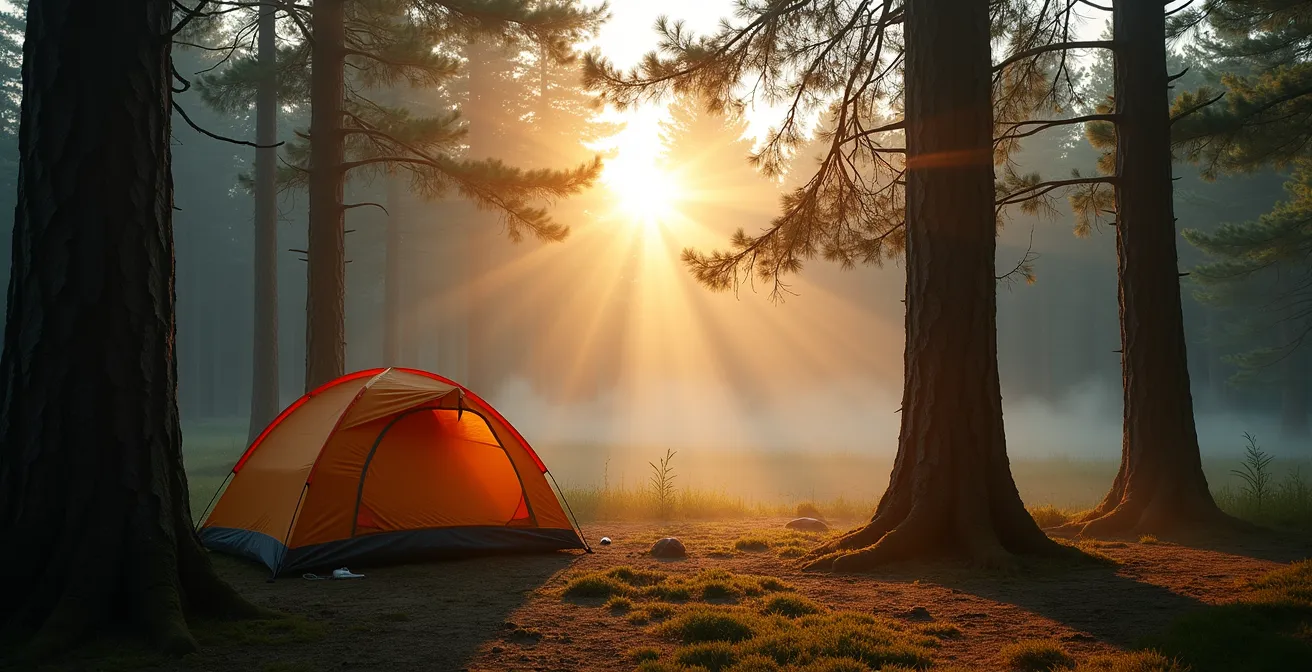
True mental restoration from camping isn’t passive; it’s an active process of substituting urban overload with deep, sensory immersion in the wild.
- Genuine wilderness (like Natura 2000 sites) provides the low-stimulus environment necessary for your brain to begin its recovery process.
- Engaging your senses mindfully—through birdwatching, listening to the forest, or even smelling the pines—directly lowers cortisol and enhances cognitive function.
Recommendation: Prioritize campsites that facilitate direct, unfiltered engagement with nature over those that simply offer a green backdrop. This is the key to unlocking profound stress reduction.
For the urban dweller trapped in a cycle of notifications, deadlines, and concrete landscapes, the promise of a “nature escape” can feel like a lifeline. We’re often told that fresh air and a change of scenery are all it takes to reset. But many return from a weekend away feeling just as drained, their minds still racing. The conventional wisdom about simply “being outdoors” misses a crucial point. It often overlooks the profound psychological mechanisms at play and the difference between a campsite next to a highway and one nestled in true wilderness.
The solution isn’t just to disconnect from technology; it’s to reconnect with something more fundamental. If the true key to healing burnout wasn’t just the absence of urban stress, but the active presence of natural, restorative stimuli? This is the core of ecotherapy: the understanding that our brains are wired for a deep, biophilic connection with the natural world. Chronic stress disrupts this connection, and true recovery involves intentionally rebuilding it through active sensory immersion.
This guide will move beyond the platitudes. We will explore the science and strategy behind choosing and experiencing a nature-based camping trip that genuinely heals the mind. We will delve into how to identify authentic wilderness, how to engage your senses to maximize cognitive benefits, and how to manage common challenges to transform your next camping trip from a simple vacation into a powerful therapeutic experience.
This article provides a roadmap for urbanites seeking genuine mental relief. Follow along to discover how to strategically use nature to combat burnout, from selecting the right environment to adopting practices that foster deep relaxation and psychological restoration.
Summary: A Guide to Healing Burnout Through Immersive Nature Camping
- Natura 2000 vs National Parks: Which Designation Guarantees True Wilderness?
- How to Teach Your Kids Respect for Wildlife Without Being Boring?
- The 3 Red Flags of “Eco-Friendly” Campsites That Are Actually Polluting
- Binoculars or Camera: What to Pack for Birdwatching in French Wetlands?
- Waking Up at Dawn: The Secret to Seeing 3x More Animals During Your Stay
- Cicadas Noise: How to embrace the Sound of the South Without Losing Sleep?
- The “No TV” Surprise: How to Prepare Teens for Low-Tech Accommodation?
- Why Sleeping in a Pine Forest Improves Your Respiratory Health?
Natura 2000 vs National Parks: Which Designation Guarantees True Wilderness?
The first step in planning a restorative escape is choosing the right location. Not all green spaces are created equal, and the labels they carry can be misleading. For someone suffering from burnout, the goal is to find an environment with minimal human intrusion and maximum natural integrity—a place where the nervous system can finally downshift. While both National Parks and Natura 2000 sites aim to protect nature, they operate under different philosophies that impact the “wilderness” experience. A National Park designation often prioritizes public access, education, and recreation alongside conservation, which can lead to more infrastructure, crowds, and regulations.
In contrast, the Natura 2000 network, a European Union initiative, is focused specifically on the conservation of valuable and threatened species and habitats. Its primary goal isn’t recreation, but ecological stability. This often means that Natura 2000 sites are less developed, wilder, and offer a more authentic sense of solitude. While camping may be more regulated or rustic, the payoff is a deeper immersion in an ecosystem that is managed for its intrinsic value, not just for human enjoyment. This distinction is critical for mental restoration; the goal is to be a quiet observer in a thriving ecosystem, not a consumer of a manicured park.
The search for true wilderness is a global imperative, with research highlighting that only 17% of protected areas globally are sufficient for ensuring biodiversity conservation. Choosing a campsite within or near a Natura 2000 area increases your chances of experiencing this authentic, undisturbed nature, allowing for the profound “stimulus substitution” your brain needs to heal from urban overload.
How to Teach Your Kids Respect for Wildlife Without Being Boring?
Bringing children into nature offers a unique opportunity to instill a lifelong respect for the environment while simultaneously boosting their own mental well-being. However, the lecture-based approach of “leave no trace” can often fall on deaf ears. The key is to transform respect from an abstract rule into an exciting game of discovery. Instead of focusing on restrictions, focus on fostering a sense of wonder and empathy. Frame wildlife observation not as a passive activity, but as being a “nature detective” or a “wildlife guardian.”

Equip them with tools of discovery, like binoculars or a magnifying glass, and create challenges: “Can you find three different types of insects?” or “Let’s see if we can identify a bird by its song.” This approach shifts the dynamic from “don’t touch” to “how can we observe without disturbing?” It teaches the most important lesson of all: that wildlife is most fascinating when it is wild and free. This form of active, mindful engagement is not just beneficial for nature; it’s a powerful tool for a child’s cognitive development. Indeed, studies on forest therapy have shown that such programs significantly reduced psychological stress in participants of all ages, including children, by fostering this deep connection.
This hands-on, empathetic engagement creates a biophilic connection—that innate and positive affiliation humans have with other living systems. By nurturing this in childhood, you’re not just teaching rules; you’re building an emotional foundation for conservation that will last a lifetime, all while giving them the mental health benefits of true nature immersion.
The 3 Red Flags of “Eco-Friendly” Campsites That Are Actually Polluting
In the quest for a restorative nature experience, the term “eco-friendly” has become a powerful marketing tool. Unfortunately, it’s also susceptible to “greenwashing,” where a campsite’s image doesn’t match its actual environmental impact. For the burned-out urbanite, falling for this can be counterproductive, leading to an experience that feels inauthentic and fails to provide the deep connection sought. Learning to spot the red flags is crucial for choosing a truly sustainable and mentally restorative location.
Here are three red flags to watch for:
- Overemphasis on Surface-Level Amenities: A site that heavily advertises “eco-pods” with air conditioning, daily linen service, and individual hot tubs is likely prioritizing luxury over genuine sustainability. True eco-campsites focus on minimizing their footprint through features like composting toilets, rainwater harvesting, and strict waste-sorting programs, not by adding energy-intensive comforts.
- Vague or Non-Existent Environmental Policies: A truly committed campsite will be transparent. Look for a dedicated page on their website detailing their specific practices regarding water conservation, energy sources (like solar panels), waste management, and support for local biodiversity. If their “eco” claim is just a word on the homepage with no substance to back it up, consider it a major red flag.
- Landscaping That Ignores Native Ecology: A pristine, perfectly manicured lawn in the middle of a wild landscape is a sign that nature is being suppressed, not celebrated. This often involves heavy water use, pesticides, and the removal of native plants that support local wildlife. A genuine eco-campsite works with the local ecosystem, featuring native vegetation, unmowed areas for pollinators, and a design that blends into the environment rather than dominating it.
Interestingly, some research suggests that visitors often don’t notice the deeper ecological impacts, focusing instead on visible tidiness. As Marion & Farrell noted in the Journal of Environmental Management, a study found that “although visitors notice the biophysical impacts on sites, these impacts do not necessarily detract visitors’ overall outdoor experiences.” This is precisely why it’s up to the conscious camper to look beyond the surface and choose a site that aligns with a deeper respect for nature, ensuring a truly restorative experience.
Binoculars or Camera: What to Pack for Birdwatching in French Wetlands?
The equipment you bring on a nature retreat profoundly shapes your experience. This is especially true for an activity like birdwatching, particularly in the rich ecosystems of French wetlands like the Camargue or the Brenne. The choice between binoculars and a camera is not just practical; it’s a choice between two different states of mind: mindful presence versus achievement-oriented documentation. For someone seeking to reduce stress, this distinction is paramount.
A camera, especially a high-end one, often comes with an implicit pressure to “get the shot.” The focus shifts to technical settings, composition, and capturing a perfect image for social media. This can pull you out of the moment and into a state of striving, which is the very mindset you’re trying to escape. Binoculars, on the other hand, are a tool of pure observation. They have one function: to bring you closer to the world as it is, without the intermediary of a screen or the pressure to perform. They encourage a state of “flow” or deep, effortless concentration, where you become fully absorbed in watching a heron fish or a flock of flamingos take flight.
This state of mindful observation is not just relaxing; it’s cognitively restorative. It allows your brain’s “directed attention,” which is exhausted by urban life, to rest and recharge. The benefits are measurable; a 2012 study of wilderness immersion found a 50% improvement in creative problem-solving after just a few days in nature, a benefit directly linked to this kind of detached, mindful engagement. As local Audubon chapters often demonstrate on their birding walks, the true thrill comes from recognition and connection, not just capture. For maximum stress reduction, leave the pressure of photography behind and pack the binoculars. Your goal is to fill your mind with memories, not your memory card with images.
Waking Up at Dawn: The Secret to Seeing 3x More Animals During Your Stay
One of the most profound shifts from urban to natural life is the realignment of our internal clocks with the rhythm of the sun. While sleeping in might feel like a vacation luxury, it means missing the most magical and active time of day in the wild. Waking up before sunrise is the single best strategy for maximizing wildlife encounters and deepening your connection to the ecosystem. The “golden hour” after sunrise and the “blue hour” just before are when most mammals are active, birds begin their dawn chorus, and the forest is alive with movement.
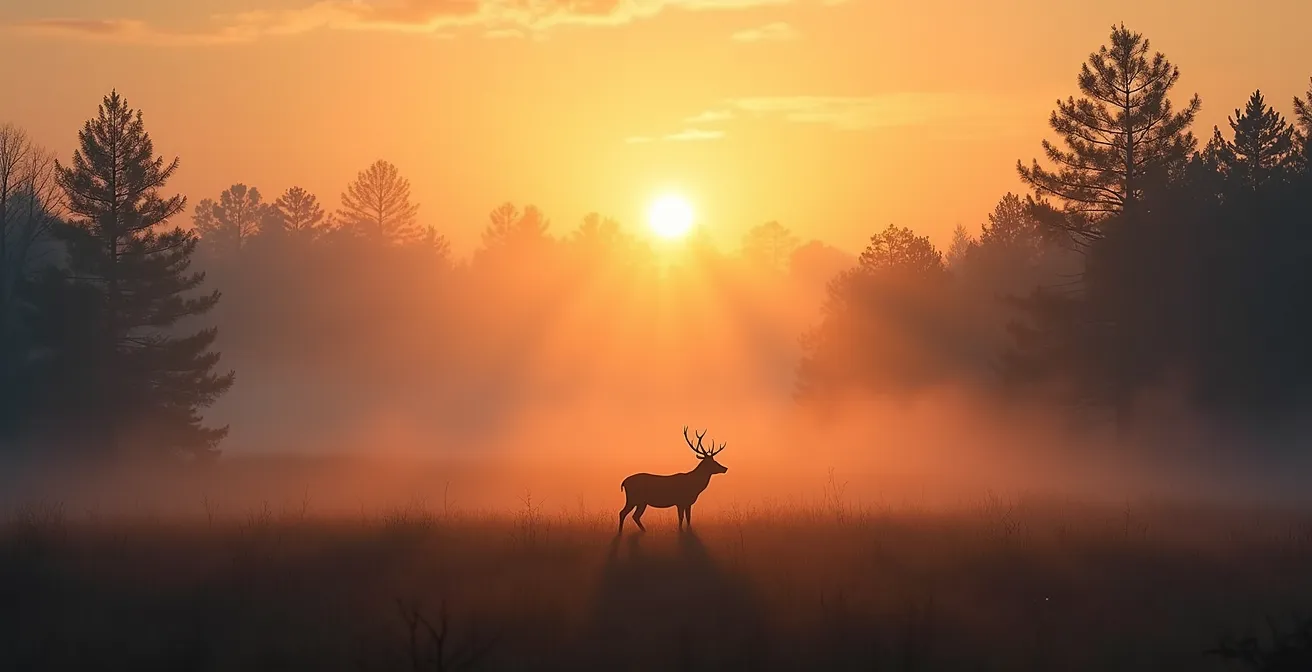
This is not just about seeing more animals; it’s about experiencing the world as they do. The soft light, the morning mist, and the crisp air create an atmosphere of tranquility that is a powerful antidote to stress. You are no longer just a visitor in the landscape; you become part of its awakening. This act of ecological mindfulness—sitting quietly and observing the world come to life—is a form of meditation. It forces you to be patient, to listen intently, and to notice the subtle details you would otherwise miss. It’s a direct and powerful way to practice the “sensory foraging” that is key to mental restoration.
By simply setting your alarm an hour earlier, you are not just gaining time; you are gaining access to a different dimension of the natural world. You’re trading the jarring noise of a city morning for the complex symphony of birdsong, and the frantic rush to start the day for a moment of profound peace. This simple shift in routine can transform your entire camping experience from a passive retreat to an active, awe-inspiring engagement with the wild.
Cicadas Noise: How to embrace the Sound of the South Without Losing Sleep?
For many campers, especially in southern regions, the incessant, high-pitched song of cicadas can feel less like a natural symphony and more like an assault on the senses, particularly when trying to sleep. This auditory challenge, however, presents a perfect opportunity to practice the core skill of ecotherapy: reframing a perceived negative into a tool for mindfulness. Instead of fighting the sound, you can learn to embrace it, transforming it from a source of irritation into an anchor for deep relaxation. The key lies in shifting from passive hearing to active, conscious listening.
This is where the concept of “sensory foraging” becomes a practical technique. Instead of letting the cicada sound dominate your awareness, you can treat the entire soundscape as a rich environment to explore. As experts from Crua Outdoors note, “The calming sounds of a flowing river, rustling leaves, or birdsong can help to reduce anxiety and promote relaxation.” The cicadas are just one layer in this complex tapestry of sound. By actively trying to distinguish the other layers—the wind in the trees, a distant bird call, the crunch of leaves—you de-center the cicada noise and integrate it into a larger, more balanced whole. It becomes part of the ecosystem’s vibrant pulse, a sign of a healthy, thriving environment, rather than an isolated annoyance.
This auditory reframing doesn’t just make the noise more tolerable; it turns it into a meditative practice that can quiet the internal chatter of a stressed mind. You are replacing anxious thoughts with a focused, external awareness, effectively hijacking your brain’s stress response. The following checklist offers a structured way to practice this.
Your Action Plan: Auditory Reframing for Natural Sounds
- Practice ‘Sense Foraging’: Close your eyes and consciously tune into different sound layers one by one: the wind, distant birds, insects, and finally, the cicadas.
- Build Positive Association: Actively associate the cicada song with warm, pleasant memories of summer evenings and the feeling of being on vacation.
- Use as a Meditation Timer: Let the constant, rhythmic pulse of the cicadas serve as a natural guide for your breathing exercises, inhaling and exhaling with their rhythm.
- See it as a Health Indicator: Remind yourself that a loud cicada chorus is a sign of a healthy, vibrant ecosystem, connecting the sound to a positive ecological fact.
- Keep a Sound Journal: Take a few minutes each day to note the different sounds you hear, their intensity, and patterns, turning observation into a creative practice.
The “No TV” Surprise: How to Prepare Teens for Low-Tech Accommodation?
The prospect of a camping trip with no Wi-Fi, no TV, and spotty cell service can be a source of major anxiety for teenagers. For a generation accustomed to constant digital connection, the “boredom” of a low-tech environment can feel like a genuine threat. As a parent, simply enforcing a digital detox is likely to be met with resistance. The key to a successful, stress-free experience for everyone is not to focus on what they’re losing, but to proactively and enthusiastically introduce what they’re gaining: a chance to develop new skills, experience real adventure, and reconnect with themselves and their family.
The strategy is stimulus substitution in its most practical form. You are not creating a void; you are filling the space normally occupied by screens with engaging, hands-on activities. Involve your teen in the planning from the very beginning. Instead of dictating a tech-free trip, frame it as a challenge. Task them with learning a crucial “primitive skill” for the trip: Can they master building a fire with a flint and steel? Can they be the official navigator with a map and compass? Can they learn to identify three edible plants?
As one adventure company points out, these experiences are transformative because they “get them out of their comfort zones.” This isn’t just about keeping them busy. It’s about building competence and self-reliance, which are powerful antidotes to the passive consumption of digital media. Learning to navigate a trail or successfully start a fire provides a sense of accomplishment that no video game can replicate. By replacing the fleeting dopamine hits of social media with the deep, lasting satisfaction of real-world achievement, you help them discover a more profound and durable source of self-worth.
Key Takeaways
- True stress reduction comes from active sensory engagement with nature, not just passive presence.
- The choice of location, tools (like binoculars), and timing (like waking at dawn) are strategic decisions that maximize mental health benefits.
- Reframing challenges like insect noise or a lack of technology into opportunities for mindfulness and skill-building is crucial for a restorative experience.
Why Sleeping in a Pine Forest Improves Your Respiratory Health?
Of all the sensory experiences camping offers, perhaps none is more subtly powerful than the simple act of breathing in a forest. This is particularly true in a pine forest, where the air is filled with aromatic compounds that have a direct, measurable impact on our physiological health. The clean, crisp scent of pine is not just pleasant; it’s a form of natural aromatherapy, delivering a cocktail of organic compounds called phytoncides directly into your respiratory system.

Phytoncides are antimicrobial volatile organic compounds released by trees to protect themselves from insects and disease. When we inhale them, they have a remarkable effect on our bodies. Research in the field of “forest bathing” or Shinrin-yoku has shown that exposure to these compounds can help reduce blood pressure, increase the activity of cancer-fighting natural killer (NK) cells, and significantly lower stress hormones. This is the ultimate proof of the H1’s claim. A systematic review of forest therapy programs confirmed that salivary cortisol levels were significantly reduced after just a few days of immersion. Sleeping in a pine forest means you are breathing in these therapeutic compounds for hours, allowing your body to engage in deep repair and recovery.
This is the “why” behind the magic. The feeling of well-being you experience isn’t just in your head; it’s a physical response to the healing chemistry of the forest. As the leading expert in the field, Dr. Qing Li, emphasizes, the goal is a full sensory experience.
The healing power of greenspace is evident. Dr. Qing Li emphasizes that forest bathing is about fully experiencing nature through sight, sound, taste, smell, and touch
– Dr. Qing Li, Forest Bathing Research
Choosing a campsite in a pine forest is a direct investment in your respiratory and immune health, providing a clear, scientific basis for the profound sense of restoration that such an experience provides.
Now that you understand the deep, scientific reasons why immersive camping is so effective against burnout, the next step is to translate this knowledge into action. Begin planning your own restorative journey by seeking out a location that offers not just a green view, but a deep, sensory connection to the wild.
Frequently Asked Questions on Camping and Mental Health
Is camping really good for mental health?
Yes, profoundly so. Camping, especially in preserved nature, reduces stress by lowering cortisol levels, improving mood, and restoring attention. The combination of fresh air, natural light regulating your sleep cycle, physical activity, and disconnection from digital stressors provides a powerful reset for the brain and nervous system.
What is the difference between a National Park and a nature reserve like a Natura 2000 site?
Generally, National Parks are designated to protect scenic and significant natural landscapes while also providing for public recreation and enjoyment. Natura 2000 sites, a European network, are specifically focused on the conservation of threatened species and habitats. While there is overlap, Natura 2000 sites can often be wilder and less focused on tourist infrastructure, offering a more immersive experience.
How can I convince my family to go camping without technology?
Focus on what they will gain, not what they will lose. Frame the trip as an adventure and a chance to learn new skills. Involve them in planning activities like learning to build a fire, navigating with a compass, or identifying constellations. By substituting passive screen time with active, engaging real-world challenges, you can foster excitement and a sense of accomplishment.