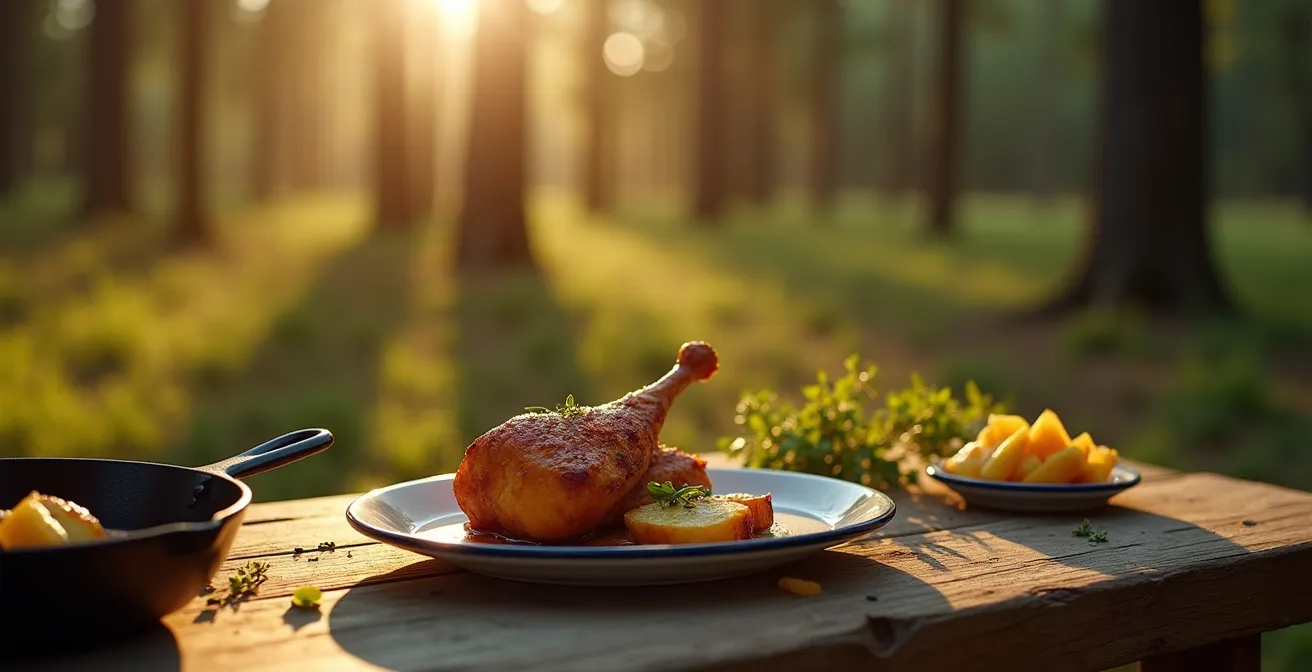
Duck confit is the ultimate camper’s meal not just for its taste, but because it’s a complete culinary system born from the ancient wisdom of preservation.
- It provides high-energy, shelf-stable protein and a versatile, flavorful cooking fat.
- Its all-season nature offers a taste of tradition when other regional delicacies are unavailable.
Recommendation: Embrace confit as a lesson in resourceful gastronomy: plan your meal around it, use every part, and connect with a piece of portable French heritage at your campsite.
Imagine the scene: a fire crackles, the stars begin to emerge, and the day’s long hike settles into your bones. There is a deep hunger that calls for more than just calories; it calls for comfort, for story, for a meal that feels like an event. Too often, campsite cooking defaults to simple sausages or canned beans. And while some adventurous souls attempt “gourmet” camping, it frequently ends in a chaotic mess of too many ingredients and not enough space. We know duck confit as a French classic, a bistro staple, but we rarely consider its rustic, utilitarian soul.
But what if the perfect camper’s meal wasn’t a modern invention, but a centuries-old tradition perfectly suited for the wild? What if we approached duck confit not as a mere dish, but as a complete, self-sufficient culinary system? This is the heart of its magic. It is more than a meal; it is portable heritage, a testament to an age when preservation was paramount. This method of slow-cooking and preserving duck in its own fat was born of necessity, creating a food that was delicious, high-energy, and, most importantly, stable without refrigeration.
This perspective transforms duck confit from a luxury item into a masterclass in resourceful gastronomy. It’s a philosophy that aligns perfectly with the leave-no-trace ethos of the thoughtful camper. This guide will delve into this culinary system. We will explore how to choose the right format for your journey, how to honor the tradition by using every part of it—especially the liquid gold that is duck fat—and how to time and balance this hearty dish to fit any season or adventure. It’s time to see confit for what it truly is: history, sustenance, and comfort, all packed and ready for the campfire.
To fully appreciate how this traditional dish can elevate your outdoor cooking, this article breaks down the entire process, from practical choices to culinary techniques. Here is a look at the journey we will take together.
Summary: A Camper’s Guide to the Culinary System of Duck Confit
- Canned vs Vacuum Packed: Which Confit Is Best for Camping Cooking?
- Duck Fat Potatoes: How to Use the Leftover Fat Like a French Grandma?
- Duck in July: How to Balance a Heavy Meal with Summer Heat?
- Green Beans or Sarladaise Potatoes: The Great Side Dish Debate
- Lunch or Dinner: When Is the Best Time to Eat a 1000-Calorie Dish?
- Duck Confit in July: How to Enjoy Perigord Food Without Overheating?
- Eating Reblochon in August: Why You Are Doing It Wrong?
- How to Cook a 3-Course Meal in 4 Square Meters Without Chaos?
Canned vs Vacuum Packed: Which Confit Is Best for Camping Cooking?
Your journey into campsite confit begins not at the stove, but at the store. The first decision you’ll make is the format, and for a camper, this choice is everything. The two primary options are traditional cans (or glass jars) and modern vacuum-sealed packs. This isn’t just about packaging; it’s a strategic choice that impacts weight, storage, and safety. Canned confit is the old-world method, offering incredible shelf-stability for years without refrigeration, making it a fortress of flavor you can leave in your car or pack for an extended trip without a second thought. However, it’s heavy and bulky.
Vacuum-packed confit, on the other hand, is the lightweight champion. It’s compact, fits easily into a crowded cooler, and often comes in individual portions. Its drawback is its reliance on refrigeration, making it suitable for shorter trips or those with reliable cooling. Your camping style—be it minimalist backpacking or fully-equipped car camping—will be the ultimate arbiter. To make the right call, you need a clear decision-making process that balances convenience with your trip’s constraints.
Your Action Plan: Choosing the Right Confit Format
- Assess camping style: For backpacking where every ounce counts, choose vacuum-packed. For car camping, the weight of a can is less of an issue.
- Evaluate cooling capabilities: If you have no cooler or an unreliable one, canned confit is the only safe option.
- Consider group size: A typical can serves four to five people, whereas vacuum packs offer individual portions, preventing waste.
- Plan your cooking setup: Vacuum-packed confit can be gently reheated in boiling water, while canned confit requires a pan to crisp the skin properly.
- Factor in trip duration: For any trip longer than three days where cooling is uncertain, the superior shelf-stability of canned confit makes it the clear winner.
To further clarify the trade-offs, this direct comparison breaks down the key attributes of each format, helping you align your choice with the practical realities of your next outdoor adventure.
| Feature | Canned Duck Confit | Vacuum-Packed Duck Confit |
|---|---|---|
| Shelf Life | 5-10 years at room temperature | 3-6 months refrigerated |
| Weight/Space | Heavier (glass/metal container) | Lighter, more compact |
| Temperature Storage | No refrigeration needed | Requires consistent cooling |
| Heating Method | Direct on camp stove or fire | Sous-vide style in boiling water (10 min) |
| Fat Recovery | Easier to collect from can | Fat integrated in vacuum seal |
| Typical Portion | 4-6 legs per can | Individual portions (1-2 legs) |
Duck Fat Potatoes: How to Use the Leftover Fat Like a French Grandma?
Herein lies the soul of resourceful gastronomy. When you open a tin of duck confit, you are greeted not just by the tender meat, but by a generous amount of glistening, solidified duck fat. To a French grandmother, throwing this out would be a culinary crime. To a camper, it is liquid gold—a versatile, flavorful, and free cooking medium. This fat is the second, equally important product of your purchase. Its primary and most noble use at the campsite is for making *pommes de terre à la sarladaise*—potatoes Sarlat-style.
The process is simple yet sublime. You gently heat the confit to release the legs, then pour off the precious fat into your cast-iron skillet. The magic of duck fat lies in its properties; with a high smoke point of around 375°F (190°C), it is more forgiving than butter and imparts a savory, almost nutty flavor that olive oil cannot replicate. This allows you to achieve an unparalleled crispiness on your potatoes over the unpredictable heat of a campfire or camp stove. You add diced potatoes, perhaps some garlic and parsley if you’ve packed it, and let them sizzle until golden brown and crispy on the outside, fluffy and tender on the inside.
This is more than a side dish; it’s a lesson in a no-waste philosophy. You are using the byproduct of your main course to create a second dish of extraordinary flavor, all in a single pan. It is the very definition of an efficient and elegant culinary system.
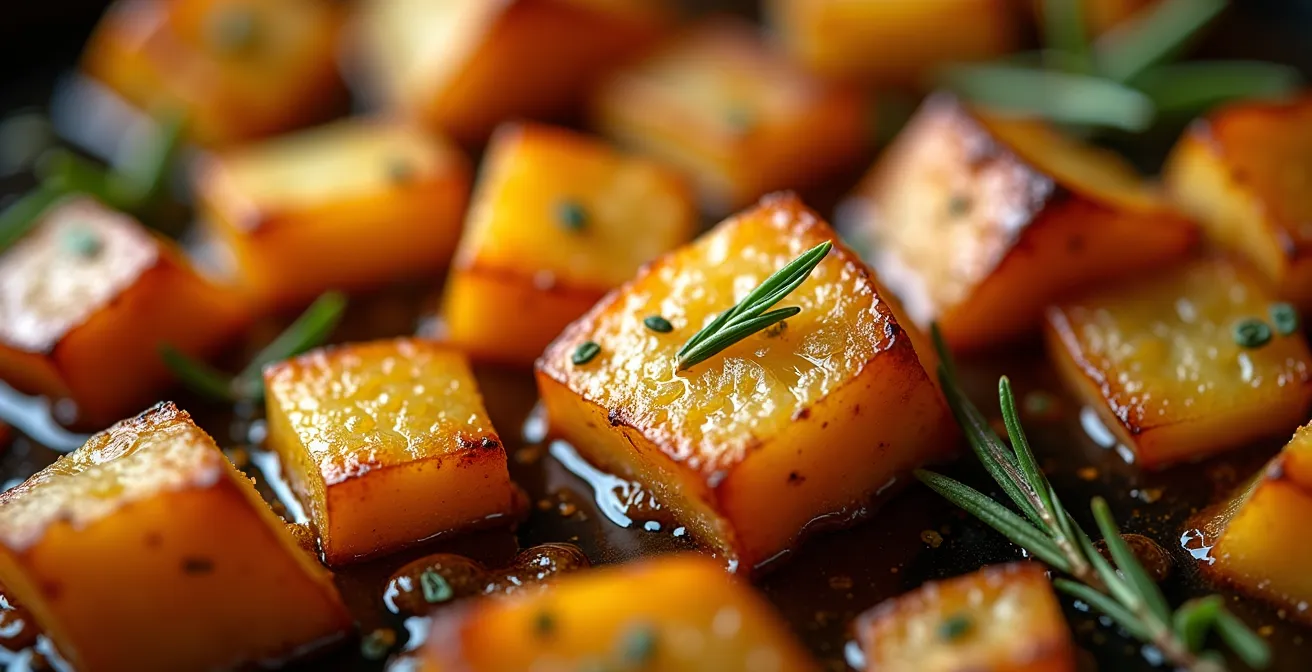
By embracing this technique, you are not just cooking; you are participating in a tradition of culinary wisdom. You transform a simple bag of potatoes into a dish that will be remembered long after the camping trip ends. Every crispy bite is a testament to the beauty of using what you have to create something truly special.
Duck in July: How to Balance a Heavy Meal with Summer Heat?
Serving a rich, hot meal like duck confit in the middle of summer might seem counterintuitive. Our instincts tell us to reach for cold salads and chilled drinks when the sun is beating down. However, many cultures in hot climates have a long tradition of consuming hot foods and drinks to cool down. This is the thermal paradox, and it has a fascinating physiological basis. When you eat a substantial, hot meal, your body’s core temperature rises, which in turn triggers its most effective natural cooling mechanism: perspiration.
As sweat evaporates from your skin, it carries away a significant amount of heat, ultimately cooling you down more effectively than the temporary relief provided by a cold drink. One analysis of cooking duck highlights a process involving a gentle rendering followed by high heat, which can induce the body’s natural cooling mechanisms through perspiration. This process of “fighting fire with fire” helps your body acclimatize to the ambient temperature rather than just momentarily shocking it with cold.
Of course, this doesn’t mean you should eat a massive, heavy meal at high noon. The key is balance. A smaller portion of duck confit, paired with lighter, more acidic side dishes, can provide the necessary energy and satisfaction without inducing a sluggish, overheated state. Think of it as a strategic refuelling. The richness of the confit replenishes salts lost through sweating, while the thermic effect of the food itself helps your body’s internal thermostat regulate more efficiently. It’s an ancient piece of wisdom that works with your body’s own systems, rather than against them.
Green Beans or Sarladaise Potatoes: The Great Side Dish Debate
Once you’ve decided to make duck confit the star of your campfire meal, the next question is who will play the supporting role. In the world of French cuisine, this often boils down to a classic debate: the rich, decadent *pommes de terre sarladaise* or the fresh, crisp *haricots verts* (green beans)? For a camper, this choice is not merely about taste; it’s a strategic decision involving fuel, time, weight, and calories. It’s a microcosm of the resource management that defines outdoor life.
Sarladaise potatoes, cooked in the rendered duck fat, are the traditional and indulgent choice. They are calorically dense, providing maximum energy—perfect after a long day of hiking. Potatoes are also hardy, require no refrigeration, and can be cooked in the same pan as the duck, which is a major win for camp logistics. However, they are heavy to pack and demand a significant amount of cooking time and fuel, which might be precious commodities.
Green beans, on the other hand, represent the lighter, quicker alternative. A quick blanch in boiling water is all they need, consuming minimal fuel. They provide a fresh, acidic counterpoint to the richness of the duck, which can be particularly welcome in warmer weather. Their downside is their fragility; they are lighter to carry but more delicate and ideally should be kept cool to maintain their freshness. The choice you make speaks to the kind of meal you want and the resources you have at your disposal.
This table lays out the practical trade-offs for a camper, moving the decision from a simple matter of preference to one of informed strategy.
| Factor | Sarladaise Potatoes | Haricots Verts |
|---|---|---|
| Cooking Time | 20-30 minutes | 5-8 minutes |
| Fuel Consumption | High (extended cooking) | Low (quick blanch) |
| Calories per Serving | 280-350 kcal | 35-50 kcal |
| Weight (raw, 4 servings) | 2 lbs | 1 lb |
| Pan Usage | Can use duck fat directly | Requires separate water for blanching |
| Storage/Transport | Hardy, no refrigeration | Delicate, needs cooling |
Lunch or Dinner: When Is the Best Time to Eat a 1000-Calorie Dish?
Duck confit is unapologetically rich. A full meal centered around it, complete with potatoes cooked in duck fat, can easily exceed 1,000 calories. For a camper, this caloric density is a feature, not a bug—it’s powerful fuel for an active body. However, timing the consumption of such a substantial meal is critical to harnessing its benefits rather than being weighed down by them. The debate between having it for lunch versus dinner is a question of energy management.
Eating a large, high-fat meal at midday provides a massive energy reserve for an afternoon of strenuous activity like hiking, climbing, or paddling. You are fuelling up before the work. The potential downside is post-meal lethargy, the dreaded “food coma,” which can be a real momentum-killer on the trail. A single vacuum-packed duck leg contains approximately 620 calories on its own, a significant portion of a day’s energy needs, so its effects will be felt.
Conversely, enjoying duck confit as the evening meal transforms it from fuel into a tool for recovery and comfort. After the day’s activities are done, the high caloric content helps replenish depleted glycogen stores and repair muscle tissue. The richness of the meal promotes a sense of satiety and relaxation, which can lead to better sleep quality in the cool night air. Outdoor experts often recommend this approach, framing the meal as a centerpiece for the evening wind-down. It becomes a ritual that marks the transition from activity to rest, a reward for a day well spent. For most campers, this makes dinner the ideal time for a feast of this magnitude.
Duck Confit in July: How to Enjoy Perigord Food Without Overheating?
While we’ve discussed the physiological trick of using hot food to cool down, the people of the Périgord region in France, the heartland of confit, have a much simpler and more elegant solution for enjoying their signature dish in the summer: they don’t always eat it hot. This is a crucial piece of cultural wisdom that unlocks confit for year-round enjoyment. The very nature of confit makes this possible. As culinary expert Susan Herrmann Loomis notes, “Confit itself is a preservation method born from necessity, allowing duck to be eaten outside its season.” This all-season purpose is built into its DNA.
So, how do they do it? The most common method is to serve the duck confit at room temperature or even chilled. The meat, already incredibly tender from the slow-cooking process, can be easily shredded and tossed into a fresh, vibrant salad. A classic Périgord salad often features shredded confit, walnuts, and a sharp vinaigrette made with walnut oil. The acidity of the dressing cuts through the richness of the duck, creating a perfectly balanced and refreshing summer meal. Another simple yet elegant approach is the ‘confit tartine’—shredded confit served on a slice of toasted country bread, perhaps with a few tangy cornichons on the side.
This approach is also about what you drink. Instead of a heavy red Bordeaux, the summer pairing of choice is a chilled, crisp Bergerac rosé or even a local apple cider. These beverages provide a clean, palate-cleansing contrast. By adopting these regional serving traditions, you’re not just avoiding overheating; you’re connecting with the authentic, practical ways this food is enjoyed in its homeland. It’s proof that a hearty food doesn’t always have to be a heavy meal.
“Confit itself is a preservation method born from necessity, allowing duck to be eaten outside its season.”
– Susan Herrmann Loomis, On Rue Tatin – Duck Confit Guide
Eating Reblochon in August: Why You Are Doing It Wrong?
To truly grasp why duck confit is such an intelligent choice for a camper, it helps to compare it to another French delicacy: Reblochon cheese. Imagine buying a wheel of this creamy, nutty cheese in the Alps for your August camping trip. It feels like the perfect authentic experience. Yet, a French local might gently tell you you’re doing it wrong. Reblochon is traditionally a winter cheese, made from the rich, high-fat milk of cows that have come down from their high-altitude summer pastures. Its peak flavor and texture are intrinsically tied to a specific season.
This highlights a fundamental difference between two types of traditional foods: those governed by seasonal freshness and those designed to transcend it. Duck confit falls squarely into the latter category. It is the epitome of a food created for preservation. As one culinary guide explains, while “confit makes one think of duck legs,” this “delicious method of preparation” is a year-round preservation technique. Unlike a seasonal cheese, whose quality wanes outside its peak window, confit was specifically invented to capture peak-season flavor and make it available anytime.
This makes duck confit a masterclass in seasonal intelligence for the modern camper. It delivers a deeply traditional and regional flavor experience without the risk of being out-of-season. You are getting a taste of the Périgord that is just as authentic in July as it is in December. It removes the guesswork and ensures a high-quality experience, honoring tradition while embracing the practical need for reliability. Choosing confit is choosing guaranteed excellence, a food designed from the ground up to be ready whenever and wherever you are.
Key Takeaways
- Confit is a ‘culinary system’: it provides not only high-quality meat but also a premium cooking fat, embodying a no-waste philosophy.
- Its nature as a preserved food makes it an all-season delicacy, offering a reliable and authentic taste of tradition when other regional foods are past their peak.
- Strategic timing (dinner for recovery) and side dish choice (potatoes for energy, greens for lightness) are essential for balancing its richness with your camping activities.
How to Cook a 3-Course Meal in 4 Square Meters Without Chaos?
The idea of preparing a three-course meal at a campsite can feel daunting, conjuring images of frantic chaos, dirt in the food, and a mountain of dirty dishes. But with duck confit as your centerpiece, it becomes a lesson in efficiency and organization, all achievable within the tiny footprint of a standard camp kitchen. The secret is to embrace the professional kitchen concept of *mise en place*—having everything prepped and in its place before you start cooking.
Let’s build a meal around our culinary system. Course 1 (Starter): This can be prepared before you even light the stove. If you’ve packed some rustic bread and a small jar of *rillettes* (another French preserved meat), you have an instant, no-cook starter. Course 2 (Main): This is our duck confit with its side dish. The beauty here is the potential for one-pan cooking. First, you crisp the duck skin in the skillet, then set it aside to rest. Next, you cook your potatoes or green beans in the same pan, using the rendered duck fat. This sequential cooking minimizes cleanup and maximizes flavor. Course 3 (Dessert): This is where a little creativity comes in. A tablespoon of the leftover duck fat can be used instead of butter to cook a simple camp-friendly dessert, like a pan-fried apple slice sprinkled with cinnamon, giving it a surprisingly savory depth.
This entire workflow relies on organization. Use vertical space: hang utensils from a ridgeline. Use stackable containers for pre-chopped ingredients. Keep a clear “dirty” zone and a “clean” zone. This isn’t about having more space; it’s about using the space you have with intention and foresight.
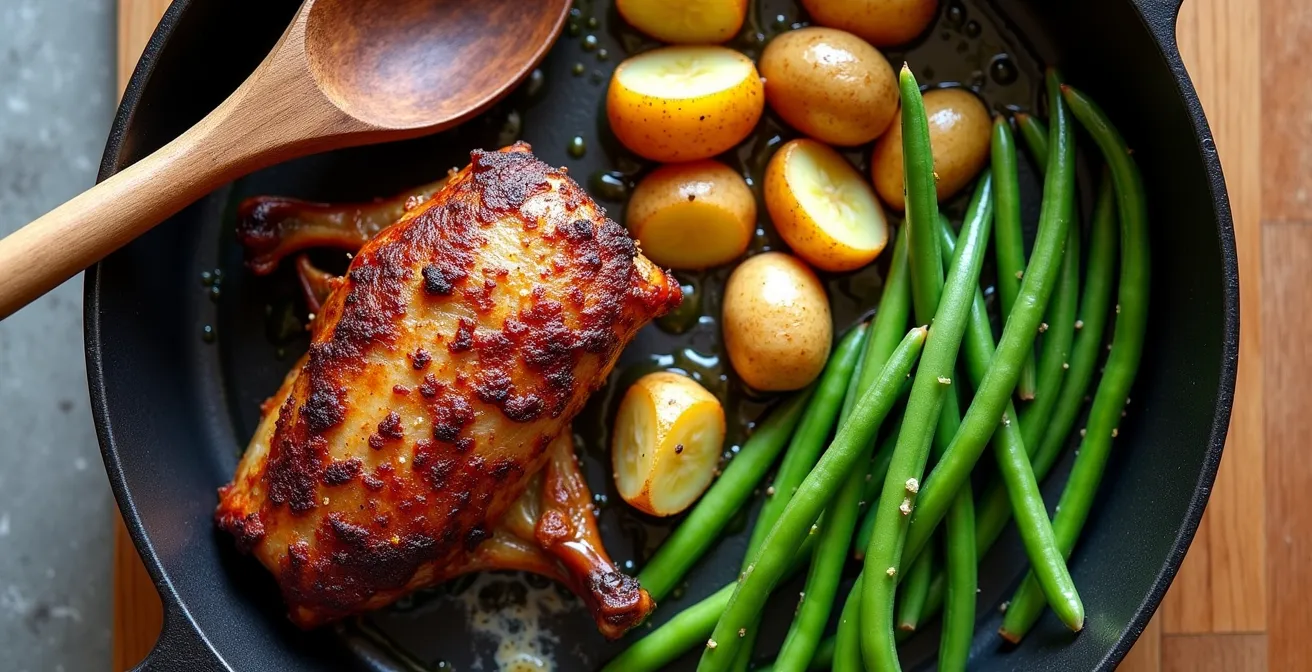
By planning your meal in stages and leveraging the versatility of your main ingredient, a sophisticated three-course meal becomes not just possible, but calm and deeply satisfying. It transforms campsite cooking from a chore into a graceful, rewarding art form.
So for your next trip, move beyond simple sustenance. Pack a piece of portable heritage, embrace the art of resourceful gastronomy, and create a meal that will nourish both body and soul. Start planning your own campfire confit experience today.