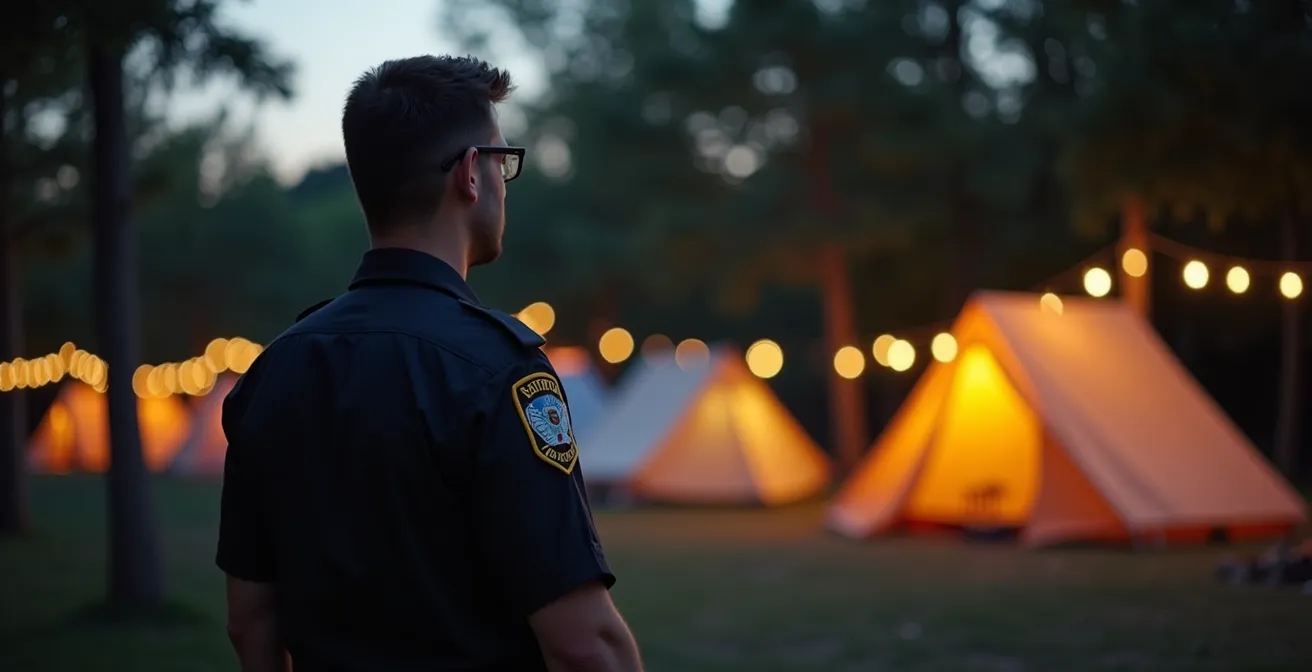
For families, true campsite security isn’t about recording events; it’s about preventing them and feeling protected. A human guard’s contextual judgment and ability to intervene creates a “bubble of trust” that a camera can never offer.
- Human guards use negotiation and de-escalation to resolve issues like noise, while cameras only record conflicts.
- They provide personalized safety advice and can launch an immediate, coordinated search for a lost child, offering reassurance no technology can match.
Recommendation: When choosing a campsite for your family, prioritize those that invest in a professional, visible human security presence, not just CCTV.
There’s a unique peace that comes with zipping up a tent for the night, with your children sleeping soundly inside. But for any parent, that peace is coupled with a quiet, lingering question of safety. In our tech-driven world, the default answer often seems to be surveillance cameras—a silent, digital eye watching over the grounds. They are perceived as a modern, efficient solution to security concerns. But do they truly deliver the most important element a family needs: genuine peace of mind?
While cameras can record an incident, they are fundamentally passive. They lack the judgment, empathy, and proactive ability to prevent a situation from escalating. They cannot distinguish a teenager’s harmless laughter from a cry for help, nor can they offer a reassuring word to a parent. This is where the limitations of technology become starkly apparent. The real key to effective campsite security for families lies not in passive recording, but in active, intelligent, and compassionate presence.
This article will explore why a human guard is fundamentally more effective than a camera. We will move beyond the simple deterrent argument to analyze the nuanced, irreplaceable skills a person brings to the role. We will look at how they handle common issues, protect privacy, and, most critically, respond in emergencies. It’s about understanding that security is not a feature, but a feeling—a “bubble of trust” that only a human can create.
This guide will walk you through the key scenarios where human oversight proves its unmatched value, providing you with a clear framework for evaluating a campsite’s commitment to your family’s safety.
Summary: Why Human Guards Are More Effective Than Cameras in Campsites?
- What Can a Security Guard Legally Do if Neighbors Are Noisy?
- Uniforms and Badges: How to Recognize Staff from Intruders?
- Surveillance vs Privacy: Do Guards Patrol Near Your Private Deck?
- Curfew Enforcement: How Guards Handle Teenagers Gathering at Night?
- Night Shifts: Why You Should Feel Safer Knowing Patrols Peak at 2 AM?
- The Wristband System: Why Wearing It Is Annoying but Necessary?
- Red Flag vs Orange Flag: What Do They Really Mean for Kayakers?
- Why a Gated Resort Is Essential for Families with wandering Toddlers?
What Can a Security Guard Legally Do if Neighbors Are Noisy?
A common camping scenario: it’s late, your kids are finally asleep, and the neighboring site’s party is just getting started. A camera can only record the escalating noise. A human guard, however, is equipped to actively and legally resolve the situation. Their primary tool is not authority, but trained de-escalation. A professional guard will not approach with confrontation. Instead, they act as a neutral mediator, reminding the noisy neighbors of the campsite rules they agreed to at check-in.
The guard’s role is to negotiate a compromise that restores peace for everyone. This human-to-human interaction is something no automated system can replicate. If verbal negotiation fails, the guard, acting as an agent of the property, has the authority to issue formal warnings. As a last resort, they can initiate eviction procedures based on the contract terms. This layered response ensures the situation is handled proportionally and effectively. It’s no surprise that 73% of camps employ nighttime security guards or patrol services; their ability to manage interpersonal conflicts is indispensable.
A Guard’s De-escalation Protocol: Step-by-Step
- Assess the noise situation and determine if it violates campsite rules agreed upon at check-in.
- Approach with de-escalation techniques, focusing on verbal negotiation rather than confrontation.
- Act as a neutral mediator between parties to find an acceptable compromise.
- Issue formal warnings as an agent of the property when necessary.
- Initiate eviction procedures if violations persist, following campsite contract terms.
Uniforms and Badges: How to Recognize Staff from Intruders?
For a parent, knowing who to trust is paramount. A clear, professional uniform and badge are the first layer of identification, instantly separating official staff from other campers. It creates an immediate sense of order and authority. However, a guard’s recognizability goes far beyond their attire. It’s about their demeanor and their very presence.
The following image illustrates the professional but approachable appearance that builds this trust.
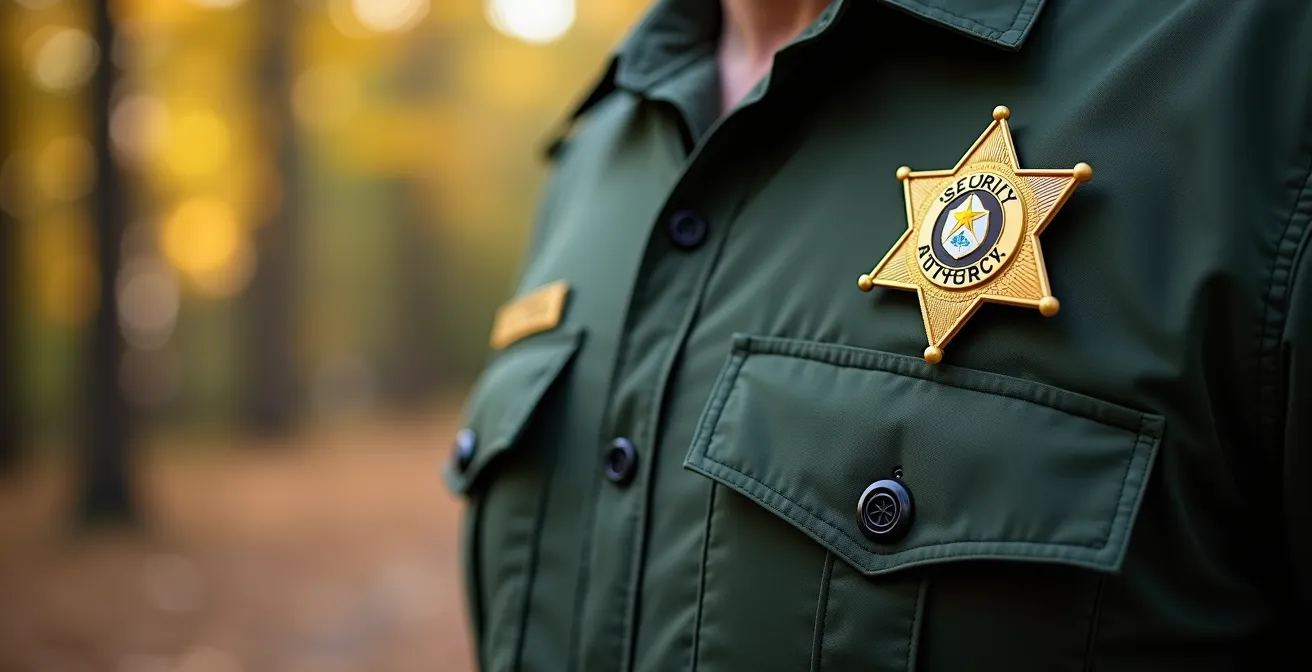
As security experts at World Guardian Security Services note, a guard’s effectiveness comes from strong observational skills and a consistent, professional presence. They are trained to be identifiable not just by a logo, but through their systematic patrol patterns and observant behavior. This creates a powerful psychological deterrence. Potential wrongdoers see a vigilant, active presence, while families see a watchful guardian. This turns the guard from a simple employee into a recognizable part of the safe environment—the “bubble of trust” your family can rely on.
Surveillance vs Privacy: Do Guards Patrol Near Your Private Deck?
The idea of being watched can be unsettling, whether by a camera or a person. However, the difference in how they “watch” is critical. A camera is indiscriminate; it records everything within its field of view. A human guard, on the other hand, is trained in the art of professional discretion. Their goal is security, not intrusion.
Patrol routes are strategically designed to maximize security while respecting privacy. Guards focus on perimeters, entry/exit points, and common areas. They are trained to look for anomalies—a broken lock, a door left ajar, unusual activity—without peering into private spaces. Unlike a camera, a guard possesses emotional intelligence; they know when to look away. This human element ensures that security doesn’t come at the cost of your family’s comfort and privacy. As a report from the Freedonia Group highlights, this human capability is central to effective security.
Trained guards will remain the best way to provide an adequate deterrent to potential unauthorized incursions and coordinate effective responses to unexpected events.
– Freedonia Group, Security Industry Report 2019
Furthermore, guards use multi-sensory surveillance. They can hear a call for help or smell smoke from a fire, threats a camera would completely miss. This ability to perceive the environment holistically allows them to be far more effective protectors while being significantly less intrusive.
Curfew Enforcement: How Guards Handle Teenagers Gathering at Night?
The sight of a group of teenagers gathered after curfew can be a point of anxiety for parents. A camera system’s response is binary: it either does nothing or triggers a generic alarm. A human guard, however, can perform a dynamic risk assessment. Their training in conflict resolution and emergency response allows them to instantly differentiate between teens harmlessly listening to music and those engaging in risky or destructive behavior.
This contextual judgment is irreplaceable. Rather than a confrontational order, a guard can initiate a conversation. They can build rapport, explain the “why” behind the curfew (e.g., safety, respect for other campers), and negotiate a resolution. This approach not only solves the immediate issue but also builds a culture of compliance and respect. Teenagers are more likely to respond positively to a person who treats them with respect than to a disembodied voice from a speaker or a flashing light. This comparison highlights the profound difference in capability.
The following table breaks down how a human guard’s nuanced approach consistently outperforms an automated system in managing these delicate social situations.
| Capability | Human Security Guard | Camera System |
|---|---|---|
| Risk Assessment | Dynamic, context-aware judgment | Binary detection only |
| Response Type | Conversation and negotiation | Alarm or recording only |
| Relationship Building | Creates rapport and respect | No interaction possible |
| Flexibility | Adapts approach to situation | Fixed programmed response |
| Prevention Impact | Builds compliance culture | Reactive only |
Night Shifts: Why You Should Feel Safer Knowing Patrols Peak at 2 AM?
The deepest hours of the night, when the entire campsite is asleep, are when a property is most vulnerable. This is when the presence of a human guard provides the most profound sense of security. While a camera keeps recording, a guard is actively patrolling, creating a vigilant and unpredictable shield. Patrols that peak around 2 AM are not arbitrary; they are strategically timed to coincide with the period of greatest quiet and potential risk.
This image of a lone guard on patrol captures the essence of this quiet vigilance.
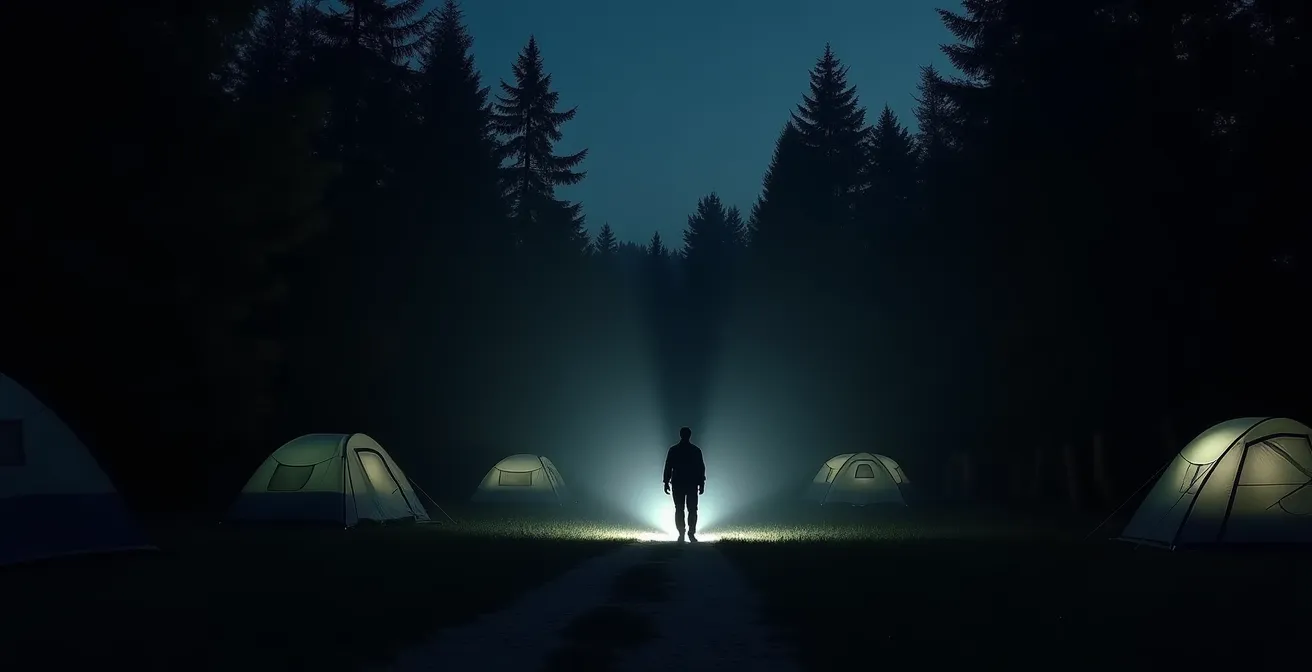
A key tactic is the randomization of patrol routes and timing. This intentional unpredictability makes it impossible for a potential thief or intruder to plan their actions. They never know when or where the guard will appear. This provides a psychological comfort that goes far beyond what a fixed camera can offer. Knowing that a person is physically walking the grounds, using all their senses to detect anything amiss, allows parents to truly rest easy. It’s the human presence, alert and in motion, that forms the ultimate protective layer while you sleep.
The Wristband System: Why Wearing It Is Annoying but Necessary?
For many, wearing a plastic or fabric wristband for the duration of a vacation is a minor annoyance. However, this simple tool is a powerful force multiplier for human security guards. It’s not just about access control; it’s about rapid identification and safety. The wristband system transforms every guard into an instant checkpoint, allowing them to verify who belongs on the property with a single glance.
This frees up their cognitive resources to focus on what truly matters: observing behavior and identifying individuals who are not wearing the required identification. It allows them to engage with potential intruders swiftly and professionally. But the wristband’s most critical function emerges in an emergency. In a medical situation or if a child gets separated from their family, the wristband is a direct link to vital information. A guard can use it to immediately identify the person, their registered campsite, and crucial emergency contacts.
A simple, annoying piece of plastic becomes a potentially life-saving device when combined with the rapid response of a human network. It’s a prime example of a simple system that becomes exponentially more effective when managed by intelligent, caring people, creating that extra layer of protection and peace of mind.
Red Flag vs Orange Flag: What Do They Really Mean for Kayakers?
A flag warning system at a campsite with a lake or beach is a standard safety feature. A camera can show you the flag, but it can’t explain what it really means for your family. A human guard, particularly one trained in water safety, provides the critical context that turns a simple color into actionable, personalized advice. They can explain *why* the red flag is up—perhaps due to a dangerous offshore current that isn’t visible from the beach.
This is where the guard’s role transitions from security to safety advisor. They can approach a family preparing to launch kayaks and offer tailored guidance. They might suggest a more sheltered cove that is safe for children, or advise an inexperienced kayaker to wait until conditions improve. This proactive, personalized safety advice is something no sign or camera can offer. In extreme cases, guards have the authority to physically prevent guests from entering dangerous waters, protecting them from harm and the resort from liability.
A guard doesn’t just enforce rules; they interpret risks in real-time and communicate them in a way that is relevant to each individual’s situation, building another layer within the “bubble of trust.”
Key Takeaways
- Human guards provide contextual judgment, differentiating real threats from harmless activities, which cameras cannot do.
- De-escalation and negotiation are uniquely human skills that resolve conflicts peacefully, preventing escalation.
- A physical presence offers multi-sensory surveillance (hearing, smelling) and a psychological “bubble of trust” that reassures families more than any technology.
Why a Gated Resort Is Essential for Families with wandering Toddlers?
For any parent of a toddler, the fear of them wandering off in a new, unfamiliar environment is profound. A gated resort provides the first physical barrier, but the final, most crucial checkpoint is not the gate itself, but the human guard who oversees it. This human element transforms a simple access point into an intelligent and caring safety net. With camping’s popularity surging— 11 million more households camped in 2024 compared to 2019—ensuring this level of security is more important than ever.
In the terrifying event that a toddler does go missing, the difference between a camera system and a human guard network becomes a matter of minutes that feel like hours. A camera system requires someone to reactively review footage. A human guard network, however, activates an instantaneous, coordinated search. The guard gets a description, communicates it to all staff via radio, and they begin executing systematic search patterns. Their training in first aid and emergency response means they are prepared not just to find, but to help.
This immediate, empathetic human response provides a level of psychological reassurance that is simply immeasurable. It’s the knowledge that a team of caring people is actively searching for your child. This is the ultimate expression of the “bubble of trust”—the final backstop against a parent’s worst nightmare, and the most compelling reason why a person will always protect your family better than a lens.
For your family’s next camping adventure, look beyond the list of amenities. Inquire about the security team. A campsite that invests in professional, human guards is a campsite that invests in your peace of mind. Make that a priority.
Frequently Asked Questions on Why Human Guards Are More Effective Than Cameras in Campsites?
How do guards maintain security without invading privacy?
Guards are trained in professional discretion, patrolling perimeters and observing general patterns without intruding on private moments. They focus on spotting anomalies like broken windows or doors left ajar without staring into personal spaces.
What advantages do human guards have over cameras for privacy protection?
Guards use multi-sensory surveillance including hearing and smell to detect issues like gas leaks or smoke without needing direct line of sight. They have emotional intelligence to know when to look away, respecting personal boundaries.
How are patrol routes designed to balance security and privacy?
Guards follow systematic patrol patterns focusing on entry/exit points and common areas, avoiding prolonged presence near private spaces unless responding to specific security concerns.
How do guards enhance flag warning systems?
Guards provide critical context explaining why specific flags are raised, such as dangerous offshore currents not visible from beach, offering personalized advice based on individual capabilities.
What enforcement powers do guards have regarding water safety?
Guards have authority to physically prevent guests from launching into dangerous waters, protecting individuals from harm and resorts from liability.
How do guards personalize safety warnings?
Guards can approach families preparing water activities and offer tailored advice based on their specific situation, such as recommending safer areas for families with children.