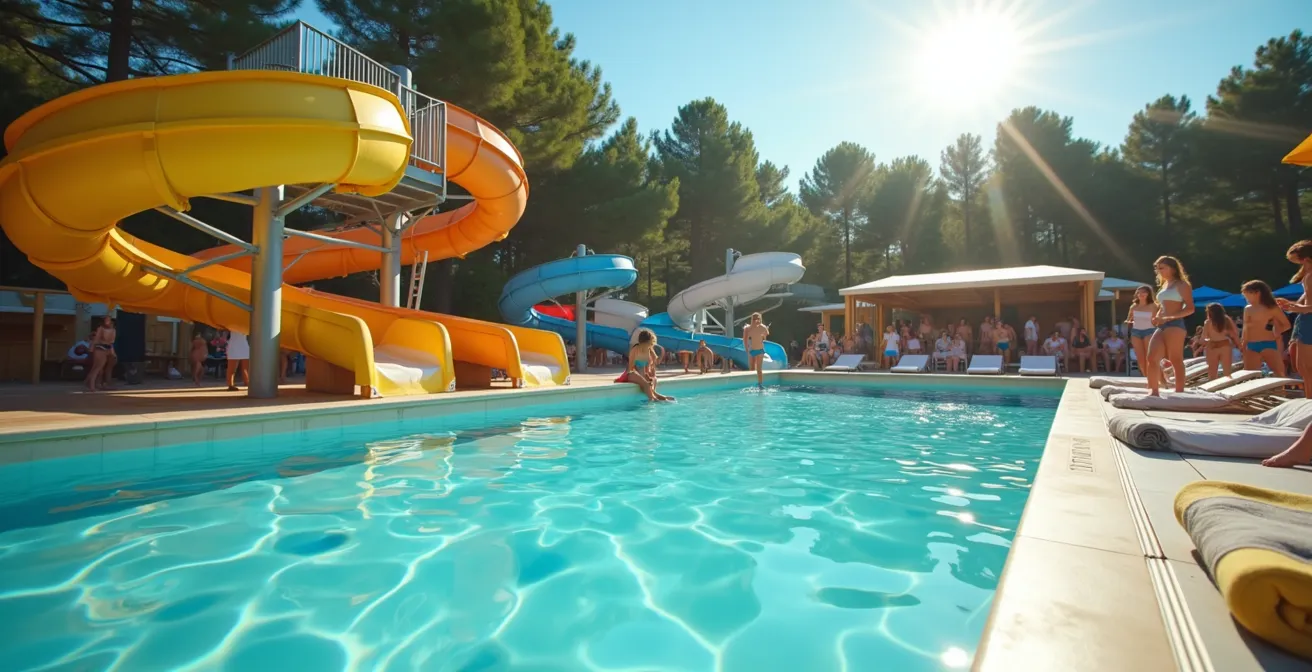
Contrary to popular belief, a happy teenager on a French campsite isn’t about the number of waterslides; it’s about successfully navigating the pool’s complex social ecosystem.
- Strict swimwear rules are less about fashion and more about a teen’s first test of social integration.
- The battle for sunbeds is a parental concern; teens establish their own territory in alternative social zones.
Recommendation: Strategically use different pool areas (like indoor or balneotherapy zones) as tools for negotiation and granting your teenager valued autonomy.
The annual family holiday looms. For parents of teenagers, this can be a delicate negotiation, a tightrope walk between forced fun and sullen silence. You’ve booked a five-star campsite in France, banking on the sun, the croissants, and the promise of a sprawling aquatic park to broker peace. Yet, you have a gnawing feeling that the success of the entire trip hinges on one specific location: the pool complex. You are absolutely right. But the reasons are far more complex than just the height of the slides or the speed of the rapids.
Most guides will tell you to look for a site with a “good pool.” This usually translates to a checklist of features: slides, a lazy river, a wave machine. While these are important, they miss the fundamental point. From a psychological perspective, the campsite pool is not just a facility; it is a living, breathing social ecosystem. For a teenager, it is the stage upon which the entire drama of their holiday will unfold. It is where they negotiate for autonomy, test social boundaries, and seek validation from their peers. It’s an arena for what can be called ‘autonomy theater’—a space where they can perform independence under your distant but reassuring watch.
This guide moves beyond the brochure. We will not be listing the best waterslides. Instead, we will decode the unwritten rules of this teenage territory. We’ll look at why seemingly trivial issues like swimwear can become major flashpoints, how to reframe the concept of ‘space’ beyond the coveted sunbed, and how to use the pool’s different zones as strategic tools to manage moods and foster connection. Understanding this ecosystem is the key to transforming the pool from a potential source of conflict into the very engine of a successful family holiday.
This article explores the critical facets of the campsite pool experience through a strategic lens. By understanding the underlying social and psychological dynamics at play, you can proactively navigate potential challenges and turn the pool complex into your greatest ally for a peaceful and enjoyable family vacation.
Summary: A Strategic Guide to the Campsite Pool for Parents of Teenagers
- Speedos vs Board Shorts: Why French Pools Ban Loose Swimwear?
- The Towel Game: How to Get a Sunbed Without Waking Up at 6 AM?
- Armbands or Vests: What Is Mandatory for Toddlers in Campsite Lagoons?
- Why an Indoor Pool Complex Is Essential Even in the South of France?
- Chlorine Levels: Why Swimming in the Late Afternoon Might Irritate Your Skin?
- The “No TV” Surprise: How to Prepare Teens for Low-Tech Accommodation?
- Curfew Enforcement: How Guards Handle Teenagers Gathering at Night?
- Can a Campsite Balneotherapy Pool Rival a Real Thalasso Center?
Speedos vs Board Shorts: Why French Pools Ban Loose Swimwear?
The first culture shock for many families arriving at a French campsite pool is the infamous “no board shorts” rule. For a self-conscious teenage boy, being told to swap his loose, knee-length shorts for tight-fitting ‘Speedos’ or ‘trunks’ can feel like a declaration of war. From a parent’s perspective, it seems arbitrary and designed to cause maximum embarrassment. However, understanding the logic behind the rule is the first step in strategically managing the situation. The ban isn’t a fashion statement; it’s a non-negotiable hygiene regulation across France. The rationale is that loose shorts are often worn as daywear, accumulating dust, sweat, and external contaminants that compromise water quality.
From a psychological standpoint, this isn’t just about clothing; it’s the first test of social adaptation. A UK family survey revealed that while 84% of teenage boys initially resisted wearing tight swimwear, they typically adapted within two or three days. Why? Because they quickly observe that *everyone* is following the same rule. Resisting marks them as an outsider, while complying is the first step to blending in and joining the pool’s social ecosystem. Forcing the issue will only create conflict. The strategic approach is to frame it not as a parental demand, but as “the code” to access the area they most want to be in.
The key is preparation. Discussing the rule beforehand and purchasing a pair of “jammers”—the cycling-short style swimwear—can be a face-saving compromise. They are widely accepted and offer more coverage than traditional trunks, making them a more comfortable entry point into the local norm. Presenting it as a practical necessity, like a keycard for a hotel room, depersonalizes the issue and empowers the teen to make the “right” choice to gain access to their social arena. This small victory sets a positive tone for the rest of the holiday.
The Towel Game: How to Get a Sunbed Without Waking Up at 6 AM?
The second source of parental stress is the “towel game”—the pre-dawn race to claim a sunbed for the day. This territorial battle, however, is almost exclusively a concern for adults. While you’re setting your alarm for 6 AM, your teenager is operating within a completely different social framework. For them, a plastic lounger is not a status symbol; it’s a stationary prison. Their priority is not solitary sunbathing but dynamic social interaction and proximity to the action.
This is the teen’s Territorial Imperative in action. They don’t want a single, isolated spot; they want a flexible base of operations. As one 15-year-old camper insightfully shared:
We never bothered with the sunbeds – that’s for the parents. We found our spot by the volleyball court near the main slides. It became our meeting point every day at 2 PM. The grass was actually more comfortable than those plastic loungers, and we could spread out, play cards, and actually talk without adults listening in.
– Mumsnet User
This testimony reveals the truth: teenagers create their own social territories. These are often on grassy verges, near the snack bar, or at the top of the most popular slide. These locations are chosen for their strategic value—they offer space for a group, a good vantage point for people-watching, and the freedom to be themselves away from the direct gaze of adults. Forcing your teen to share your sunbed is counterproductive; it traps them in “the parent zone” and stifles their social opportunities.
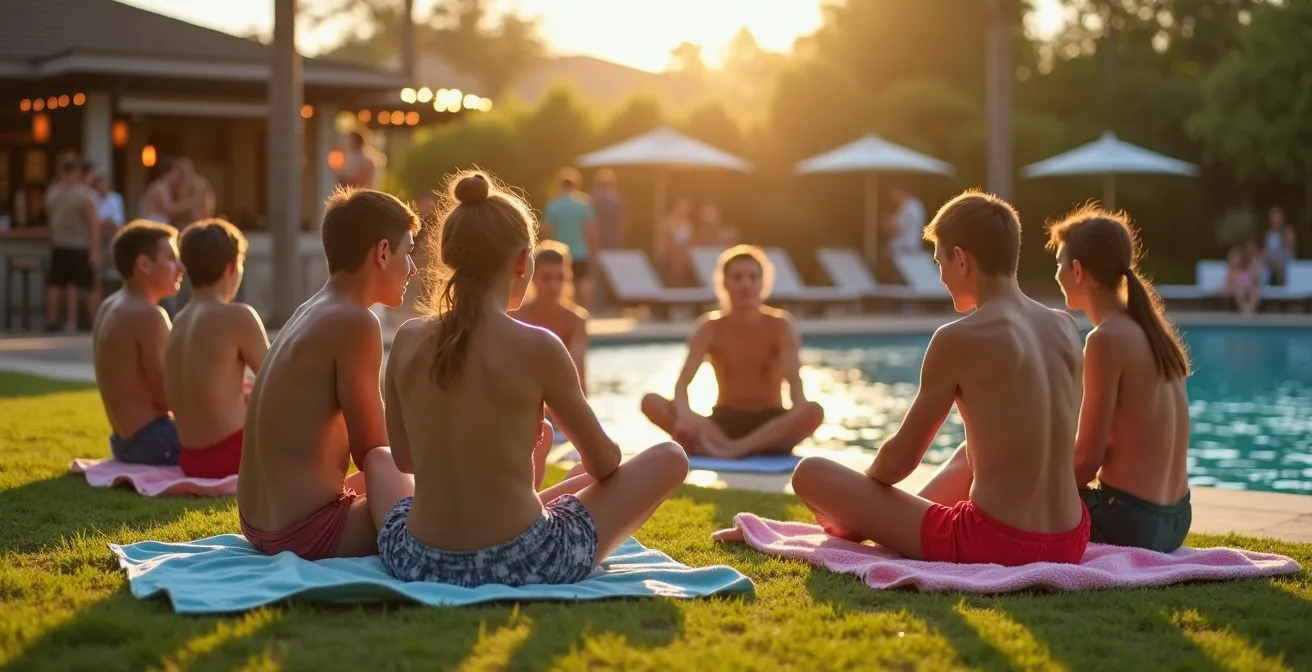
The strategic parent relinquishes control of the sunbed battle. Instead, observe where the teen social hubs are forming. Encourage your teen to “go find their friends” and establish their own space. This act of trust grants them the autonomy they crave. You can keep your sunbed as a home base for essentials like sun cream and money, but understand that your teen’s real holiday is happening elsewhere, on a patch of grass they’ve claimed as their own.
Armbands or Vests: What Is Mandatory for Toddlers in Campsite Lagoons?
While your teenager navigates their complex social world, parents often have another layer of responsibility: the safety of younger children. The rules for toddlers in French campsite pools can seem confusing, but they are rooted in a strong culture of safety. While there isn’t a national law mandating flotation devices for every child, individual campsite policies are often very strict, especially at higher-end establishments. It’s a matter of liability and ensuring a safe environment for all guests.
In fact, safety is paramount, with a study showing that 95% of 5-star French campsites require flotation devices for children under the age of five in their main pools. This is not a suggestion; it is an enforced rule. Arriving unprepared can lead to disappointment or an expensive purchase at the campsite shop. The most commonly accepted and recommended items are not just traditional armbands but full swim vests. Vests certified with the EN 13138-1 standard are preferred as they offer superior buoyancy and stability, keeping the child’s head well above water while allowing their arms to move freely.
Another critical point is supervision. French regulations are clear: children under 10 require active adult supervision. This means a teenager, no matter how responsible, cannot legally be the sole supervisor for their younger sibling in the water. An adult must be present and attentive. For a family with mixed-age children, this requires strategic planning. It means parents must tag-team supervision duties, ensuring one adult is always dedicated to the younger child while the teenager enjoys their own freedom within the pool complex.
Why an Indoor Pool Complex Is Essential Even in the South of France?
Booking a campsite in the sun-drenched South of France might make an indoor pool seem redundant. You’re picturing endless blue skies, so why would you need a covered pool? The answer, once again, lies in teenage psychology. An indoor pool is not just a rainy-day backup; it’s a strategically vital asset for managing the social and emotional needs of an adolescent. It offers a change of scene, a different social dynamic, and a valuable escape.
First, it provides an escape from the weather—not just rain, but also the intense midday sun or the evening chill. This allows the “pool day” to be extended, offering more opportunities for social interaction. More importantly, it functions as a distinct social zone. A case study from the Les Méditerranées campsite group found that their indoor pools see peak teen usage between 6-8 PM. Even in high summer, these controlled environments, often with a consistent 28°C water temperature, become the preferred evening social hub after the outdoor pools have closed or become too chilly. The study noted that the enclosed space has better acoustics for conversation, allowing for more intimate social connections than the chaotic outdoor area.
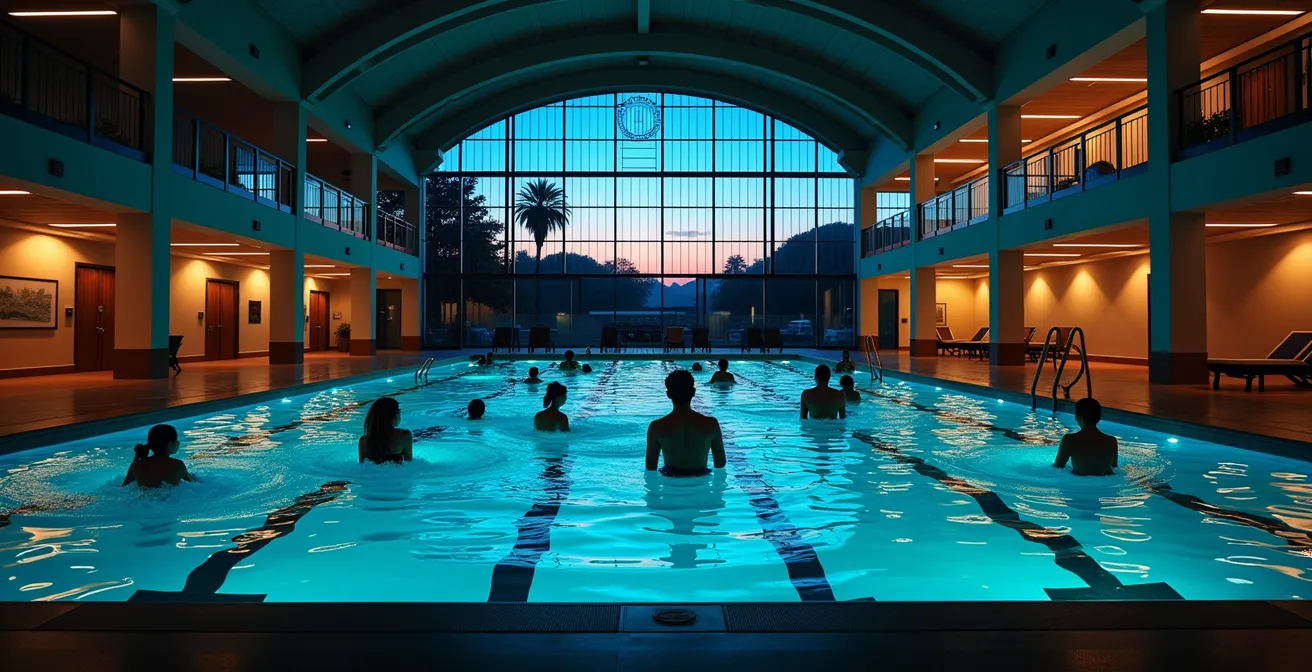
This data reveals the indoor pool’s true purpose: it is the evening’s ‘pre-game’ location, a place to gather before the campsite’s evening entertainment begins. For a teenager, it’s a semi-private space away from both younger kids and their parents. For you, the parent, it’s a godsend. It provides a safe, contained, and supervised environment for your teen to socialize in during the often-tricky twilight hours. When booking, seeing an indoor pool on the features list shouldn’t be a “nice to have,” but a key strategic element for a harmonious holiday.
Chlorine Levels: Why Swimming in the Late Afternoon Might Irritate Your Skin?
A common holiday complaint is itchy skin or red, stinging eyes after a long day at the pool. This is often blamed on “too much chlorine,” but the science is more nuanced and understanding it can help you manage your family’s comfort. The irritation is rarely caused by chlorine itself, but by compounds called chloramines. These are formed when chlorine reacts with organic matter like sweat, oils, and urine brought into the pool by swimmers. The more swimmers, the higher the concentration of chloramines.
This is why the time of day you swim matters. The late afternoon, typically between 4 PM and 6 PM, is when the pool has had its highest bather load and the sun’s UV rays have broken down some of the free chlorine, leaving a higher ratio of irritating chloramines. This isn’t just an anecdote; research on pool water chemistry confirms that a significant 78% of swimmers reported eye irritation and 34% experienced skin rashes when swimming during these peak hours. The water can also appear cloudier as a result.
For parents, this knowledge is a strategic tool. If your teenager has sensitive skin or is prone to complaining about stinging eyes, you can guide them towards swimming earlier in the day or later in the evening after the pool’s cleaning cycle has had a chance to run. The following table illustrates how water quality typically fluctuates.
| Time of Day | Chloramine Levels | Water Clarity | Skin Irritation Risk |
|---|---|---|---|
| Morning (8-10 AM) | Low | Excellent | Minimal |
| Midday (12-2 PM) | Moderate | Good | Low |
| Late Afternoon (4-6 PM) | High | Poor (cloudy) | Elevated |
| Evening (After cleaning) | Low | Good | Minimal |
Simply rinsing off with fresh water immediately after leaving the pool can also significantly reduce irritation by washing away the chloramine residue. Framing this as expert advice to “hack” the pool for maximum comfort is far more effective than a simple command to “go and shower.”
The “No TV” Surprise: How to Prepare Teens for Low-Tech Accommodation?
Many modern campsite accommodations, from mobile homes to safari tents, deliberately omit televisions. For a teenager accustomed to constant digital stimulation, this “no TV” surprise can feel like a punishment. Their immediate reaction might be boredom or frustration. However, this perceived lack is actually the campsite’s greatest strength, and the pool complex is the antidote. The key is to frame this low-tech environment not as a deprivation, but as an opportunity for a more intense, real-world experience.
Without the passive distraction of a screen, teenagers are naturally pushed towards more active and social forms of entertainment. The pool complex becomes the default hub of activity, a vibrant, ever-changing source of stimulation that no screen can replicate. It’s a place of physical challenges, social dares, and constant drama. As travel blogger Emma Thompson eloquently puts it:
The pool complex becomes a living theater where every dive, every race, and every dare creates content more engaging than any screen could offer.
– Emma Thompson, Travel Lynn Family Blog – Best Family Campsites France 2026
This “living theater” provides a powerful sensory experience that is far more compelling than a pixelated display. The feeling of speed on a water slide, the impact of hitting the water, the shared laughter with a new friend—these are the high-definition moments that form lasting memories. The strategic parent can prepare their teen by setting this expectation early: “The accommodation is for sleeping; the holiday happens outside.”

By pre-framing the absence of a TV as a feature, not a bug, you shift the focus to the rich, real-world experiences waiting to be had. You’re not taking something away; you’re directing them toward something better. The pool complex isn’t just a place to cool off; it’s the high-energy, real-life content stream that will define their holiday.
Curfew Enforcement: How Guards Handle Teenagers Gathering at Night?
For many parents, the biggest anxiety is what happens after dark. You see groups of teenagers gathering, and your mind races with worst-case scenarios. You hear about the 11 PM campsite curfew and wonder how it’s possibly enforced. Will your teen get into trouble? Here, it’s crucial to understand the reality versus the perception. Campsite security’s primary role is not to punish, but to prevent accidents and manage liability.
The pool complex, securely fenced and locked at night, is often a magnetic draw for teens seeking a clandestine thrill. A veteran security guard from a top Brittany campsite shared their pragmatic approach: “We know teens will try to access the pool at night – it’s a tradition. Our job isn’t to catch them but to prevent accidents. We do rounds every 30 minutes with flashlights, making noise deliberately. Smart kids hear us coming and leave.” This reveals the unwritten rule: the goal is gentle dispersal, not confrontation. Security guards are not police officers; they are shepherds guiding the flock towards safer pastures.
The most effective parental strategy is not to forbid nighttime wandering, which is a losing battle, but to work *with* the system. This means knowing and communicating the safe, designated alternatives for after-hours socializing. Rather than issuing a blanket “be back by 11,” have a conversation about *where* they can go. Most modern, teen-focused campsites have anticipated this need and provide excellent, supervised alternatives.
Your Teen’s Guide to Safe Night-Time Socializing
- Multi-sports court: Check if it’s lit, as these are often open until midnight for ball games and group hangouts.
- Games room: Locate the games room; at many 4-5 star sites, it’s open 24/7 with pool tables and arcades, offering a supervised indoor option.
- Beach access paths: If the campsite has one, confirm it’s a designated and safe route for evening gatherings away from the main hub.
- Reception area Wi-Fi zones: Identify these as acceptable, well-lit gathering spots that also offer connectivity.
- Designated teen zones: Ask at reception if the site has a specific ‘hangout’ or disco for teens, designed for after-hours socializing.
By providing your teen with a menu of approved options, you grant them the freedom they desire while ensuring their safety within the campsite’s established boundaries. You’re not just setting a curfew; you’re providing a roadmap for responsible freedom.
Key Takeaways
- The pool complex is a social ecosystem; its rules are a teenager’s guide to social integration.
- Teenagers seek autonomy and social territory, which is rarely a sunbed by the pool’s edge.
- Strategic use of different pool zones (indoor, balneo) can be a powerful tool for parental negotiation and family harmony.
Can a Campsite Balneotherapy Pool Rival a Real Thalasso Center?
In the hierarchy of the pool ecosystem, the balneotherapy or spa area sits at the very top. Often restricted to adults, these zones with their hydro-massage jets, jacuzzis, and serene atmosphere represent a world of calm and exclusivity. While it may not offer the medical rigour of a dedicated thalassotherapy center, its strategic value for a family with teenagers is arguably far greater. It’s not about the therapeutic quality of the water; it’s about the currency of status and privilege.
For a teenager, being granted access to an “adults-only” space is a powerful symbol of trust and maturity. It’s a rite of passage that acknowledges they are no longer a child. Some of the most forward-thinking campsites have recognized this and are using their spa facilities as a revolutionary tool for family connection. A compelling case study comes from Camping Les Mimosas, which introduced ‘Family Spa Hours’ in the early evening.
During these specific time slots, supervised teens aged 14 and over are allowed to access the balneotherapy area with their parents. The campsite reports this has become their most requested feature, with 73% of families with teens specifically booking these slots. The management noted it significantly reduces parent-teen conflict by providing a rare opportunity for quality time in a calm, shared environment. It transforms the spa from a point of exclusion into a coveted reward and a space for genuine conversation.
As a parent, you can leverage this feature as the ultimate bargaining chip. Offer an hour in the jacuzzi as a reward for helping with chores or for respecting family time. This positions you not as a rule-enforcer, but as a gatekeeper to a high-status experience. It’s a moment of shared luxury that can reset the mood, ease tensions, and create a positive memory that will long outlast the holiday itself.
Ultimately, a successful holiday with a teenager is a masterclass in strategic negotiation. By viewing the campsite pool not as a mere amenity but as a complex social arena, you can move from being a reactive manager of conflicts to a proactive architect of harmony. Understand their need for autonomy, respect their social territories, and use the facilities as tools for connection, and you will find that the pool complex truly becomes the heart of a happy family holiday.
Frequently Asked Questions About French Campsite Pools
Are armbands mandatory for toddlers in French campsite pools?
While not a strict national law, most 4- and 5-star campsites either strongly recommend or contractually require approved flotation devices (like swim vests) for children under 5 in any pool deeper than 60cm for safety and insurance reasons.
Can older siblings supervise toddlers in the pool?
No. French pool regulations are very clear that children under the age of 10 must be under the direct and active supervision of an adult. A teenager, regardless of their age or swimming ability, cannot legally be considered the sole supervisor for a younger sibling.
What type of flotation device is best for campsite pools?
Swim vests that are certified to the European standard EN 13138 are highly recommended over simple armbands. They provide better stability and buoyancy, keeping the child’s head higher above the water, and allow for more natural arm movement, which is better for both safety and play.