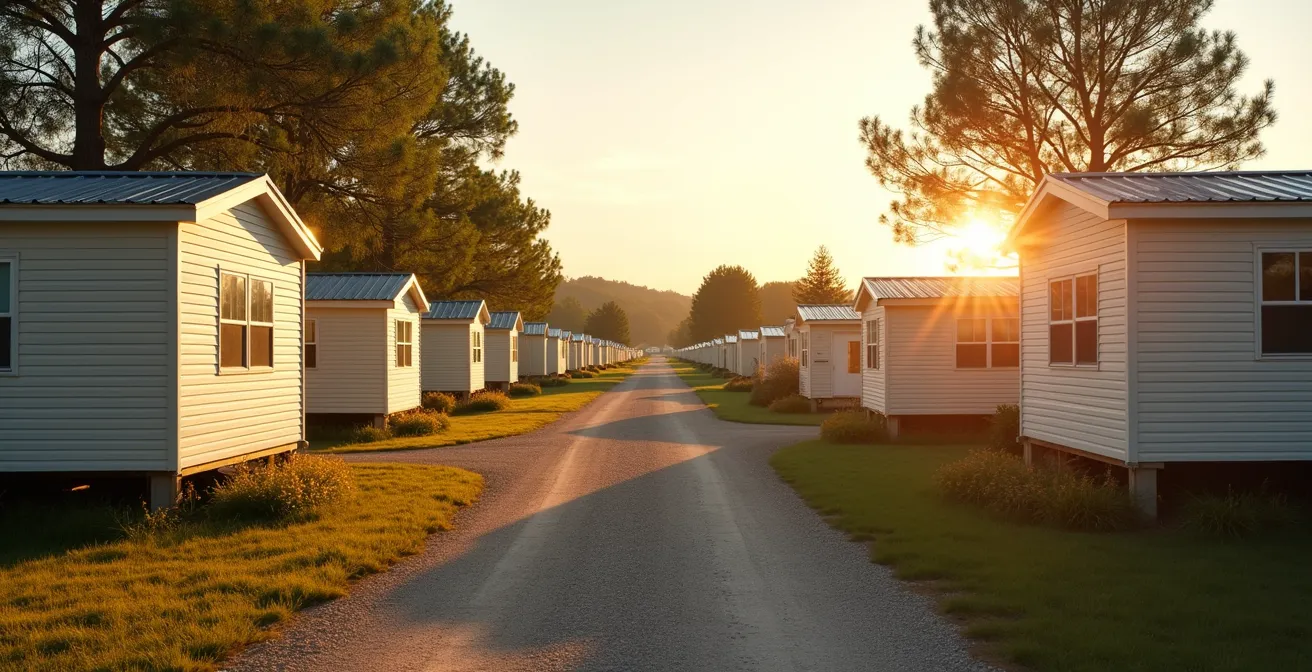
The key to travel safety during a viral outbreak isn’t just distancing, but gaining full control over your environmental transmission vectors.
- Standalone units eliminate shared air systems (HVAC) which can spread aerosols between rooms, a primary risk in multi-story buildings.
- Full autonomy over cleaning, entry, and guest policies drastically reduces exposure to contaminated surfaces and external contacts.
Recommendation: Prioritize accommodations that offer a self-contained “hygiene bubble”—detached units with private facilities and contactless check-in.
For the health-conscious traveler, the question of accommodation safety has never been more critical. In the wake of global viral outbreaks, standard advice often revolves around personal actions: hand washing, mask-wearing, and maintaining distance in public spaces. While essential, these measures are only one part of a comprehensive safety strategy. They address personal conduct but overlook the most significant variable in viral transmission: the environment itself. The conventional wisdom of simply “avoiding crowds” is insufficient when staying in a building with hundreds of other people and shared infrastructure.
The fundamental flaw in this thinking is equating all accommodations as equal risks. The structural reality of a hotel—with its shared corridors, elevators, and centralized HVAC systems—creates a web of interconnected transmission vectors that are entirely outside a guest’s control. The real question is not just how to act safely within a space, but how to choose a space that is inherently safer by design. This is where the concept of a personal hygiene bubble becomes paramount.
This article shifts the focus from behavior alone to environmental control. We will demonstrate that the true safety advantage of a private mobile home lies in its ability to function as a self-contained unit. Instead of navigating a shared system, you inhabit a controlled environment. We will explore the specific mechanisms, from airflow dynamics to surface contact points, that make a detached mobile home a clinically superior choice for minimizing viral risk, giving you not just a place to stay, but a fortress of well-being.
This guide delves into the specific factors that contribute to this enhanced safety, offering a clear framework for making informed decisions on your next trip. By understanding these principles, you can travel with confidence and peace of mind.
Summary: Why Private Mobile Homes Offer Superior Viral Safety
- Detached vs Semi-Detached: How Much Distance Do You Need for Silence?
- Do You Need a Vaccine Pass to Stay in Private Accommodation?
- Hard Shell Suitcases: Why They Are a Nightmare in Small Mobile Homes?
- Safes and Locks: How Secure Is Your Laptop in a Canvas Lodge?
- Contactless Check-In: How to Access Your Unit Without Visiting Reception?
- Private Bathroom on Your Pitch: Is It Worth the Premium Price Tag?
- Can My Friends Visit? Understanding the Strict Guest Policy
- Why 5-Star Camping Is the New Mental Health Retreat for Burned-Out Executives?
Detached vs Semi-Detached: How Much Distance Do You Need for Silence?
While the title mentions silence, the core benefit of distance during a viral outbreak is about air quality, not acoustics. The primary vulnerability of a hotel is its shared air. Centralized HVAC systems can become conduits for aerosolized transmission, circulating airborne particles throughout a building. In fact, a stark CDC case study documented SARS-CoV-2 transmission between different hotel floors, concluding that aerosol spread through the building’s structure was the most plausible route in a poorly ventilated setting. This means that even in the isolation of your room, you are connected to the building’s shared respiratory system.
A detached mobile home fundamentally breaks this chain of transmission. Each unit is a standalone structure with its own independent ventilation. The space between units acts as a natural buffer where viral aerosols are rapidly dispersed by outdoor air currents. The science is clear on this: research published in Environmental Science & Technology demonstrates that outdoor spaces with better ventilation show significantly lower infection risk parameters. A detached unit ensures you are breathing your own air, not recirculated air from other guests.
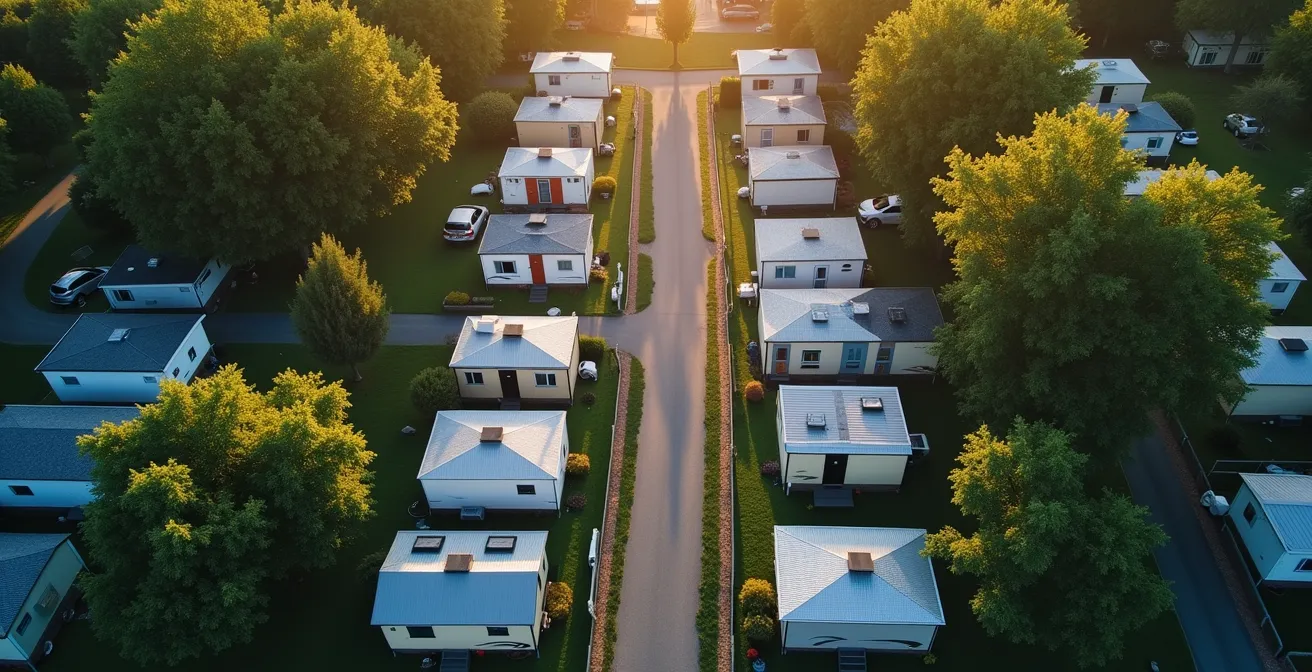
Even semi-detached units, while not as ideal as fully detached ones, offer a significant advantage over a hotel corridor. The lack of enclosed, shared hallways means ingress and egress occur in the open air, minimizing incidental contact and exposure. The key is to sever the connection to a shared indoor atmosphere, and physical separation is the most effective way to achieve this.
Do You Need a Vaccine Pass to Stay in Private Accommodation?
During peak periods of the pandemic, vaccine passes and health checks became a key part of public health strategy. Hotels, as high-density, high-traffic environments, were often subject to stringent government mandates regarding guest and staff vaccination status. While this provided a layer of security, it also relied on universal compliance and the operational capacity to enforce it. The system was only as strong as its weakest link, and it did not eliminate the inherent risks of shared spaces.
Private accommodations and campgrounds often operated under a different, more flexible framework. Their inherent design lends itself to better risk management. As the Boston Hospitality Review noted in its Camping Amidst COVID-19 Report:
Campgrounds and RV parks are better suited to allocate social distancing since the units are in sectioned spaces.
– Boston Hospitality Review, Camping Amidst COVID-19 Report
This structural advantage meant that many private sites could focus on physical controls (like spacing and contactless services) rather than relying solely on pass systems. For the traveler, this translates to having more direct control. Instead of depending on a hotel’s enforcement of a broad policy, you can vet a campsite’s specific protocols. This proactive approach empowers you to choose an environment that aligns with your personal risk tolerance, ensuring your hygiene bubble remains intact from the moment you book.
Checklist Before Booking Your Safe Stay
- Verify protocols: Check the campground’s website for updated COVID-19 guidelines, policies, and sanitization measures.
- Assess common areas: Inquire if facilities like bathhouses and laundry are open and confirm their cleaning frequency.
- Confirm capacity limits: Ask about site spacing and whether the property is operating at reduced capacity for better distancing.
- Seek contactless options: Inquire about remote check-in procedures to minimize interactions at reception.
- Check environmental policies: Confirm if the campground follows leave-no-trace principles and has enhanced sanitization for all site amenities.
Hard Shell Suitcases: Why They Are a Nightmare in Small Mobile Homes?
While the physical inconvenience of a large, rigid suitcase in a compact space is a valid concern for any traveler, the issue takes on a new dimension from a public health perspective. Your luggage is the first object from the outside world to enter your carefully selected hygiene bubble. During its journey through airports, taxis, and baggage carousels, it comes into contact with countless surfaces and hands, making it a potential fomite—an object capable of carrying infectious agents.
Hard-shell suitcases, with their non-porous plastic or metal surfaces, present a specific challenge. While they may seem easier to wipe down, viruses can remain viable on such materials for extended periods. This is less about the suitcase material itself and more about the discipline of decontamination upon arrival. The bulkiness of a hard-shell case makes it difficult to isolate in a designated “decontamination zone” within a small mobile home. It often ends up on the bed or floor, potentially cross-contaminating the primary living surfaces before it can be properly cleaned.
This reinforces the core benefit of a private mobile home: total environmental control. You decide what enters your space and how it is handled. As RV owners know well, the ability to manage your own cleanliness is a significant advantage.
RV owners report that having “your own bed, kitchen, bathroom, shower, TV, and other amenities” in a mobile home allows for better control over sanitization and cleanliness compared to shared hotel facilities.
– RVplusYou
A soft-sided duffel bag may be a more practical choice, as it can be more easily stowed away after being wiped down, minimizing its footprint within your clean space. The key takeaway is to treat your luggage as a vector and have a clear protocol for its entry into your sanctuary.
Safes and Locks: How Secure Is Your Laptop in a Canvas Lodge?
When considering security in a mobile home or canvas lodge, the conversation naturally turns to protection against theft. However, in the context of viral safety, the concept of security expands. It’s not just about protecting your valuables from outsiders, but also about protecting your pristine environment from unnecessary internal access. A hotel room, even when locked, is not a truly private space. Housekeeping staff, maintenance personnel, and managers all possess master keys, creating multiple potential entry points and, therefore, transmission vectors.
A private mobile home offers a fundamentally different model of security. You are typically the sole keyholder for the duration of your stay. This exclusivity is a powerful tool for maintaining your hygiene bubble. It means no one else will enter your living space, touch your surfaces, or breathe your air unless you explicitly authorize it. This eliminates the variable of daily housekeeping as a potential source of cross-contamination.

Modern mobile homes and high-end lodges are increasingly equipped with digital keypad locks, further enhancing this security. These systems not only offer robust protection for your belongings but also facilitate contactless check-in, as codes can be sent directly to your phone. This dual benefit—physical security and health security—makes the lock on your door one of the most important features of your self-contained sanctuary. The assurance that you and only you control access provides invaluable peace of mind.
Contactless Check-In: How to Access Your Unit Without Visiting Reception?
The hotel check-in process is a convergence point of risk. It involves queuing in a lobby, interacting closely with front desk staff, handling pens, documents, and key cards that have been touched by many others. This single process can involve dozens of touchpoints, each a potential opportunity for viral transmission. It represents the first and often most significant breach in a traveler’s attempt to maintain social distance.
Contactless check-in completely dismantles this risk vector. By leveraging technology, it allows you to bypass the reception area entirely and proceed directly to your sanitized, private mobile home. This process typically involves pre-arrival online registration, digital identity verification, and receiving a mobile key or keypad code on your smartphone. You arrive, go to your unit, and unlock the door. The first time you touch the door handle, you are entering your own controlled hygiene bubble, not a common area.
This isn’t just a niche feature for the hyper-cautious; it has become a mainstream expectation for safety-conscious travelers. The demand for such technologies has soared, reflecting a permanent shift in guest priorities. In fact, a significant majority of travelers now see this as a critical factor in their booking decisions, with the Oracle Hospitality Report stating that 71% of guests are more likely to book properties offering contactless options. Choosing a mobile home park that offers this service is one of the most effective steps you can take to ensure your journey from car to sanctuary is seamless and safe.
Private Bathroom on Your Pitch: Is It Worth the Premium Price Tag?
For many campers, the shared bathroom block is a standard part of the experience. However, from a clinical standpoint, it is arguably the single greatest point of risk in a campground setting. These high-traffic, enclosed, and often humid spaces are ideal environments for the spread of airborne and surface-based pathogens. Every visit involves contact with multiple shared touchpoints: door handles, stall locks, faucets, and flush mechanisms. Despite frequent cleaning schedules, the sheer volume of users makes it nearly impossible to eliminate risk completely.
This is where the premium for a pitch with a private bathroom shifts from a luxury to a critical health investment. Having a dedicated facility eliminates 100% of the exposure associated with a shared block. The value of this cannot be overstated. An analysis of 7,324 early COVID-19 cases published in PNAS found that all clusters of three or more cases occurred indoors, with an overwhelming 80% in apartment homes. Only a single transmission was recorded outdoors. This data starkly illustrates the danger of shared indoor air.
A private bathroom transforms your mobile home from a largely self-contained unit into a completely hermetic hygiene bubble. You have absolute control over its cleanliness, the products used, and, most importantly, who uses it. You are not depending on the diligence of other guests or the timing of the cleaning crew. The additional cost is not for convenience; it is for the certainty that you have secured the most personal and vulnerable part of your daily routine. For any health-conscious traveler, the answer to whether it’s worth the premium is an unequivocal yes.
Can My Friends Visit? Understanding the Strict Guest Policy
You’ve successfully created your hygiene bubble. Your mobile home is a detached, self-contained sanctuary. You’ve used contactless check-in, you have a private bathroom, and you’ve decontaminated your luggage. Your environment is secure. The final and most critical variable to manage is people. During an outbreak, the strictest guest policies are not about being antisocial; they are about maintaining the integrity of the controlled environment you’ve worked so hard to establish.
Every visitor you allow inside your unit represents a new and unknown set of potential exposures. They are, in essence, a bridge from the outside world directly into the heart of your safe zone. This concept is captured perfectly by a simple but powerful analogy:
Your mobile home is a fortress, but visitors are the Trojan Horse.
– Article analysis, Understanding quarantine protocols in mobile accommodations
This doesn’t mean you must live in total isolation. Social connection is vital, but it must be managed with a clear protocol. Most campgrounds with strict policies recommend that all interactions with visitors happen outdoors, maintaining ample physical distance. Allowing friends into your mobile home effectively nullifies its primary safety advantage. If a visit is necessary, it is crucial to adhere to a safe visitor protocol:
- Meet visitors exclusively outdoors, maintaining at least 6 feet of distance.
- Designate a specific outdoor meeting area away from your unit’s entrance.
- Set up an external hand sanitizing station for any essential interactions.
- Strictly avoid allowing non-registered guests inside your mobile home.
- Keep the duration of any visits brief and purposeful.
- Ensure your visitors are aware of all campground policies before their arrival.
Enforcing a strict guest policy is the final act of diligence in protecting your health and peace of mind. It’s about recognizing that the strength of your fortress depends entirely on controlling who gets to cross the drawbridge.
Key Takeaways
- Focus on environmental control: shared air systems in hotels are a primary risk vector that standalone units eliminate.
- Autonomy is safety: managing your own cleaning, access, and facilities minimizes unknown touchpoints and potential exposures.
- The “hygiene bubble” is a system: every element, from contactless check-in to a strict visitor policy, contributes to its integrity.
Why 5-Star Camping Is the New Mental Health Retreat for Burned-Out Executives?
The conversation about mobile home safety has rightly focused on the physical mechanisms of viral protection. However, the benefits extend far beyond the clinical. The very act of securing a private, controlled environment creates a profound psychological effect. For burned-out executives and professionals grappling with constant stress and decision fatigue, the ability to step into a space where risk is minimized and control is maximized offers a rare form of mental and emotional relief.
This is the essence of why “5-star camping” or glamping has become the new mental health retreat. It combines the biophilic benefits of being in nature with the deep-seated comfort of a secure, private sanctuary. The constant, low-level anxiety that accompanies navigating shared public spaces simply dissolves. You are not worried about the person in the elevator, the cleanliness of the hotel restaurant, or who was in your room just hours before. This offloading of cognitive burden is deeply restorative.
This trend is not just a feeling; it’s a reflection of a major shift in traveler priorities, where safety and well-being are the new luxury. As Anand Subramanian, the CEO of camping-tech company Tentrr, stated:
People view Tentrr as a safe alternative to going on a cruise or being crammed in a plane with other passengers. I think 2020 is going to open the floodgates for the outdoor industry.
– Anand Subramanian, Tentrr CEO on camping growth
The “luxury” is no longer about opulent lobbies or elaborate turndown service. It is the priceless peace of mind that comes from knowing you are in a safe, self-contained environment. It is the freedom to relax completely, knowing your hygiene bubble is intact. This makes the private mobile home not just a safer way to travel, but a more restorative one.
Empower your next journey by choosing an accommodation that gives you complete environmental control and the profound peace of mind that comes with it.
Frequently Asked Questions About Health Safety in Private Accommodations
How does outdoor air circulation affect transmission risk?
Experts confirm that coronavirus does not spread as easily in well-ventilated outside areas. Global Rescue CEO Dan Richards stated that ‘Outdoor activities – like individual or small group camping – have a lower risk of coronavirus exposure than indoor activities.’ The open air rapidly disperses viral particles, drastically reducing the concentration a person might be exposed to.
What’s the actual difference in touchpoint exposure?
Private bathroom facilities eliminate multiple daily touchpoints from door handles, faucets, and surfaces shared with dozens of other guests, significantly reducing transmission vectors. While a shared facility may have 10-20 high-contact surfaces used by many people between cleanings, a private facility’s surfaces are only touched by you.
Is professional cleaning always better than personal control?
While shared facilities may be cleaned multiple times daily by professionals, a private bathroom allows complete and total control over cleaning products, methods, and frequency based on your personal comfort level and health needs. You can ensure that disinfectants are used correctly and that no areas are missed, providing a level of certainty that third-party services cannot guarantee.