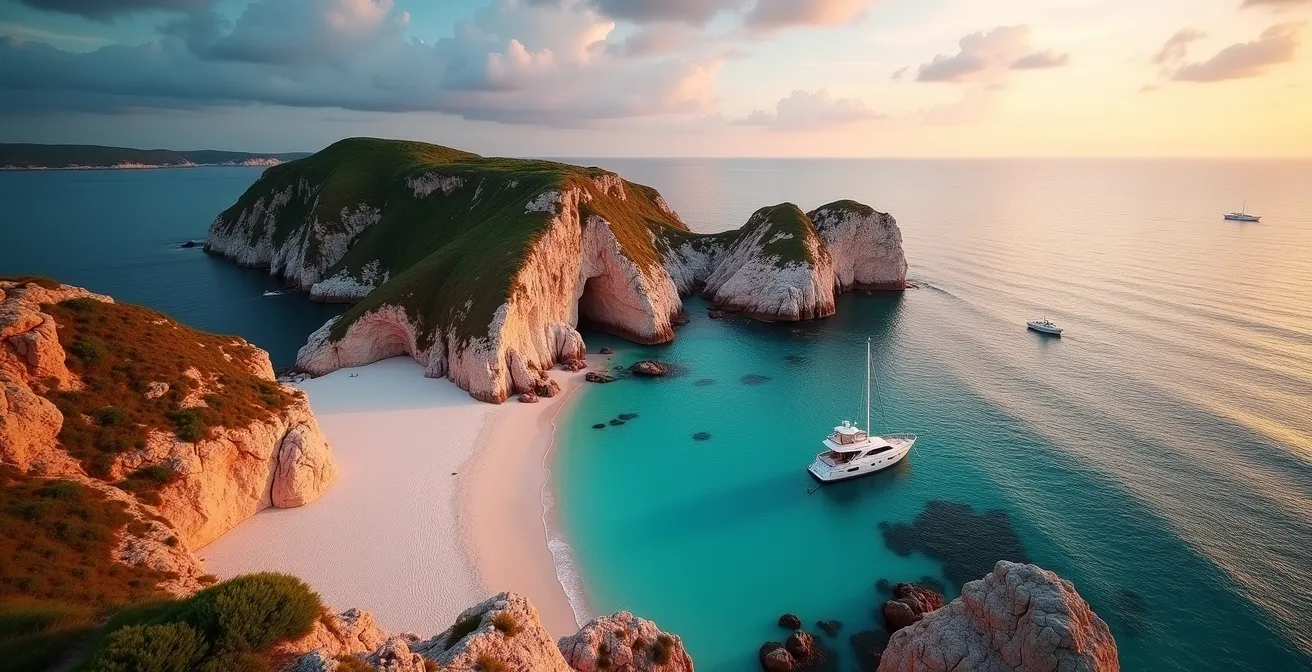
The Pink Granite Coast’s true luxury isn’t its similarity to the Seychelles; it’s the profound, ‘earned beauty’ that rewards engagement with its raw, elemental power.
- Its dramatic, ever-changing weather is not a flaw but a spectacle, offering a private, shifting light show for the observant traveler.
- Authentic experiences, from sourcing lobster direct from boats to unlocking tidal islands, are active pursuits, not passive services.
Recommendation: Embrace the dynamic environment. Use its tides, weather, and rugged trails as tools to access a deeper, more memorable form of luxury.
As a landscape photographer, I chase light. I’ve framed the serene lagoons of the Seychelles and the sun-drenched cliffs of the Mediterranean. Yet, my lens and my soul are repeatedly drawn back to a place of more elemental and profound power: Brittany’s Pink Granite Coast. Many sophisticated travelers see it as a beautiful European curiosity, a landscape of peculiar pink rocks. They compare its secluded coves to far-flung tropical islands, searching for a familiar kind of beauty. This is the first mistake.
The conventional wisdom about luxury travel often involves predictable sunshine, placid seas, and effortless comfort. But what if true luxury isn’t about escaping the elements, but about immersing yourself within them? What if the most exclusive experience is one that you must earn through observation, timing, and a willingness to engage with nature on its own terms? This is the secret of the Côte de Granit Rose. It doesn’t offer the passive comfort of a resort; it offers something far more valuable: a sensory sculpture carved by the wind, the waves, and the tides.
This guide isn’t about simply seeing the pink rocks. It is an invitation to understand their magic. We will explore how the notoriously fickle Breton weather is actually a key asset, how to turn a family walk into a geological safari, and why the Atlantic’s vigorous spirit provides a more fulfilling adventure than the calm Mediterranean. Forget what you think you know about coastal destinations. The real journey begins when you learn to read the landscape, listen to its rhythms, and discover the earned beauty that awaits.
To help you navigate this unique destination, this article breaks down the essential experiences that define the Pink Granite Coast’s rugged luxury. From practical tips on a family hike to the secrets of the tides, you’ll find everything you need to engage with this landscape, not just observe it.
Summary: Why the Atlantic Coast Offer a Better Adventure Than the Calm Mediterranean?
- Is It Really Raining All the Time in Northern Brittany?
- How to Explain the Chaos of Rocks to Your Curious Kids?
- Where to Buy Fresh Lobsters Direct from the Boat in Perros-Guirec?
- North Coast vs South Coast: Which Side of Brittany Has Warmer Water?
- The Tide Mistake That Strands Tourists on Ploumanac’h Rocks Every Year
- How to Hike the GR34 Customs Path Without Exhausting Your Children?
- Coastal Path or Forest Loop: Which Is Easier for a 5-Year-Old?
- Why the Atlantic Coast Offer a Better Adventure Than the Calm Mediterranean?
Is It Really Raining All the Time in Northern Brittany?
The most persistent cliché about Brittany is its rain. Travelers accustomed to the relentless sun of the Mediterranean often view it as a drawback. But from a photographer’s perspective, this is the coast’s greatest asset. The weather is not a monolithic grey curtain; it is a dynamic spectacle. The coastal microclimate creates rapid, dramatic shifts in light and atmosphere. A morning of soft, misty rain can give way to an afternoon where the sun breaks through, setting the wet granite ablaze with a coppery, almost otherworldly glow. This isn’t bad weather; it’s a private, ever-changing light show.
The key is to reframe your mindset from “weather tolerance” to “weather chasing.” The true luxury here is witnessing the landscape transform before your eyes. The air, filled with the scent of salt and pine, seems to clear the mind and refresh the soul with each passing shower. Instead of hiding from the weather, the sophisticated traveler learns to work with it, turning a potential inconvenience into the main event. A dramatic storm viewed from a panoramic window, a gust of wind that clears the sky to reveal a perfect sunset—these are moments of earned beauty, more memorable than a week of monotonous sunshine.
Your Action Plan: Embrace Brittany’s Changing Weather Like a Luxury Traveler
- Download weather apps like Windy or Météo-France to track microclimates hour by hour and chase the sun from cove to cove.
- Pack stylish rain gear from brands like Saint James or Aigle to turn weather protection into a fashion statement.
- Book accommodations with panoramic windows and fireplaces to enjoy dramatic storm watching from luxury comfort.
- Plan indoor-outdoor flexibility with visits to covered markets, thalassotherapy centers, and coastal museums as weather pivots.
This approach transforms you from a passive tourist into an active participant in the coastal drama, ready to capture the fleeting moments of extraordinary light.
How to Explain the Chaos of Rocks to Your Curious Kids?
To a child’s eye, the pink granite chaos of Ploumanac’h is a natural playground of mythic proportions. But how do you translate that geological wonder into a language they understand? The secret is to move beyond a simple explanation of magma cooling over 300 million years ago. Instead, present the landscape as a sensory sculpture and an open-air art gallery. The “chaos” is actually a collection of shapes waiting to be discovered. It’s a game of pareidolia on a grand scale, where imagination is the only tool required.
Encourage them not just to look, but to touch the coarse, crystalline texture of the granite, warmed by the sun. Talk about how the wind and salty water have acted as sculptors for millennia, smoothing edges and carving out fantastical forms. This transforms a simple walk into a shape-spotting safari, an adventure in creative observation. By giving the rocks names and stories, you connect your children to the landscape on a personal, memorable level. They are no longer just looking at rocks; they are engaging with a giant’s toy box, a place of magic and discovery.

This process of active observation, perhaps even sketching the forms in a notebook, fosters a deep sense of wonder. It’s an educational experience that feels like play, teaching them to look closer and find the extraordinary in the natural world. This is the essence of an enriching family journey.
Your Action Plan: Shape-Spotting Safari Checklist for Families
- Find the Tortoise Rock near Saint-Guirec beach (easiest to spot at low tide).
- Locate Napoleon’s Hat between Trestraou and Saint-Guirec beaches.
- Spot the Witch formation along the GR34 coastal path.
- Discover the Rabbit shape near Ploumanac’h lighthouse.
- Search for the Shark rock visible from the customs officer’s path.
Ultimately, you’re not just explaining geology; you’re giving them a lifelong tool for appreciating the art within nature.
Where to Buy Fresh Lobsters Direct from the Boat in Perros-Guirec?
The culinary dimension of the Pink Granite Coast follows the same principle of “active luxury.” While excellent restaurants abound, the most memorable gastronomic experience isn’t found on a menu; it’s sourced directly from the sea. Buying lobster straight from the fishing boats in Perros-Guirec harbor is a ritual that connects you to the lifeblood of the coast. This isn’t a simple transaction. It’s an interaction, a moment of participation in the local economy and culture that is infinitely more rewarding than a standard restaurant meal.
Understanding the port’s “three-tier freshness system” is the kind of insider knowledge that defines a sophisticated traveler. The ultimate prize is the same-day catch, bought directly from the fishermen as they return in the late afternoon. This requires timing, a bit of patience, and a friendly approach. Next are the viviers (tanks) on the port, holding lobster that is still exceptionally fresh. Finally, there are the excellent local ‘poissonneries’ (fishmongers) offering convenience and consistent quality. Each tier serves a purpose, but the thrill of the direct purchase—the epitome of an earned experience—is unmatched.
Your Action Plan: Insider’s Guide to Boat-Fresh Lobster in Perros-Guirec
- Arrive at Perros-Guirec harbor between 4-6 PM when small fishing boats (caseyeurs) typically return.
- Look for boats with lobster traps visible on deck – these are your direct sources.
- Approach fishermen politely with ‘La pêche a été bonne?’ (Was the catch good?).
- Ask ‘Vous vendez directement?’ (Do you sell directly?) to confirm boat sales.
- Bring cash and a cooler with ice – most fishermen don’t accept cards.
Preparing a lobster that you bought minutes after it left the water, while overlooking the very coast it came from, is a sensory peak that no five-star restaurant can replicate.
North Coast vs South Coast: Which Side of Brittany Has Warmer Water?
The direct question is simple: the south coast of Brittany generally has water temperatures a couple of degrees warmer than the north. However, for the discerning traveler, “warmer” is not necessarily “better.” The North Coast’s cooler, invigorating waters are the engine of a thriving wellness culture. The choice isn’t between cold and warm, but between two different philosophies of water: the Atlantic’s invigorating therapy versus the south’s traditional swimming comfort.
The cooler temperatures on the Pink Granite Coast are precisely what make it a world-class wellness destination. The water is rich in iodine and minerals, and its crispness is sought after for its therapeutic effects on circulation and vitality. This is why the North Coast’s cooler waters support 3 world-class thalassotherapy centers within 30km. A quick, bracing dip here is not about leisurely bathing; it’s an act of revitalization, a jolt to the senses that leaves you feeling alive and energized. This is a perfect match for adventurous activities like sea kayaking or coasteering, where the water is part of the thrilling environment, not just a medium for floating.
This table compares the two experiences, allowing you to choose based on your desired outcome: gentle relaxation or dynamic adventure.
| Feature | North Coast (Pink Granite) | South Coast |
|---|---|---|
| Average Water Temp (Summer) | 16-18°C | 18-20°C |
| Wave Conditions | Dynamic, adventurous | Calmer, family-friendly |
| Wellness Benefits | Invigorating cold therapy, high iodine | Traditional swimming comfort |
| Best Activities | Sea kayaking, coasteering | Swimming, paddleboarding |
| Microclimate Spots | Sheltered north-facing coves | Wide open beaches |
Choosing the North Coast is choosing an active, wellness-oriented experience, where the sea is a source of energy rather than a tranquil backdrop.
The Tide Mistake That Strands Tourists on Ploumanac’h Rocks Every Year
Nowhere is the concept of “earned beauty” more apparent than in the rhythm of the tides. On the Pink Granite Coast, the tides are among the most dramatic in Europe. They are not a minor detail; they are the master choreographers of the landscape. Ignoring them is the single biggest mistake a visitor can make, often leading to being cut off by the rapidly rising sea. But for those who learn to read the tide charts, this powerful natural force becomes a key that unlocks ephemeral, exclusive landscapes.
Mastering the “tidal choreography” means knowing when a sandbar will appear to connect you to an island, or when a hidden cove will reveal its pristine beach. It transforms your visit from a static itinerary into a dynamic dance with the ocean. A perfect example is Milliau Island, a wild and magical place accessible only for a few hours around low tide. Those who time their walk correctly are rewarded with near-solitude on an island steeped in history, featuring a 3,000-year-old Celtic grave. This is an experience that cannot be bought; it can only be earned through knowledge and timing. It’s the ultimate active luxury, granting you private access to a place that disappears twice a day.
Your Action Plan: Tidal Safety Checklist for Ploumanac’h Exploration
- Download ‘marée.info’ app and check tide times before any coastal walk.
- Note that tide rises 2 meters in 2 hours – plan return routes accordingly.
- Save SNSM emergency number: 196 (French sea rescue) in your phone.
- Start exploration 2 hours before low tide for maximum safe time.
- Watch for wet sand lines on rocks – they indicate high tide level.
By respecting the tides, you are not just staying safe; you are aligning yourself with the fundamental rhythm of the coast and gaining access to its most precious secrets.
How to Hike the GR34 Customs Path Without Exhausting Your Children?
Hiking the GR34, or Customs Path, is an iconic Breton experience. However, the vision of a multi-hour trek can be daunting for families with young children. The key is to abandon the idea of a long, linear hike and instead treat the path as a series of short, rewarding loops and segments. The goal isn’t to cover distance, but to maximize delight. Luxury, in this context, means curating the experience to be stimulating and joyful, not an endurance test.
The section of the GR34 around Ploumanac’h and Trégastel is perfectly suited for this approach. It’s a string of pearls, with each segment offering a unique reward. You can opt for a short, flat walk that ends at a beach with a crêperie, or a slightly longer loop that incorporates sheltered coves perfect for a mid-hike paddle. The constant proximity to the sea, the opportunities for rock scrambling, and the promise of ice cream at the end of a trail are powerful motivators. It’s about creating a narrative for the walk—a treasure hunt for the best views or a journey to a well-deserved treat.
Here are some of the most family-friendly sections, rated for their fun factor:
- Ploumanac’h to Saint-Guirec Beach: 2km, flat, with rock-climbing opportunities and a crêperie at the end (5/5 stars).
- Trégastel Peninsula Loop: A 2.5-hour circuit with sheltered coves for paddling and multiple beach stops (4/5 stars).
- Port-Blanc to Buguéles: A 3km walk where you can watch fishing boats and find ice cream at the harbor (4/5 stars).
- Trestraou Beach Path: A completely flat 1km path with a playground nearby, perfect for the youngest walkers (5/5 stars).
By curating the hike, you ensure the GR34 remains a source of wonder and adventure, creating positive memories of the trail for years to come.
Coastal Path or Forest Loop: Which Is Easier for a 5-Year-Old?
When planning a walk with a five-year-old, the question of “easier” is more complex than just distance and elevation. It’s about managing energy and attention. A coastal path and a forest loop offer two vastly different sensory experiences, and choosing the right one depends on the child and the moment. The coastal path is a high-stimulus environment, while the forest offers a calmer, more contained experience.
The coastal trail is a visual and auditory feast: crashing waves, calling gulls, passing boats, and an endless horizon. This constant stimulation is exciting but can also be draining. The exposure to wind and sun can burn energy quickly. Conversely, a forest loop, like those in the woodlands behind the coast, provides shelter. The sensory experience is more tactile and olfactory—the feel of moss, the scent of pine. Distractions are more periodic, like a gurgling stream or a sun-dappled clearing, allowing for periods of calm walking. For a tired child, the sheltered and predictable nature of the forest can be a welcome retreat.
The Pointe du Château trail in Trébeurden offers a perfect hybrid. This 3km loop cleverly combines an exciting coastal section, with rock pools and dramatic views, with a peaceful return through a pine forest. It provides the initial thrill of the coast and then a gentler, more sheltered finish for tired little legs.
| Trail Feature | Coastal Path | Forest Loop |
|---|---|---|
| Sensory Stimulation | High visual/auditory (waves, boats) | High tactile/olfactory (moss, pine) |
| Energy Burn Rate | High (wind resistance, excitement) | Moderate (sheltered, calmer) |
| Safety Concerns | Cliff edges, tide awareness needed | Minimal, enclosed environment |
| Weather Sensitivity | High (wind, rain exposure) | Low (tree shelter) |
By matching the trail to your child’s energy level, you turn a simple walk into a perfectly paced adventure.
Key Takeaways
- The true value of the Pink Granite Coast lies in ‘active luxury’—experiences earned through engagement, not passively consumed.
- The dynamic weather and dramatic tides are not obstacles but key elements of the spectacular, ever-changing landscape.
- Authenticity is found in direct interaction, whether it’s buying lobster from a fisherman or timing a walk to access a tidal island.
Why the Atlantic Coast Offer a Better Adventure Than the Calm Mediterranean?
The Mediterranean offers a dream of predictable perfection: calm, warm seas, endless sunshine, and a culture of shoreside relaxation. It is a luxury of passivity. The Atlantic, and specifically the Pink Granite Coast, proposes a different, more profound definition of luxury: one based on adventure, discovery, and elemental connection. It doesn’t give you perfection on a platter; it invites you to find it in a gust of wind, a rising tide, or a hard-won view.
This is the essence of “active luxury.” Consider the journey to the Sept-Îles archipelago, one of France’s most important bird reserves. Reaching this sanctuary requires a boat journey through dynamic waters, a stark contrast to lounging at a Mediterranean beach club. The reward is an exclusive encounter with one of Europe’s largest colonies of seabirds. This is an experience earned through effort, a privilege granted by nature, not by payment. It’s this spirit of authentic wilderness, with 50% of the landscape around Trébeurden being protected, that the Atlantic offers.
As one travel writer beautifully summarized, the coast is a place where nature, history, and exploration converge. This is a sentiment echoed by many who have felt its unique pull.
The Pink Granite Coast is more than just a destination; it’s a place where the beauty of nature, the richness of history, and the thrill of exploration come together in perfect harmony.
– Tales from Brittany Travel Blog, Why You Should Visit the Pink Granite Coast
Ultimately, the choice is between being a spectator of beauty or a participant in its creation. For the traveler seeking a story to tell and a memory etched by the elements, the wild, adventurous heart of the Atlantic will always offer the greater prize.