The common belief is that campsite hygiene is a matter of luck; the reality is that it’s a verifiable science based on a strict inspection protocol.
- Surface cleanliness is a deceptive metric; true quality lies in maintenance schedules, material integrity, and structural design.
- Labels like “accessible” or high star ratings require rigorous, on-the-ground verification to confirm they are not outdated marketing claims.
Recommendation: Adopt an auditor’s mindset. Do not trust, but verify every aspect of sanitation infrastructure, from water pressure to cleaning log authenticity, before committing to a stay.
The success or failure of a camping trip does not hinge on the weather or the scenic views. It is decided in the silence of 2 AM, during a desperate trip to the facilities. For the discerning camper, the sanitation block is not an amenity; it is the very bedrock of the experience. A pristine, functional, and secure facility ensures comfort and health, while a neglected one can ruin an entire holiday. Yet, most campers approach this critical factor with little more than hope, scrolling through ambiguous online reviews or trusting outdated star ratings.
This approach is fundamentally flawed. Relying on subjective feedback is a gamble. One person’s “clean enough” is another’s biohazard. The only reliable method is to abandon the role of a hopeful guest and adopt the mindset of a meticulous hygiene standards auditor. This requires a systematic protocol, an unwavering eye for detail, and an understanding of what to look for beyond the superficial wipe-down. It involves inspecting not just what is visible, but what is implied by cleaning schedules, material choices, and spatial design.
This is not about being difficult; it is about enforcing a non-negotiable standard for your own well-being. The difference between a premium experience and a sanitation disaster lies in your ability to identify the subtle signals of quality or neglect. This guide provides the framework for that inspection. It is a methodical audit designed to empower you to see past the marketing photos and assess the true hygiene integrity of any campsite.
This article provides a comprehensive audit protocol, dissecting every critical component of campsite sanitation. By following this structured analysis, you will gain the expertise to evaluate facilities with professional rigor, ensuring your standards are met every single time.
Summary: The Definitive Guide to Auditing Campsite Sanitation
- Private Bathroom on Your Pitch: Is It Worth the Premium Price Tag?
- Does “Accessible” Really Mean Wheelchair Friendly in French Campsites?
- The 6 PM Rush: How to Time Your Shower to Avoid Cold Water?
- Cleaning Schedules: How to Read the Sheet Behind the Door?
- Dry Toilets vs Flush: What to Expect in Eco-Campsites?
- Detached vs Semi-Detached: How Much Distance Do You Need for Silence?
- How to Spot a Campsite Trading on an Expired Star Rating?
- Why Private Mobile Homes Are Safer Than Hotels During Viral Outbreaks?
Private Bathroom on Your Pitch: Is It Worth the Premium Price Tag?
The allure of a private sanitary unit is undeniable: absolute privacy, no queues, and hygiene standards dictated solely by you. However, this convenience comes at a significant premium. The critical question is not one of comfort, but of value. An auditor’s assessment demands a cost-benefit analysis that goes beyond the initial price shock. According to data from premium campsite operators, pitches with private facilities are often 30-50% higher than standard pitches. This surcharge must be justified by more than just a dedicated toilet.
A true premium unit must meet stringent criteria. Water pressure must be consistent, regardless of the time of day. The space must be adequate, not a cramped afterthought. Materials should be high-quality and mold-resistant, with proper ventilation to prevent the damp, unhealthy environment common in lesser units. Finally, practicalities like storage are non-negotiable; a lack of hooks or dry shelving renders the space frustratingly impractical. For families with small children or those requiring 24/7 access without a late-night trek across the campsite, the value proposition is strong. The time saved avoiding queues and the peace of mind from controlled hygiene can be invaluable.
The following table provides a structured comparison to determine if the premium is a justifiable investment or an unnecessary expense. The decision hinges on a quantitative assessment of time, convenience, and hygiene control, weighed against the significant nightly surcharge.
| Factor | Private Bathroom (Premium) | Shared Facilities (Standard) |
|---|---|---|
| Average nightly surcharge | $25-45 extra | Base rate |
| Time saved daily | 30-45 minutes (no queuing) | Variable wait times |
| Privacy level | Complete | Limited |
| Hygiene control | Your standards only | Dependent on others |
| Convenience for families | 24/7 access, child-friendly | Distance/safety concerns at night |
Does “Accessible” Really Mean Wheelchair Friendly in French Campsites?
The term “accessible” is frequently used in campsite marketing, but its application is often dangerously inconsistent. From an auditor’s perspective, this label is meaningless without rigorous verification of specific, measurable standards. True accessibility is not a vague promise; it is a set of precise dimensions and design principles. A campsite claiming accessibility must prove compliance, as mandated standards can be surprisingly minimal. For example, ADA standards for campgrounds require only 1 accessible space required per 25 total spaces, a ratio that can lead to severe shortages at busy sites.
A thorough audit must investigate beyond the toilet block itself. The entire journey is part of the assessment. Is the path from the pitch to the facility paved, stable, and at a manageable gradient? A minimum door width of 90cm (36 inches) is non-negotiable for wheelchair access. Inside, a 1.5m (60-inch) turning circle is mandatory for maneuverability. The slope of the floor, especially in roll-in showers, must not exceed a 1:48 gradient. These are not suggestions; they are pass/fail criteria. Any campsite failing to provide these basic measurements cannot be considered genuinely accessible, regardless of what their brochure claims.
Some operators, however, set a benchmark for true inclusivity, demonstrating what is possible when accessibility is a core design principle rather than an afterthought.
Case Study: Wisconsin DNR’s Commitment to True Accessibility
The Wisconsin Department of Natural Resources provides a blueprint for comprehensive accessibility. Their ADA-compliant campsites feature paved driveways and pathways that lead directly to accessible buildings with running water, restrooms, and showers. Going further, they offer eight barrier-free cabins equipped with roll-in showers, adjustable hospital beds, patient lifts with slings, and dedicated shower wheelchairs. This demonstrates a holistic approach where the entire user journey, from arrival to daily routines, is considered and accommodated, setting a standard far above the legal minimum.
The 6 PM Rush: How to Time Your Shower to Avoid Cold Water?
The post-beach, pre-dinner “shower rush hour” between 6 PM and 7:30 PM is a predictable point of failure for many campsite plumbing systems. This period sees maximum demand, leading to inevitable queues, plummeting water pressure, and the dreaded cold shower. An astute camper does not join the herd; they strategize. Avoiding this peak time is the single most effective tactic for ensuring a hot, powerful shower. The key is to identify and exploit the predictable lulls in campsite activity.
There are several strategic windows. The “aperitif window” from 4:30 PM to 5:30 PM is often ideal; most campers are settling back at their pitches, preparing for dinner, and not yet thinking about showering. Likewise, the post-dinner slot from 8:30 PM to 10 PM can be quiet, as families are typically occupied with washing dishes or settling children for the night. For the truly dedicated, the “early bird” advantage between 6 AM and 7 AM beats the breakfast rush and is particularly effective on departure days when others are packing up. A less obvious but equally effective lull occurs mid-afternoon, between 2 PM and 3 PM, after lunch and before most people return from their day’s activities.
Observing the flow of people is crucial. A seasoned auditor watches for patterns. A surge of sandy children returning from the beach is a clear signal to wait. The sight of a nearly empty shower block during these off-peak times is a sign of a well-executed strategy.

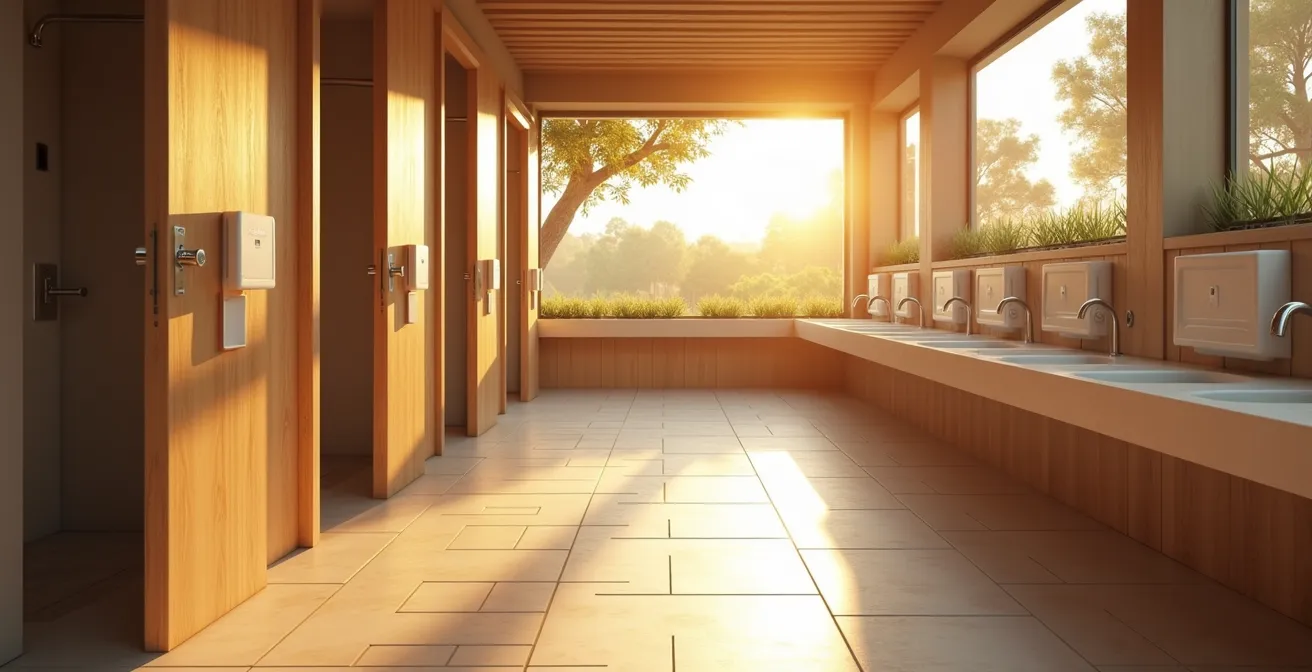
As this image illustrates, the goal is to find the facility in a state of quiet readiness. The presence of steam and empty stalls during these “golden hour” windows confirms that your timing is impeccable. The ultimate strategy, however, is to align your shower with the cleaning schedule, ensuring not only hot water but a pristine environment.
Cleaning Schedules: How to Read the Sheet Behind the Door?
The cleaning sign-off sheet, often taped to the back of the facility door, is the single most important document for a sanitation auditor. It is not merely a piece of paper; it is a legal record of the campsite’s commitment to hygiene. A cursory glance is insufficient. A proper inspection of this document reveals everything about the operational standards of the site. The first point of analysis is frequency. Based on campground sanitation standards research, facilities should be cleaned multiple times daily at multi-star campsites. Anything less, especially during peak season, is an immediate red flag indicating substandard protocol.
Next, scrutinize the entries. Are the signatures and times consistent and legible, or are they hastily scrawled, suggesting a rushed, tick-box exercise? Look for patterns. Does the cleaning happen at the same predictable times each day, or is it responsive to peak usage? A truly professional operation will schedule cleaning immediately after the morning and evening rush hours. The absence of a recent signature is a non-negotiable failure. If the sheet indicates the last cleaning was 12 hours ago, the facility cannot be considered clean, regardless of its appearance. You must also cross-reference the sheet with reality. If a cleaning was signed off 10 minutes ago but the bins are overflowing and the floor is wet, the integrity of the entire system is compromised.
This sheet is your primary evidence. Use it to hold management accountable. A photograph of an overdue or falsified cleaning log is irrefutable proof of negligence. Do not be timid; your health is on the line. The following checklist outlines the physical inspection that must accompany your document analysis.
Your Action Plan: Facility Cleanliness Inspection
- Grout Line Verification: Inspect the grout between tiles. Clean, white grout indicates deep, regular scrubbing, not just a superficial surface wipe. Dark or moldy grout is a sign of long-term neglect.
- Corner and Edge Audit: Check the corners of the floor and where walls meet fixtures. The absence of dust, hair, and grime in these hard-to-reach areas demonstrates meticulous attention to detail.
- Floor Dryness Test: Observe the floor area away from showers and sinks. A consistently dry floor indicates a proper ventilation system and frequent, thorough mopping, preventing the growth of mold and bacteria.
- Olfactory Assessment: A properly cleaned facility should smell neutral or faintly of mild disinfectant. An overwhelming smell of bleach or strong air fresheners often indicates an attempt to mask underlying odors from poor cleaning.
- Arrival Documentation: On your first day, take time-stamped photos of the facilities’ condition. This creates a baseline for your stay and serves as objective evidence if standards decline or issues arise.
Dry Toilets vs Flush: What to Expect in Eco-Campsites?
The rise of eco-conscious camping has introduced alternative sanitation systems that challenge the traditional flush toilet. For the unprepared visitor, a composting or dry toilet can be an unwelcome surprise. However, from an auditor’s perspective, these systems are not inherently inferior; they simply operate on a different set of principles and require a specific user protocol for success. A well-managed dry toilet can be more hygienic and less odorous than a poorly maintained flush system. The key is understanding the technology and what to expect.
Composting toilets function by separating waste and using a carbon-rich material, typically sawdust or wood chips, to cover deposits. This initiates the composting process and is the critical step for odor control. If the campsite fails to provide ample covering material, the system will fail. Bio-toilets, a more advanced option, use anaerobic digestion to break down waste in a sealed system, often producing biogas for cooking as a byproduct. These systems can be as user-friendly as a low-flush toilet. When evaluating an eco-campsite, your inspection must focus on the management of the system: is there a clear, posted user guide? Is the supply of cover material abundant? Is the unit well-ventilated?
The following table, based on an analysis of modern glamping toilet systems, breaks down the core differences, demonstrating that environmental impact does not have to come at the cost of user comfort when managed correctly.
| System Type | Water Usage | Odor Control | User Maintenance | Environmental Impact |
|---|---|---|---|---|
| Composting/Dry Toilet | Zero | Good with proper sawdust use | Add covering material after use | Produces usable compost |
| Bio-Toilet (HomeBiogas) | Minimal flush | Excellent (anaerobic digestion) | None required | Produces cooking biogas |
| Low-Flush System | 1.6 gallons/flush | Standard | None | Reduced water waste |
| Standard Flush | 3-7 gallons/flush | Standard | None | High water consumption |
Case Study: 28 Palms Ranch Eco-Innovation
The 28 Palms Ranch, a desert yurt retreat in California, exemplifies the successful integration of eco-technology. They equipped six yurts with HomeBiogas flushing bio-toilets. This system provides guests with the convenience of a familiar flush mechanism while managing waste in a sealed anaerobic digester. The process produces methane-rich biogas, which is then piped to the yurts for clean cooking energy. This case demonstrates how innovative eco-toilets can significantly enhance the guest experience by adding value, rather than compromising on comfort or hygiene.
Detached vs Semi-Detached: How Much Distance Do You Need for Silence?
Acoustic privacy is a critical, yet often overlooked, component of the camping experience. The proximity of your neighbours can be the difference between a restful night and an ordeal of second-hand noise. The terms “detached” or “semi-detached” are subjective. An auditor requires measurable parameters. The goal is to secure a pitch within an acoustic quiet zone, insulated from the high-traffic areas and the inevitable noise generated by other campers. This requires a pre-booking spatial analysis.
Your first tool is satellite imagery. Before booking, use Google Maps to assess the campsite layout. Look for natural barriers: dense hedges, tree lines, or changes in elevation create effective sound buffers. Pitches on the periphery, away from central hubs like playgrounds, pools, and sanitary blocks, are inherently quieter. The material of the pitch surface is also a factor; grass absorbs up to 50% more sound than gravel or hard-standing surfaces. When booking, specifically request a pitch in a “quiet zone” or a “no-car section” if available. The orientation of the pitch is also key; pitches with entrances facing away from each other can reduce direct noise transfer by a significant margin.
The ideal campsite design incorporates clear acoustic zoning, using natural landscaping to create pockets of tranquility. This thoughtful planning separates areas of high activity from those intended for rest.
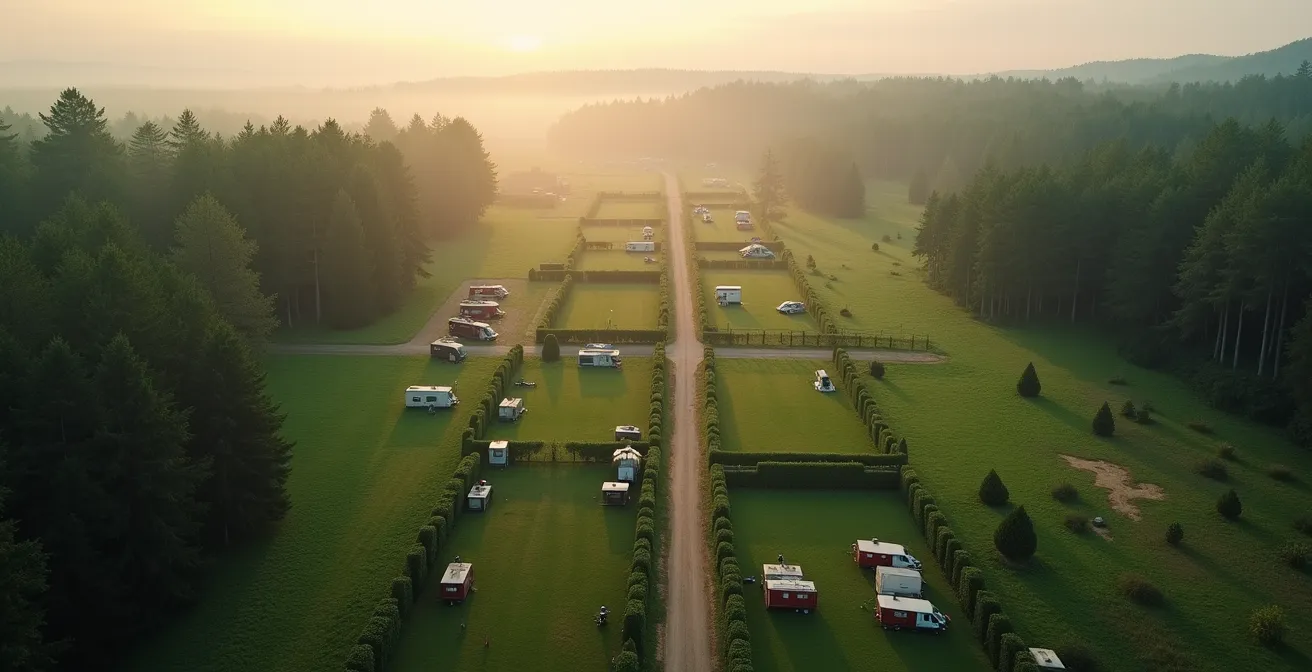
As shown in this aerial view, the campsite is divided into distinct zones. The generously spaced peripheral pitches, buffered by trees, form a “green zone” of low noise. In contrast, the central areas near facilities constitute a “red zone” of high acoustic traffic. Your objective is to secure a position within the green zone at all costs. This proactive approach to pitch selection is a non-negotiable part of a successful camping strategy.
How to Spot a Campsite Trading on an Expired Star Rating?
A high star rating is one of the most powerful marketing tools a campsite possesses, but it can also be the most deceptive. Ratings are awarded at a specific point in time and can quickly become irrelevant due to a decline in maintenance, a change in management, or simple aging. A 5-star rating from five years ago means nothing if the facilities have since fallen into disrepair. An auditor must treat old accolades with extreme skepticism and conduct their own contemporary investigation.
The protocol for verifying a rating’s current validity involves forensic analysis of recent user-generated content. Ignore the professional photos on the campsite’s website; they are marketing material. Instead, focus on reviews from the last 12 months. Use keyword searches within review platforms for terms like “bathroom,” “shower,” “clean,” and “maintenance” to zero in on relevant feedback. Cross-reference these comments with user-uploaded photos on Google Maps, which show the unvarnished reality. Look for red flag phrases in management responses or descriptions like “classic charm” or “traditional camping” when not accompanied by mentions of recent renovations—these are often euphemisms for “outdated.”
The dissonance between a historic rating and current reality is a common pitfall for unsuspecting campers. As the editors at RV Travel succinctly put it in their “Essay on Camping Standards and Pricing”:
A 5-star rating from 2018 is irrelevant if 2023 reviews complain about the toilets
– RV Travel Editorial, Essay on Camping Standards and Pricing
This single sentence encapsulates the core principle of the audit: current, verifiable data always supersedes historical claims. Trusting an expired rating is an invitation to disappointment.
Key Takeaways
- Assume nothing, verify everything: Treat all marketing claims, from “accessible” to “5-star,” as unproven until you have audited them against strict, measurable criteria.
- The cleaning log is your primary evidence: This document provides an objective record of a campsite’s commitment to hygiene. Scrutinize it for frequency, consistency, and authenticity.
- Strategy trumps luck: Secure comfort and quiet not by chance, but by strategically timing your facility use, analyzing satellite imagery for acoustic zones, and choosing self-contained options where possible.
Why Private Mobile Homes Are Safer Than Hotels During Viral Outbreaks?
During periods of heightened concern about viral transmission, the choice of accommodation becomes a critical risk management decision. From a hygiene auditor’s perspective, the structural differences between a private mobile home and a hotel room present a stark contrast in exposure vectors. The mobile home offers a fundamentally more controllable and isolated environment, drastically reducing the number of shared touchpoints and airborne transmission risks inherent in a hotel setting.
A hotel stay involves navigating a gauntlet of high-traffic common areas: lobbies, elevators, corridors, and restaurants. Each represents a significant increase in potential exposure. The air itself is a risk, with central HVAC systems potentially circulating pathogens across multiple rooms and floors. In contrast, a private mobile home is a self-contained unit. It has its own independent ventilation system. Access is typically direct from a vehicle to the front door, minimizing entry touchpoints to a handful of surfaces under your control. There are no shared indoor common areas; the space outside your door is open air.
Ultimately, the most significant factor is control. In a mobile home, you manage the cleaning standards. In a hotel, you are placing your trust in the unseen protocols of the housekeeping staff. This table breaks down the key risk factors, illustrating the clear structural advantages of a mobile home in minimizing viral exposure.
| Risk Factor | Private Mobile Home | Hotel |
|---|---|---|
| Shared Air Systems | None – independent ventilation | Central HVAC shared across floors |
| Entry Touchpoints | Direct car-to-door (2-3 surfaces) | 20+ surfaces (doors, elevators, reception) |
| Cleaning Control | Self-managed standards | Dependent on staff protocols |
| Common Areas | Outdoor only | Multiple indoor (lobby, corridors, restaurant) |
| Staff Interaction | Minimal/outdoor check-in | Multiple daily encounters |
By internalizing this auditor’s protocol, you transform from a passive guest into an empowered consumer. You are now equipped to dissect, analyze, and verify the true quality of any campsite, ensuring your standards for hygiene, comfort, and safety are never compromised.
Frequently Asked Questions on Campsite Accessibility
What specific measurements define wheelchair accessibility?
The non-negotiable minimums include a 90cm (36 inch) door width, a 1.5m (60 inch) turning circle diameter inside the facility, and a maximum slope gradient of 1:48 in all directions, especially in roll-in showers and on access ramps.
Can anyone book accessible campsites?
Yes, in most cases, accessible sites are not restricted for exclusive use by persons with disabilities. However, many campground operators have a policy of holding these sites in reserve, only releasing them for general booking after all standard sites have been filled. It is always necessary to inquire directly about the specific policy.
What about the path to the facilities?
A truly accessible route is as important as the facility itself. The path must be at least 36 inches wide, constructed from a paved or firm, stable surface (not loose gravel or grass), and be clearly marked with appropriate signage. It should also be logically located near designated accessible parking spaces.