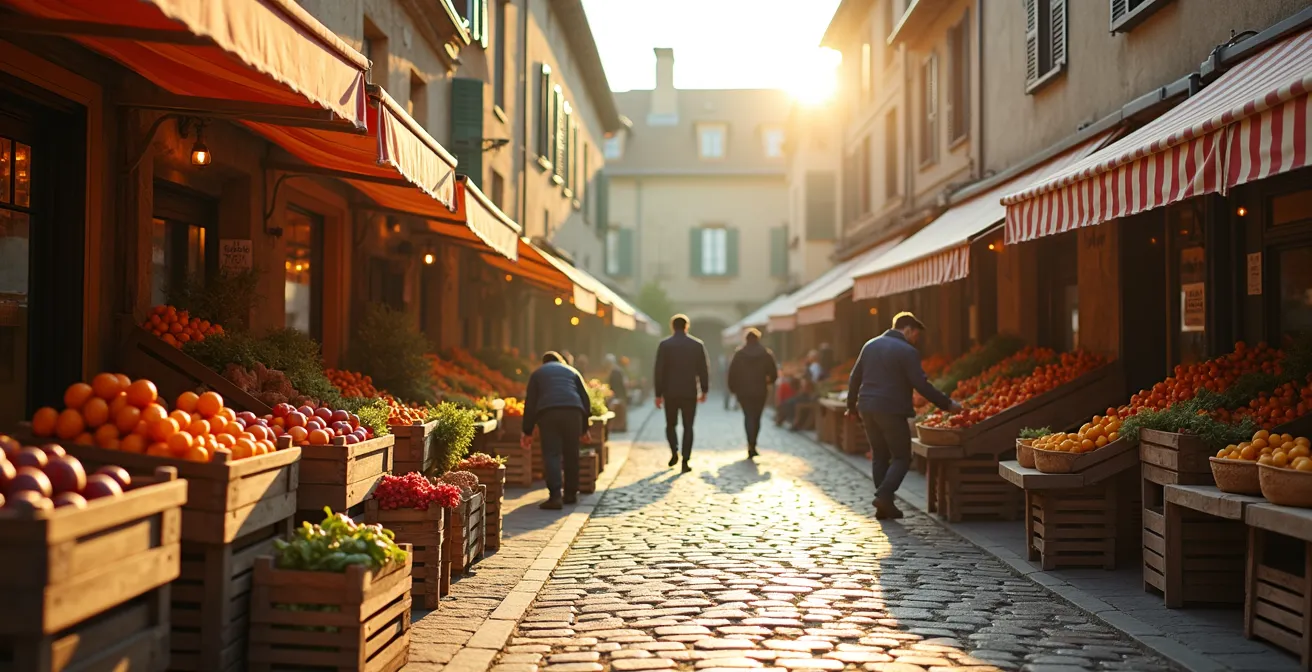
The higher price at a French market isn’t a cost, it’s an investment in a vastly more efficient and valuable food system.
- Supermarket prices hide massive unseen costs in transport, packaging, and food waste.
- Market produce offers superior nutrient density and flavor, meaning more value per bite.
- “Short-circuit” economics ensure your money directly supports producers and the local ecosystem.
Recommendation: Reframe market shopping not as a splurge, but as a strategic choice for better food, a smaller carbon footprint, and a more authentic travel experience.
The initial sticker shock is a familiar experience for any budget-conscious traveler in France. You wander into a vibrant, sun-drenched village market, captivated by the mountains of glistening cherries and earthy scent of heirloom tomatoes, only to see the prices. They are almost always higher than at the nearby Intermarché or Carrefour. The immediate, logical question is: why pay more? The common answers—that the produce is “fresher” or the experience “more authentic”—feel vague and unsatisfying when you’re trying to make your euros last.
These platitudes, while true, miss the fundamental economic argument. They fail to account for the hidden costs baked into the supermarket’s seemingly lower prices: the cost of long-haul transportation, plastic packaging, refrigerated storage, and a long chain of middlemen, each taking a cut. The market price, in contrast, represents a much more direct and honest transaction. It reflects the true cost of producing high-quality food in a sustainable way, a concept often referred to as short-circuit economics.
But what if the market wasn’t more expensive at all? What if we’ve been trained to measure value incorrectly? This guide dismantles the supermarket price illusion. It’s an argument that the market stall is not a luxury, but a strategic investment in superior flavor, higher nutrient density, environmental responsibility, and genuine economic transparency. By understanding the system you’re buying into, you’ll see that the village market offers a value proposition the supermarket can never match.
To fully grasp this value, we will explore the essential etiquette of market shopping, decipher the true meaning of organic labels, and understand the practicalities of paying. We will then uncover how to distinguish real producers from resellers, learn to cook economically with market finds, and finally, quantify the powerful environmental benefits of this traditional way of shopping.
Summary: Why French Markets Are a Smarter Investment Than Supermarkets
- Don’t Touch the Fruit: The #1 Rule to Respect in French Markets
- “Bio” vs “Natural”: Which Sign Actually Means Organic in France?
- Cash or Card: Why You Must Bring Euros to Rural Markets?
- The “Reseller” Trap: How to Identify Producers vs Wholesalers at Markets?
- Can You Experience the “Billionaire Lifestyle” of the Riviera While Camping?
- What to Cook in July: A Weekly Meal Plan Using Only French Market Produce
- Honey and Olive Oil: How to Spot “Tourist Trap” Fakes in Provence?
- How “Short-Circuit” Shopping Reduces Your Carbon Footprint by 60%?
Don’t Touch the Fruit: The #1 Rule to Respect in French Markets
The first step in understanding the market’s value system is to participate in its culture of respect. The unwritten rule—never, ever touch the produce yourself—is not about snobbery; it’s the cornerstone of a low-waste, high-quality model. Unlike a supermarket where bruised fruit is an accepted cost of business, the market vendor is often the producer. They have a personal and economic stake in every single piece of fruit and vegetable. By allowing them to select for you, you are respecting their expertise and ensuring that only the best, undamaged produce is sold. This minimizes waste and upholds the quality for which you are paying a premium.
This interaction is also a crucial opportunity. When you point and ask, you begin a dialogue. You can specify your needs, which further reduces waste. Asking “C’est pour manger aujourd’hui ou dans deux jours?” (Is this for eating today or in two days?) allows the vendor to give you a perfectly ripe peach for tonight and a firmer one for later in the week. This level of personalized service is a form of value the supermarket cannot replicate. To navigate this system effectively, a few key behaviors are essential.
- Always greet vendors with “Bonjour” before making any requests.
- Never touch the produce; simply point and say, “Je voudrais celui-là, s’il vous plaît” (I’d like that one, please).
- Respect the queue, even if it’s more of a cluster than a formal line. People know who is next.
- Come prepared, as markets typically end by 1 p.m., and vendors begin packing up even earlier.
Embracing this etiquette is more than just being polite. It is your entry ticket into the market’s economic ecosystem, a system built on trust, expertise, and a shared commitment to quality.
“Bio” vs “Natural”: Which Sign Actually Means Organic in France?
Once you’ve mastered the etiquette, the next layer of value is found in the labels—or lack thereof. In a French market, “natural” is a meaningless marketing term. The real indicators of quality are official certifications that represent specific, legally-defined farming practices. Understanding these is key to ensuring you’re paying for genuine agricultural integrity, not just a rustic-looking sign. The most important label is “Agriculture Biologique,” often shortened to “AB.” This is the official French and EU certification for organic farming, guaranteeing the absence of synthetic chemical pesticides and fertilizers. It is a rigorous standard that requires years of conversion and regular inspections.
Another increasingly common label is “HVE” (Haute Valeur Environnementale). This certification is a step-based system that encourages farms to improve their performance on biodiversity, pesticide strategy, fertilizer management, and water use. While not strictly organic, an HVE Level 3 farm represents a significant commitment to sustainable practices. Seeing these signs is a direct signal of the farmer’s investment in an agricultural model that prioritizes soil health and biodiversity over sheer yield—a primary driver of the higher cost and superior flavor. To get to the truth, you must ask the right questions.
- Start with the most direct question: “C’est votre production?” (Is this your own production?). This helps identify true producers.
- Look for the green “AB” or “HVE” logos displayed on the stall.
- For uncertified producers, ask: “Vous utilisez des traitements chimiques?” (Do you use chemical treatments?). Their answer will be revealing.
- Keep an eye out for farmers “en conversion bio” (transitioning to organic), who often offer near-organic quality without the full certified price premium.
By learning to read these economic signals, you transform from a passive consumer into an active investor in sustainable agriculture. You are paying for the verified practices that result in healthier ecosystems and more nutrient-dense food.
Cash or Card: Why You Must Bring Euros to Rural Markets?
The preference for cash at French markets, especially rural ones, is not an archaic quirk; it’s a direct reflection of the “short-circuit” economy. For small producers, credit card transaction fees represent a significant percentage of their already slim margins. By using cash, you ensure that 100% of the price you pay goes directly to the person who grew the food. This economic transparency is a core part of the market’s value proposition. It fosters a direct relationship between consumer and producer, free from the interference and fees of financial intermediaries. This is why arriving with a pocketful of euros is not just a convenience, but a gesture of support for the entire system.
From a practical standpoint, especially when camping or traveling on a budget, cash also helps with financial discipline. A typical market shopping budget includes around €40-€50 for a family of four’s 2-day supply. Having this amount in cash makes it easier to track spending. Furthermore, many rural areas have limited ATM access, and the ones at the market often have long lines or run out of money. Planning ahead is essential.
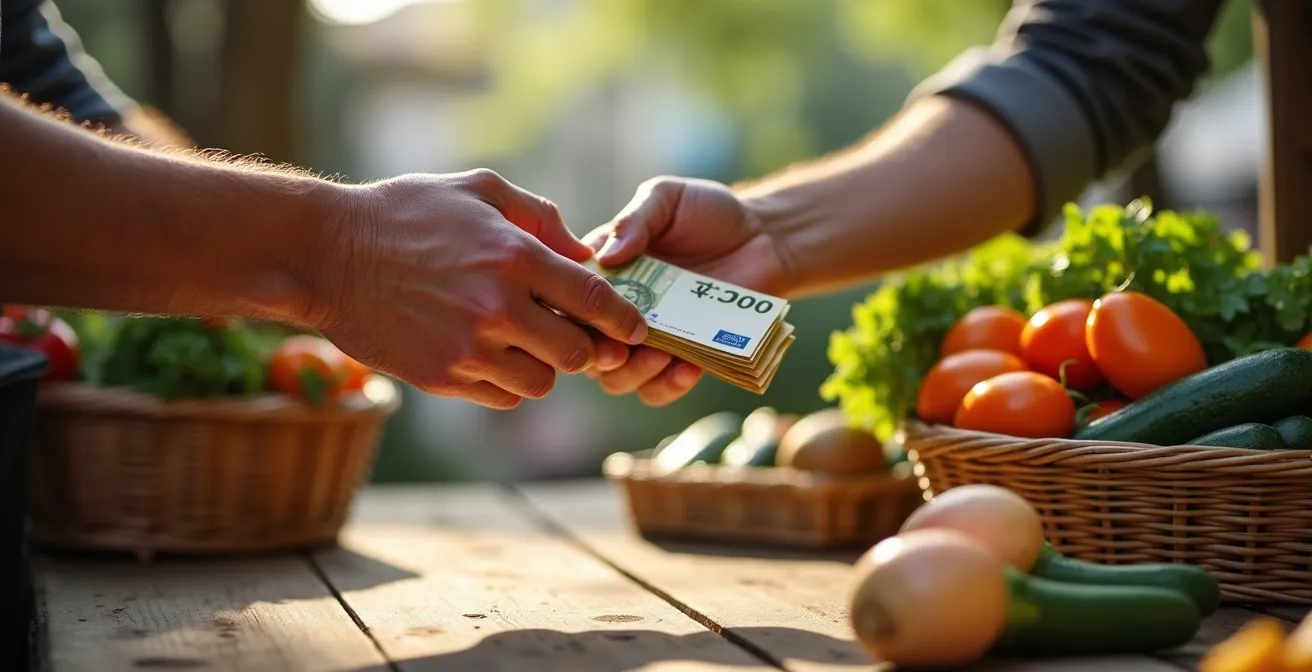
Managing your cash correctly can make the entire experience smoother and more pleasant for both you and the vendors, who appreciate customers who don’t require them to break large notes for a small purchase. Here are some tips for effective cash management:
- Visit an ATM the day before you go to the market.
- Keep a mix of small bills (€5 and €10 notes) and coins for easier transactions. Vendors often run low on change.
- In a pinch, look for a “buraliste” (a shop selling tobacco and newspapers, marked “Tabac/Presse”) as some offer a cash withdrawal service (“retrait d’espèces”).
- Try to have the exact or close to the exact amount, as vendors greatly prefer this.
Using cash is a small act that reinforces the direct, person-to-person nature of the market economy, ensuring your money’s impact is maximized where it matters most.
The “Reseller” Trap: How to Identify Producers vs Wholesalers at Markets?
The ultimate justification for the market’s price is buying directly from the person who grew the food. However, not every vendor at a French market is a local producer. Many are “revendeurs,” or resellers, who buy their produce from large wholesale markets like Rungis near Paris and transport it across the country. While their produce may still be good, buying from them negates many of the market’s key benefits: the short food miles, the connection to the terroir, and the economic transparency. As the guide from About-France.com notes, the ideal scenario is finding the authentic source.
In rural areas, it is still possible to find markets where small farmers sell just their own produce
– About-France.com, France’s outdoor markets guide
Spotting the difference between a true “producteur” and a reseller is perhaps the most important skill for a conscious market shopper. The producer’s stall tells a story of seasonality and locality. It will have a limited, almost humble, selection of what is currently growing in the immediate area. A reseller’s stall, by contrast, looks more like a miniature supermarket, with a vast, picture-perfect array of produce from all over the world, regardless of the season. Learning to read these visual cues is essential to ensure your money is supporting the local agricultural system.
The following table, based on observations from seasoned market-goers, provides a clear guide to help you distinguish a genuine local farmer from a wholesaler.
| True Producers | Resellers |
|---|---|
| Limited seasonal selection | Wide variety year-round |
| Non-uniform produce sizes | Standardized sizes |
| Weathered wooden crates | Clean plastic containers |
| Handwritten village names | Professional printed signs |
| Family name on truck | Generic refrigerated van |
By actively seeking out the true producers, you are voting with your wallet for the short-circuit model. You guarantee your money flows directly into the local economy and that the food you buy has the lowest possible carbon footprint and the highest possible connection to the land.
Can You Experience the “Billionaire Lifestyle” of the Riviera While Camping?
The French Riviera conjures images of superyachts and exclusive beach clubs, a lifestyle seemingly at odds with budget-friendly camping. Yet, the true luxury of this region has always been rooted in its incredible “terroir”—the unique combination of sun, soil, and sea that produces some of the world’s most flavorful ingredients. This sensory wealth is not locked away in Michelin-starred restaurants; it’s on full display at vibrant markets like the Cours Saleya in Vieux Nice, celebrated as one of the most exciting in France. Here, the “billionaire lifestyle” can be experienced not through extravagant spending, but through strategic shopping.
The secret is to redefine luxury. It’s not about expensive brands; it’s about access to unparalleled quality. It’s the taste of a sun-ripened tomato so sweet it needs no dressing, the intensity of tiny black Niçoise olives, or the freshness of a fish caught that morning. For a camper with a simple grill or a one-pot stove, these ingredients are transformative. A meal of grilled day-boat fish with herbs and a simple salad of market greens and vine-ripened tomatoes can rival any restaurant meal in pure flavor, for a fraction of the cost. This is the market’s great equalizer.
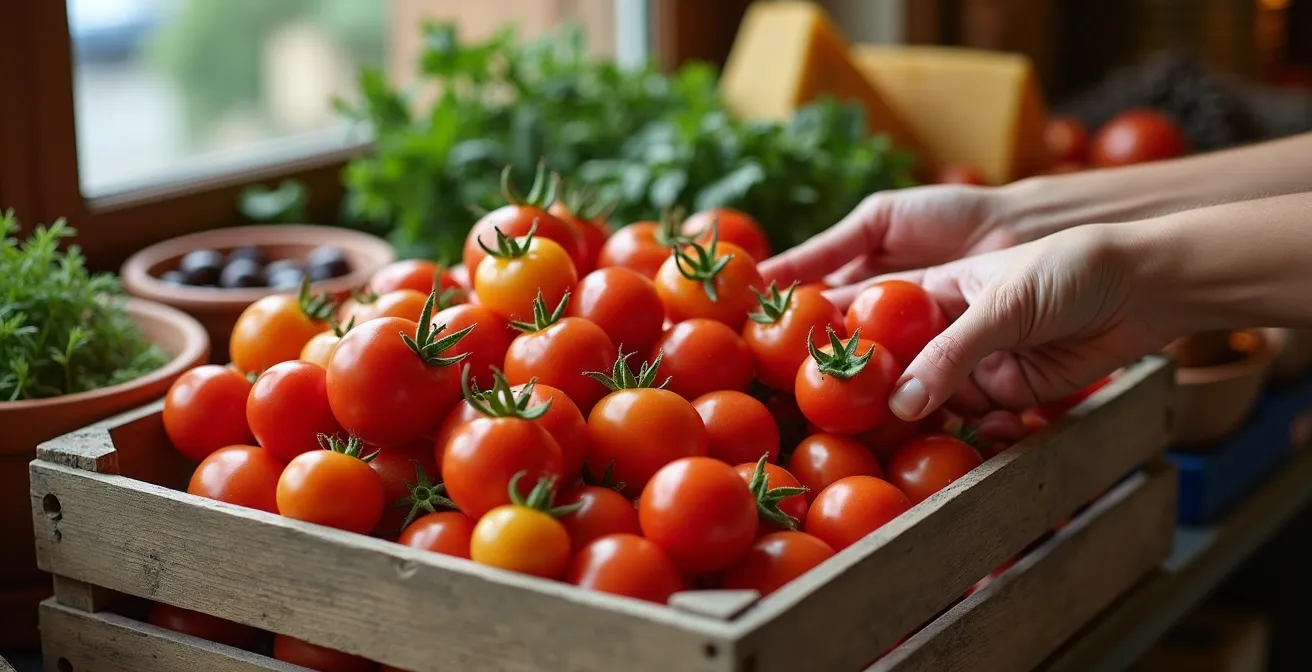
By focusing on a few high-quality, signature ingredients, you can elevate simple campsite cooking into a gourmet experience. This approach allows you to taste the very essence of the Riviera, proving that true luxury is about quality, not quantity.
- Hunt for small, potent black Niçoise olives, a cornerstone of local cuisine.
- Select various types of vine-ripened tomatoes from different local producers to taste the subtle differences.
- Choose a small, artisanal goat cheese (chèvre) from a mountain farm vendor.
- Pick up fresh fava beans (fèves) in the spring for an authentic salade niçoise.
- Buy a single, beautiful day-boat fish like sea bass (loup de mer) to grill whole at your campsite.
This “billionaire on a budget” approach is the essence of smart market shopping. It’s about prioritizing flavor and quality, creating an experience of abundance and luxury that has nothing to do with the size of your wallet.
What to Cook in July: A Weekly Meal Plan Using Only French Market Produce
One of the most powerful economic advantages of market shopping is its ability to inspire “strategic gastronomy”—a way of cooking that is both delicious and incredibly efficient. Instead of deciding what you want to eat and then searching for the ingredients, you let the market decide for you. By building your meals around what is fresh, seasonal, and abundant (and therefore, often cheaper), you minimize cost, maximize flavor, and eliminate waste. For a camper, this approach is brilliant. It encourages simple, one-pot or grill-based meals where the quality of the ingredients does all the heavy lifting.
July in France is a time of incredible abundance. The stalls are overflowing with tomatoes, peppers, zucchini, eggplants, and fragrant herbs. This is the perfect time to embrace a simple, produce-forward meal plan. Many classic French regional dishes were born from this same principle of using what’s on hand. A one-pot piperade, for example, is a Basque classic that perfectly utilizes market peppers, onions, and tomatoes. The key is to think regionally, as the produce and local specialties will vary dramatically depending on where you are in France.
The following table highlights the different “personalities” of French markets in July, giving you a shopping list tailored to your location.
| Provence Markets | Atlantic Coast Markets |
|---|---|
| Tomatoes, zucchini, eggplant | Mussels, oysters, sea bass |
| Basil, thyme, lavender honey | Butter, crème fraîche, cider |
| Cavaillon melons, apricots | Île de Ré potatoes, samphire |
| Goat cheese, tapenade | Sardines, mackerel |
| Rosé wine, olive oil | Muscadet wine, fleur de sel |
Using these regional products as a base, you can craft a simple and delicious weekly menu that is perfectly suited to campsite cooking.
- Monday: One-pot piperade with market peppers and local eggs.
- Tuesday: Grilled market fish (sardines or mackerel) with herb butter and Île de Ré potatoes.
- Wednesday: Cold ratatouille salad (make a big batch, eat it for two days).
- Thursday: A classic picnic of saucisson sec, hard cheeses, and a fresh baguette.
- Friday: Market tomatoes stuffed with local sausage meat (chair à saucisse).
- Saturday: Moules marinières, using fresh mussels and local cider or white wine.
- Sunday: A simple tart made with market fruit, cooked in a pan on the camping stove.
This way of eating is the ultimate expression of the market’s value: delicious, economical, low-waste, and deeply connected to the place you are visiting.
Honey and Olive Oil: How to Spot “Tourist Trap” Fakes in Provence?
Certain products carry such a strong sense of place that they become targets for fraud. In Provence, lavender honey and olive oil are at the top of this list. The high demand and premium prices create a powerful economic incentive for resellers to pass off inferior, imported products as local specialties. A jar of “lavender honey” might be a generic floral honey with lavender flavoring added, while a bottle of “Provence” olive oil could be a blend from Spain or Tunisia. For the consumer paying a premium for authenticity, this is the ultimate “tourist trap.” Learning to spot these fakes is crucial to protecting your investment and ensuring you’re buying the real thing.
Authenticity lies in the details—official labels, specific terminology, and, most importantly, taste. A legitimate producer is proud of their product and will always encourage you to taste it. The phrase “Je peux goûter?” (Can I taste?) is your most powerful tool. A real lavender honey (“Miel de Lavande”) will have complex, evolving floral notes, not a one-dimensional sweetness. A true “Huile d’Olive de Provence” will often have a peppery finish in the back of your throat—the signature of healthy polyphenols, a quality often lost in mass-produced oils. Look for the AOP (Appellation d’Origine Protégée) label, which legally guarantees the product’s origin and production method.
Navigating this requires a methodical approach, a quick audit you can perform right at the stall to verify you’re getting the quality you’re paying for.
Your 5-Step Audit for Authentic Provençal Products
- Check the Label: Look for the official ‘AOP Huile d’Olive de Provence’ or ‘Miel de Lavande’ (IGP/Label Rouge) certification. Be wary of generic terms like ‘Produit de France’ or ‘Préparation à base de miel’.
- Ask to Taste: Use the phrase “Je peux goûter?”. Legitimate, proud producers will almost always say yes. A refusal is a major red flag.
- Analyze the Flavor (Honey): Is it a complex floral taste that lingers, or a simple, sugary sweetness? Real lavender honey is distinctive, not just sweet.
- Analyze the Flavor (Olive Oil): Does it have a fresh, “green” taste? Do you feel a slight peppery or bitter kick at the back of your throat? This is a sign of high-polyphenol, high-quality oil.
- Question the Vendor: Ask about the harvest date (“De quelle année?”), the specific location of their hives or groves, and their production methods. A passionate producer will love to talk about their work.
This diligence ensures your money rewards the true artisans of Provence, not opportunistic resellers. It is the final step in guaranteeing the integrity of your market purchases.
Key Takeaways
- The supermarket’s low price is an illusion that hides significant environmental and quality costs.
- The market’s higher price reflects true value: superior nutrient density, zero-waste principles, and direct economic support for producers.
- “Short-circuit” shopping is an economic strategy that reduces your carbon footprint and maximizes the flavor and quality of your food.
How “Short-Circuit” Shopping Reduces Your Carbon Footprint by 60%?
We arrive at the most compelling, quantifiable reason why the market is worth its price: its dramatically smaller environmental impact. The term “short-circuit” (circuit court) is the French concept for a food supply chain with minimal intermediaries. This is the market’s default operating model, and its benefits are enormous. When you buy a tomato from a local producer, you are purchasing an item that has likely traveled less than 10 kilometers, required no plastic packaging, and was picked at peak ripeness just hours before. This stands in stark contrast to its supermarket equivalent.
The economic efficiency of this model is staggering. Research indicates that short-circuit market shopping achieves up to a 60% carbon footprint reduction compared to buying the same goods in a supermarket. This saving comes from eliminating long-haul, refrigerated transport, reducing packaging waste, and minimizing food spoilage. The supermarket model is built on a “just-in-case” logic of oversupply and long-distance sourcing, which generates immense waste at every step. The market model is a “just-in-time” system, where supply is naturally regulated by seasonality and daily demand.
The lifecycle of a single tomato provides a powerful illustration of these two opposing economic and ecological systems.
| Market Tomato | Supermarket Tomato |
|---|---|
| Grown within 10km | Transported 1500km average |
| No packaging required | Plastic wrapped |
| Picked when ripe | Picked green, ripened in transit |
| Sold within 24 hours | Refrigerated for weeks |
| Open crate transport | Climate-controlled trucks |
This table makes the value proposition crystal clear. The higher price at the market is not an arbitrary markup. You are paying for a fundamentally different, vastly more efficient system. You are paying to remove the 1500km of transport, the plastic wrap, the artificial ripening, and the weeks of refrigeration from your food’s journey. When viewed through this lens, the market doesn’t seem more expensive; the supermarket suddenly seems incredibly wasteful.
Embrace your next market visit not as a simple shopping trip, but as an act of conscious investment. See it as an opportunity to participate in a smarter, more sustainable, and ultimately more delicious food economy. This is the true worth of the village market.