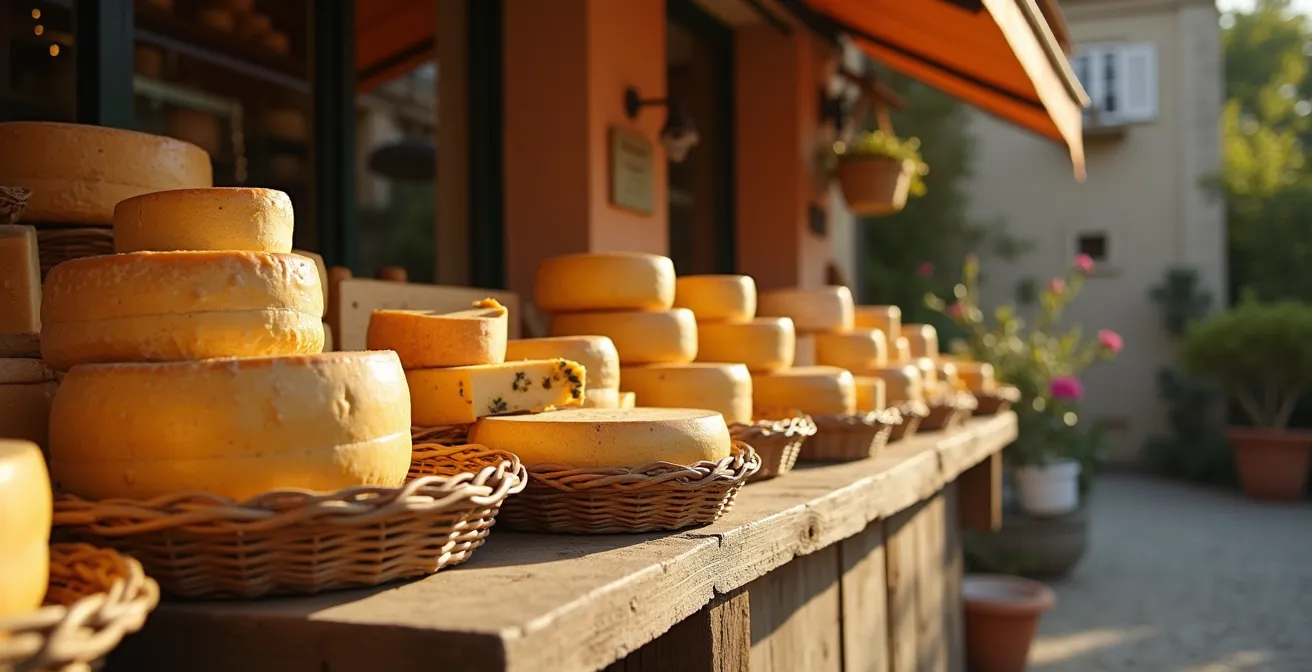
Buying non-certified products at a French market is a gamble against a stacked deck of sophisticated fakes and reseller tactics.
- Official labels like AOP (Appellation d’Origine Protégée) are the only legal guarantee of a product’s origin, ingredients, and traditional production methods.
- Authenticity goes beyond labels; it requires understanding seasonality, identifying true producers versus resellers, and recognizing the sensory cues of genuine terroir.
Recommendation: Treat every purchase as a small investigation. Question the vendor, scrutinize the stall, and learn to trust the legally binding signals of quality over the charm of a ‘free tasting’.
The scene is iconic: a bustling French market, stalls overflowing with vibrant produce, the air thick with the scent of lavender and rotisserie chicken. At the heart of it all is the fromager’s stand, a glorious mosaic of cheese wheels, pyramids, and logs. For any food lover, this is paradise. Yet, this idyllic picture hides a critical vulnerability. The belief that everything at a local market is inherently authentic is a dangerous assumption. Many tourists and even locals fall prey to what I call the “reseller’s veil”—a carefully crafted illusion of authenticity designed to sell inferior, non-certified, or industrially produced goods at artisanal prices.
The common advice is to simply “look for the AOP/AOC label.” While correct, this is rudimentary. It’s like telling a detective to “look for clues.” The real skill lies in knowing which clues matter and how to interpret them. This guide goes beyond that surface-level advice. It equips you with the mindset of a food quality inspector, teaching you the principles of forensic gastronomy. We will dissect the legal frameworks, expose the common traps for products beyond cheese, and train your palate to become the ultimate lie detector.
The core principle you must adopt is this: true authenticity is not just a label; it’s a verifiable chain of custody from the soil to the stall. It’s an unwavering respect for the seasonal imperative of production. By internalizing these rules, you protect not only your wallet and your taste buds but also the very fabric of traditional French agriculture that these certifications were created to preserve. This is not about snobbery; it’s about safeguarding quality and heritage.
This article will guide you through the essential checkpoints for verifying authenticity. We will explore the legal guarantees behind quality labels, the tell-tale signs of fakes, and the methods for identifying true artisans in a crowded marketplace, empowering you to shop with the confidence of a true connoisseur.
Summary: A Guide to Authentic French Market Shopping
- AOP vs IGP: Which Label Guarantees 100% Local Ingredients?
- Honey and Olive Oil: How to Spot “Tourist Trap” Fakes in Provence?
- Which AOC Cheeses Can Survive a Week in a Camping Fridge?
- Why Buying AOC Products Directly Supports Traditional Farming?
- Eating Reblochon in August: Why You Are Doing It Wrong?
- The “Free Tasting” Scam: How to Spot Genuine Winemakers vs Tourist Shops?
- The “Reseller” Trap: How to Identify Producers vs Wholesalers at Markets?
- How to Train Your Palate to Recognize Genuine Terroir Flavors?
AOP vs IGP: Which Label Guarantees 100% Local Ingredients?
In the complex world of European food certifications, not all labels are created equal. As a consumer, your first line of defense is understanding the hierarchy of these guarantees. The two most common you will encounter are AOP (Appellation d’Origine Protégée) and IGP (Indication Géographique Protégée). While both offer a level of quality control, only one provides an uncompromising guarantee of origin for every single component. This distinction is not academic; it is fundamental to ensuring you are paying for true terroir.
The AOP label is the gold standard. It certifies that every stage of production, from the raw materials to the final processing, has occurred in the specific, designated geographical area. For an AOP cheese, this means the milk comes from local breeds, raised on local feed, and the cheese is made and aged according to a strict, traditional ‘cahier des charges’ (book of specifications) within that same region. This is a closed-loop system that guarantees 100% local ingredients and methods. The trust in this system is immense; a recent analysis confirmed that 80% of French consumers trust PDO/AOP labels, which cover 46 cheeses representing a massive production volume.
In contrast, the IGP label is less stringent. It requires that at least one stage of production, processing, or preparation takes place in the designated region. This means an “IGP Provence” product could be made with ingredients sourced from outside Provence, as long as a key part of its processing happened there. While still a mark of quality, it does not offer the absolute ‘chain of custody’ assurance of an AOP. Therefore, when your goal is to experience a product that is an undiluted expression of a specific place, you must insist on the AOP certification. It is the only legally binding promise of 100% local integrity.
Honey and Olive Oil: How to Spot “Tourist Trap” Fakes in Provence?
The principles of authenticity extend far beyond the cheese counter. Products like honey and olive oil, especially in tourist-heavy regions like Provence, are rife with fraud. Deceptive labeling and adulterated products are common, designed to prey on the consumer’s desire for an authentic taste of the region. A ‘Miel de Provence’ label may mean nothing if it isn’t backed by a certification, and “extra virgin” olive oil can be a blend of inferior oils. Your inspector’s mindset is crucial here to avoid these “tourist trap” fakes.
The problem is not merely anecdotal; it is a documented issue. An investigation by the French government’s fraud control agency (DGCCRF) revealed just how widespread the problem is. The agency’s findings, which led to criminal reports and sales withdrawals, showed that one-third of edible oil samples had issues, including mislabeled olive oils sold at markets. These fakes often involve blending high-quality oil with cheaper oils or misrepresenting the origin entirely with vague labels like “Product of EU.” For honey, common scams include diluting it with sugar syrup or blending local honey with cheap, imported varieties while still marketing it as a purely local product.
To protect yourself, you must scrutinize the packaging and labeling with forensic detail. Look for an AOP or IGP certification, a specific harvest date (millésime), and the precise location of the producer or mill. Be wary of suspiciously low prices and products sold in clear plastic bottles, as light and plastic degrade quality. The following table outlines the key signals that separate genuine products from fraudulent ones.
| Feature | Genuine Extra Virgin | Fake/Adulterated |
|---|---|---|
| Price | Higher price reflecting production costs | Suspiciously cheap for ‘extra virgin’ |
| Harvest Date | Clearly marked millésime/harvest date | No harvest date or only ‘best before’ date |
| Packaging | Dark glass bottles or tins | Clear plastic bottles |
| Taste | Grassy, peppery, or fruity notes | Bland, tasteless, or rancid |
| Origin Label | Specific farm/press location | Vague ‘Product of EU’ labeling |
| Certifications | PDO/PGI certification marks | No quality certifications |
Which AOC Cheeses Can Survive a Week in a Camping Fridge?
For the traveling food lover, especially campers, there’s a practical consideration: durability. Not all cheeses are created equal when it comes to withstanding the rigors of travel and the fluctuating temperatures of a camping cooler. Choosing the right type of AOC cheese is critical to ensure your prized purchase doesn’t spoil before you have a chance to enjoy it. The key lies in understanding the relationship between a cheese’s moisture content and its shelf life.
The general rule is simple: the harder the cheese, the longer it lasts. Hard, aged cheeses like Comté, Beaufort, or Cantal have had most of their moisture removed during a long aging process. This low moisture content makes them naturally resistant to spoilage. These cheeses are your best allies for a camping trip, often lasting for a week or more even in less-than-ideal conditions, provided they are stored correctly. Wrapped first in wax or parchment paper (to allow them to breathe) and then loosely in plastic, they can endure the journey with their flavor intact.
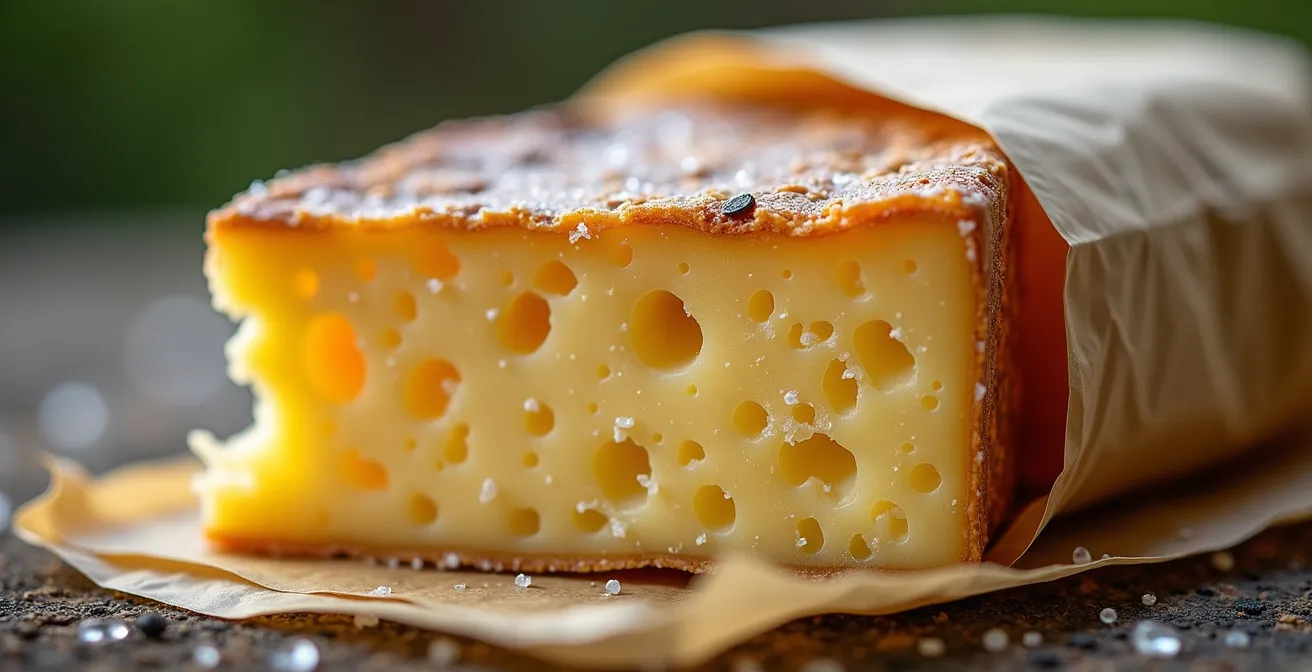
Conversely, soft, high-moisture cheeses are delicate and must be treated with care. A creamy, bloomy-rind cheese like Camembert or Reblochon is a ticking clock. Once it reaches peak ripeness, it has only a few days before its quality declines rapidly. These are best purchased for immediate consumption, not for a week-long excursion. Fresh cheeses, such as Chèvre frais (fresh goat cheese), have the highest moisture content and are not recommended for camping at all. The following guide provides a clear breakdown of durability by cheese category.
| Category | Examples | Camping Durability | Storage Tips |
|---|---|---|---|
| Hard Aged Cheeses | Comté, Beaufort, Cantal | 1-2 weeks | Wrap in wax paper then loose plastic |
| Semi-Hard Cheeses | Saint-Nectaire, Tomme de Savoie | 5-7 days | Store in airtight container after opening |
| Soft Bloomy Rinds | Camembert, Brie, Reblochon | 2-3 days maximum | Keep in coolest part of cooler |
| Fresh Cheeses | Chèvre frais, Faisselle | Not recommended | Avoid for camping trips |
Why Buying AOC Products Directly Supports Traditional Farming?
Choosing an AOC/AOP product is more than a culinary decision; it’s an economic act with profound consequences. By prioritizing these certified goods, you are directly funding the preservation of traditional, sustainable, and often small-scale farming practices. This system was designed specifically to protect local economies and agricultural heritage from the homogenizing force of industrial production. When you buy a wheel of AOP Comté, you are not just buying cheese; you are casting a vote for biodiversity, animal welfare, and the livelihood of rural communities.
The ‘cahier des charges’ for each AOP product is a legally binding contract that enforces these traditional methods. It goes far beyond simply dictating a recipe. As detailed in an analysis of French food classifications, the rules for AOP Comté stipulate everything from the specific cow breeds (Montbéliarde or French Simmental) to their diet (pasture grazing in the Jura Massif, with restrictions on silage feed). The regulations even control the distance between the farm and the dairy to ensure milk freshness. According to a deep dive into these protected food classifications, this meticulous oversight ensures that the final product is an authentic expression of its environment.
This rigorous framework creates a virtuous cycle. It allows the thousands of small producers in France to compete on quality rather than price, guaranteeing them a fair return for their labor-intensive work. This economic stability, in turn, incentivizes the preservation of local animal breeds and plant varieties that might otherwise disappear. It prevents the consolidation of farmland and maintains a vibrant, diversified agricultural landscape. Your purchase is the fuel that runs this entire engine of cultural and ecological preservation. It ensures that the unique flavors of a region’s terroir, developed over centuries, will continue to exist for future generations to experience.
Eating Reblochon in August: Why You Are Doing It Wrong?
A fundamental aspect of terroir-literacy, and one often overlooked by consumers, is the seasonal imperative. True artisanal cheese is not a static, year-round product like its industrial counterparts. Its character is intrinsically linked to the seasons, the life cycle of the animals, and the richness of their milk. Eating a cheese out of its prime season is like listening to a symphony with half the orchestra missing; you may get the basic tune, but you lose all the nuance and complexity. Reblochon in August is a classic example of this mistake.
Reblochon is an AOP cheese from the Savoie region, traditionally made from the rich, fatty milk of cows that have spent the summer grazing on alpine pastures. This high-quality summer milk is essential for the cheese’s signature creamy texture and nutty flavor. However, the cheese then requires a period of aging to develop these characteristics. Consequently, the Reblochon that is truly at its peak is the one consumed in the autumn and winter, after it has been made from summer milk and properly aged. Eating it in August likely means you are getting a cheese made from less-rich spring milk or one that hasn’t been aged to perfection.
This principle applies to many other French cheeses. For instance:
- Spring (March-May): This is the prime season for fresh goat cheeses (chèvres). Goats give birth early in the year, and their milk is delicate and fresh, perfect for young, unaged cheeses.
- Summer (June-August): This is the time for hard, aged cheeses made from the previous year’s milk, which have had time to mature.
- Autumn (September-November): The best time for Reblochon, as well as other soft, washed-rind cheeses made from rich summer milk.
- Winter (December-February): The exclusive season for Mont d’Or, an AOP cheese so seasonal its production and sale are legally restricted from approximately October to March.
A simple way to ensure you’re buying a cheese with true seasonal expression is to look for the ‘fermier’ label or the small, green casein lozenge on the rind. This signifies it was made on the farm with milk from that farm’s own herd, as opposed to ‘laitier’ (red lozenge), which is made in a dairy with milk collected from multiple farms and is more likely to be a standardized, year-round product.
The “Free Tasting” Scam: How to Spot Genuine Winemakers vs Tourist Shops?
The allure of a “Dégustation Gratuite” (Free Tasting) sign is powerful, especially in renowned wine regions. However, this seemingly generous offer can often be a sophisticated trap. As an inspector, you must learn to differentiate between a genuine winemaker offering a sample of their craft and a tourist-oriented reseller using tastings as a high-pressure sales tactic. The former is an authentic cultural experience; the latter is often a front for selling overpriced, mediocre wine.
A genuine winemaker’s tasting room (‘caveau’) is typically located at the vineyard itself. The person pouring the wine is often the owner, a family member, or someone deeply involved in the production process. They speak with passion and detail about the soil, the grape varietals, the weather of a specific vintage, and the winemaking process. Their goal is to share their story and their product, with the hope that you will appreciate it enough to buy a few bottles. The focus is on education and passion. There is rarely a wide variety of wines from other regions; they sell what they produce.
In stark contrast, a reseller’s shop is often located in a high-traffic tourist area, far from any vineyard. The staff are salespeople, not vignerons. They may have a slick presentation but lack deep knowledge of any single product. Their main red flag is the overwhelming variety. If a shop in Burgundy is also offering a “free tasting” of wines from Bordeaux, the Rhône, and Provence, you are in a tourist shop, not a producer’s cellar. These businesses buy wine in bulk and sell it at a significant markup. The “free” tasting is a loss leader designed to make you feel obligated to purchase a bottle you could likely find cheaper and of better quality elsewhere.
The “Reseller” Trap: How to Identify Producers vs Wholesalers at Markets?
The market stall is the final frontier in your quest for authenticity. This is where the “reseller’s veil” is at its most convincing. A wholesaler can easily set up a rustic-looking stall, arrange their products artfully, and masquerade as the small-scale farmer you’re hoping to find. Unmasking them requires sharp observation and direct questioning. You must look for the subtle but consistent signals that separate a true ‘producteur’ from a ‘revendeur’.
The most telling sign is the specialization of the product range. A genuine goat cheese producer will typically sell only goat cheese, perhaps in various stages of aging. A sheep cheese producer will sell only sheep cheese. It is incredibly rare for a small farm to raise multiple types of animals for milk production at a scale required for a market. Therefore, a stall that offers a “greatest hits” of French cheese—Roquefort (sheep) next to a Comté (cow) next to a Sainte-Maure de Touraine (goat)—is almost certainly a reseller. They offer variety because they are a shop, not a farm.
Another key indicator is the appearance of the products themselves. Artisanal, farmstead products have natural variations. The wheels of cheese won’t be perfectly uniform in size or color. There will be beautiful imperfections that speak of a handmade process. A reseller’s stall, supplied by industrial or semi-industrial sources, will often display products that are unnervingly consistent. Do not be afraid to engage the vendor directly. A true producer will light up when asked about their farm, their animals, or their production methods. A reseller’s answers will be generic and lack personal detail. Legally meaningful signs like “Producteur Fermier” are also a strong positive signal.
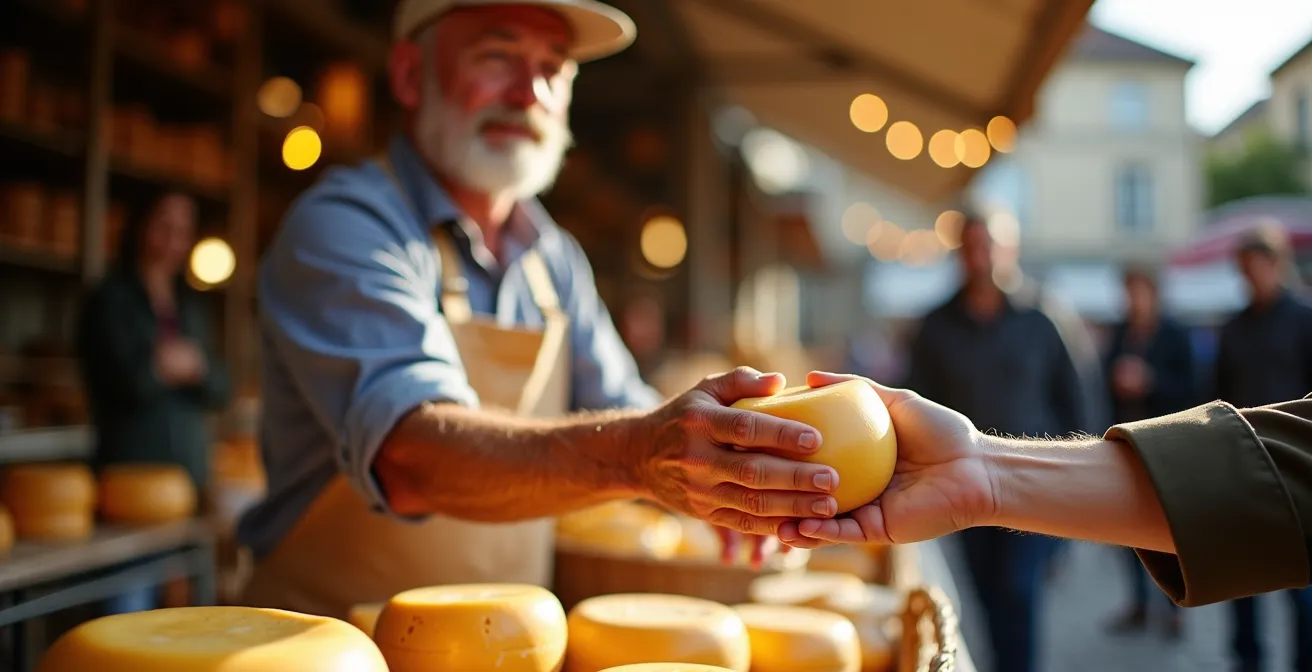
To systematically identify a genuine artisan, you need a clear method of investigation. The following checklist provides a step-by-step process for piercing the reseller’s veil and ensuring your money goes directly to the producer.
Your 5-Point Checklist for Identifying a True Producer
- Ask Directly: Start with a simple, polite “Bonjour, vous êtes le producteur?” (Hello, are you the producer?). A real producer’s passionate, detailed response is your first clue.
- Observe the Stall: Look for smaller, highly specialized stalls. A producer is a specialist, often focusing on a single type of product (e.g., only goat cheeses, only honey from their hives).
- Check for Legal Signage: Seek out legally protected terms like ‘Producteur Fermier’ or ‘Production Fermière’. These are not just marketing fluff; they have legal weight.
- Notice Imperfections: True artisanal products are not perfectly uniform. Look for natural variations in size, shape, and color between items, which signify a handmade process.
- Analyze the Product Range: Be suspicious of overwhelming variety. A stall selling cheeses from Normandy, the Alps, and the Pyrenees is a retailer, not a single farm.
Key Takeaways
- Trust in AOP is Paramount: The AOP (Appellation d’Origine Protégée) label is your only legal guarantee of 100% local ingredients and traditional methods. Prioritize it above all else.
- Seasonality is Non-Negotiable: Authentic products have a peak season. Eating cheese like Reblochon in autumn, not summer, ensures you experience its intended flavor profile.
- Identify the Producer, Not the Reseller: A true artisan specializes. Be wary of stalls with an overwhelming variety of products from different regions; they are almost always retailers, not producers.
How to Train Your Palate to Recognize Genuine Terroir Flavors?
Ultimately, the most reliable tool in your inspection kit is your own palate. Labels and questioning can get you far, but the final verdict on authenticity is delivered through taste, aroma, and texture. Developing ‘terroir-literacy’—the ability to discern the subtle story of a food’s origin—is the highest level of connoisseurship. It’s a skill that transforms eating from a simple act of consumption into an act of discovery. This is not an innate gift but a faculty that can be trained through mindful tasting and exposure to genuine products.
The journey begins with understanding what ‘terroir’ truly means. It is the complex interplay of a specific geography, geology, climate, and local human tradition. In a genuine AOP cheese, you can taste the specific wildflowers the animals grazed on, the mineral notes from the soil, and the unique microflora of the aging cellar (‘cave d’affinage’). A farmstead cheese will have a complexity and a lingering finish that an industrial product, made from blended, pasteurized milk, can never replicate. The latter often has a one-dimensional, salty flavor that disappears quickly, while the former evolves on the palate.
To train your palate, start by tasting two versions of the same type of product side-by-side: a certified ‘fermier’ AOP product and a generic supermarket version. Pay close attention to the differences in aroma, the initial taste, the texture in your mouth, and how the flavor develops and lingers. Is it complex or flat? Does it evoke anything—grass, nuts, earth, cellar dampness? This comparative tasting is the most effective training exercise. As Laure, an expert cheesemonger from the Taka & Vermo shop in Paris, explains, the journey of flavor is central to the craft. As she noted in the Chocolate & Zucchini Paris Cheese Guide:
Cheese doesn’t have an expiration date; just a point of peak ripeness when it tastes best.
– Laure, Taka & Vermo cheese shop
This idea of “peak ripeness” is the essence of terroir. It’s a fleeting moment when the product perfectly expresses its origin story. Learning to recognize that peak is the ultimate goal of your training. It is the final and most rewarding step in becoming not just a consumer, but a true guardian of authentic taste.
Now that you are armed with an inspector’s knowledge, your next visit to a French market can be a mission, not a gamble. Apply these principles, ask the right questions, and trust the legally binding certifications to guide you to the most authentic and delicious products France has to offer.